The Northern Territory’s only university faces a premature renegotiation of its funding agreement with the provincial government, as the aftershocks from a training “bungle” rumble on.
The territory’s education and training minister, Jo Hersey, has vowed to amend the Charles Darwin University (CDU) Act and rewrite the two parties’ “partnership agreement”, which was not scheduled to expire until mid-2029.
The new agreement will include key performance indicators (KPIs) based on “outcomes rather than untied funding”, with the university set to lose revenue unless it achieves the new targets. “If KPIs are not met I will look to divert resources to other training providers,” Hersey warned.
“We must have accountability for Territorians’ money invested into our training providers. It’s just too critical that we get this right.”
CDU is one of Australia’s six dual-sector universities, which have both higher education and TAFE (technical and further education) divisions. Hersey’s threat follows the February revelation that skills assessment had not been conducted properly in three CDU carpentry subjects, leaving around 130 graduates at risk of having their qualifications ruled invalid and forcing some to redo training and assessment tasks.
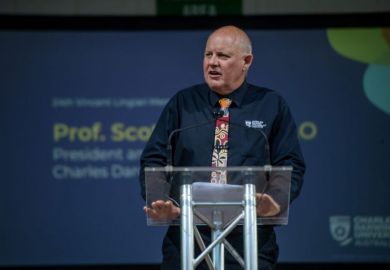
The mistake led to the resignation of CDU TAFE chief executive Michael Hamilton, and subsequently vice-chancellor Scott Bowman. In July, the university revealed a similar error in an electrotechnology subject, affecting almost 200 current and former students.
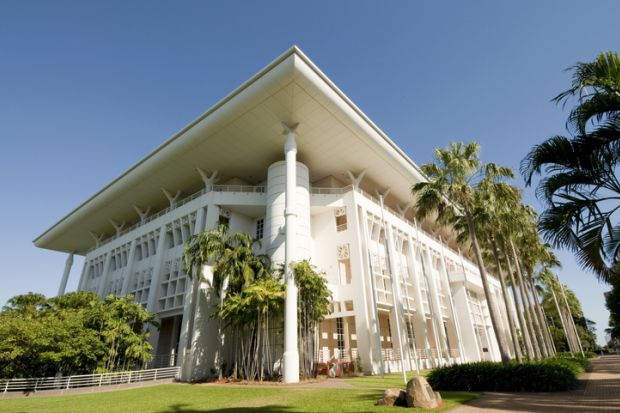
Hersey said her government had begun drafting amendments to the CDU Act, promising to introduce them into the territory’s parliament in early 2027, and said she would use the partnership renegotiation to “build a strong relationship” with the institution. “I am bringing forward these changes to end the frustration and unnecessary costs in time and money students and their families have been caught up in,” she said.
The territory’s chief minister, Lia Finocchiaro, said the university had “lurched from drama to drama” for years. “We have lifted the hood and are now taking very strong action around governance and funding agreements to make sure they are held accountable,” Finocchiaro told a press conference, according to the NT News.
The comments underline the complex operating environment facing dual-sector universities. While they are considered exemplars of the federal government’s desire to “harmonise” tertiary education, by making vocational and higher education work together more effectively, they must deal with the federal government on higher education matters and state or territory governments on training matters – adding an extra layer of uncertainty to their funding base.
CDU’s financial health has been undermined for several years by the faltering performance of its vocational education arm, which lost a net A$42 million (£22 million) in 2025 – up from A$14 million in 2024 and A$11 million in 2023. Financial assistance from the territory government has more than halved since 2022, as capital funding for a central Darwin campus came to an end, while income from training fees declined by A$3 million last year.
Acting vice-chancellor Fiona Coulson has moved into damage control, admitting that the institution’s performance “wasn’t good enough”, according to comments reported by NT News.
Coulson said regional authorities tended to be “hardest” on local institutions out of an acute proprietary interest. “People want us to be successful and they hold us to a high standard,” she told the newspaper. “I get it.”
CDU is Australia’s smallest publicly funded university in terms of higher education enrolments.
Register to continue
Why register?
- Registration is free and only takes a moment
- Once registered, you can read 3 articles a month
- Sign up for our newsletter
Subscribe
Or subscribe for unlimited access to:
- Unlimited access to news, views, insights & reviews
- Digital editions
- Digital access to THE’s university and college rankings analysis
Already registered or a current subscriber?