Australian universities have been given three months to resubmit assessment material on their handling of antisemitism on campus, after the entire sector received a fail grade on work so far.
Constitutional lawyer and former Australian Catholic University vice-chancellor Greg Craven said universities had “short circuited” his “report card” on the sector by failing to address the “threshold issue” of adequately defining antisemitism.
Craven said this “intrinsically unacceptable” shortcoming had undermined “any effective attempt to address university antisemitism either by external authority or institutions themselves”.
“In the absence of the substantive adoption of a real definition, it is impossible to move to assessment of policy and procedures against that definition,” he told Australia’s Special Envoy to Combat Antisemitism, Jillian Segal.
Craven was appointed by Segal to produce report cards on universities’ individual and collective efforts to combat antisemitism. The first reports, on Group of Eight member institutions, were due in May.
The report cards were to assess universities’ progress against four “primary criteria” – policy settings, complaint processes, definition of antisemitism and training for antisemitic awareness – as well as an optional fifth criterion of “rebuilding trust” on campus. But Craven said assessment had proven unfeasible because of the “definitional defects”.
He recommended that universities be given “another and final opportunity” to produce “appropriate” definitions of antisemitism. A “further sectoral definitional failure” would need to be referred to the education minister “to consider an appropriate response”, which could include impacts on funding or registration.
Segal agreed, asking all universities to send Craven a “detailed timetable for adopting and operationalising a definition” by the end of August.
“[This] is absolutely essential for combating antisemitism,” she said. “No university can develop adequate policies and procedures…if it cannot first define what its policies and procedures are intended to eliminate.”
Segal supports the International Holocaust Remembrance Alliance (IHRA) definition, which has been adopted by the federal government and the Royal Commission on Antisemitism and Social Cohesion. However, many consider the IHRA definition inconsistent with academic freedom.
In February last year, the 39 Universities Australia (UA) members approved an alternative shorter definition, although it was criticised as both too weak and too restrictive. But Craven said some universities had shown “a settled opposition to defining antisemitism and a determination not to do so”.
Others did not appear “resolutely opposed” to a definition but were “experiencing challenges in formulating one”. Still others claimed to have “approved” or “adopted” a definition, but Craven found “almost no evidence” of “actual implementation” into policies and procedures. He blamed a “lack of focus, relevant resources and necessary expertise”.
The next phase of the report card process, which Craven has dubbed the “antisemitism definition review”, requires universities to address more exacting definitional standards than those outlined in his initial appraisals. They include adopting the definition in the constitution or statutes “so as to control all inferior policies and procedures”.
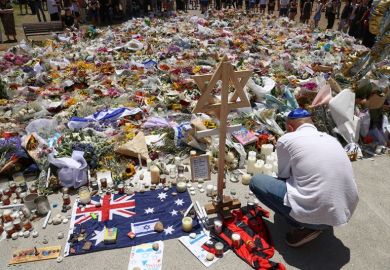
Craven said universities that decided against adopting the IHRA definition should explain their approach in “public documentation”. The Bondi massacre warranted a “move” from “the weaker UA definition to the now standard and stronger IHRA definition”, he said.
UA said the sector would consider the report carefully. “Antisemitism is abhorrent and has no place in Australia’s universities or anywhere in Australian society,” it said.
Register to continue
Why register?
- Registration is free and only takes a moment
- Once registered, you can read 3 articles a month
- Sign up for our newsletter
Subscribe
Or subscribe for unlimited access to:
- Unlimited access to news, views, insights & reviews
- Digital editions
- Digital access to THE’s university and college rankings analysis
Already registered or a current subscriber?