Odds and quads

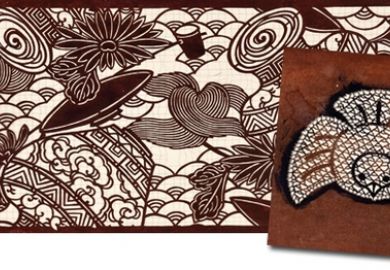
These are among the 400 Japanese stencils (katagami) acquired by the Silver Studio, one of the UK's most influential design houses, in the late 19th century.

27 September

This sculpture of a "terror bird", with painted polystyrene eye, can be found in the Alfred Denny Museum at the University of Sheffield.

20 September

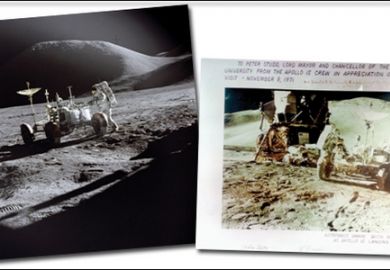
The Apollo 15 mission of July and August 1971 was the first to allow a manned spacecraft to spend an extended period of time - close to three days - on the surface of the Moon.

13 September

This hepatic trocar - a late 19th-century surgical instrument for the treatment of deep-seated liver abscesses - forms part of the collection at what is now the London School of Hygiene and Tropical Medicine.

30 August

These pictures of women - one wearing a blue silk headdress, the other displaying her gold engagement jewellery and hennaed hands - were taken in rural Turkey in the 1980s.

23 August

This bolon harp would traditionally have been used by the Malinke people of Mali and Guinea in hunting ceremonies and before battle.

16 August

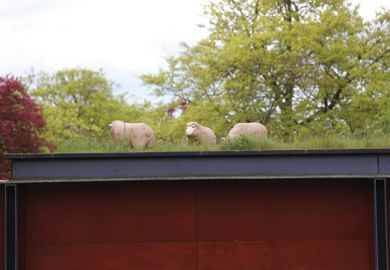
This small flock of fibreglass sheep appeared overnight earlier this year on a building known as The Stripe at the University of Winchester.

9 August

A Brown University chemistry class from the 1870s poses for a photograph on the steps of Rogers Hall (now the Salomon Center) as a professor, John Appleton, appears to watch current students leaving the 150-year-old building after a morning class.

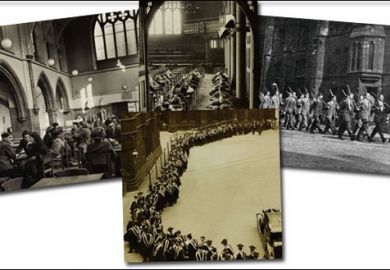
These images are just a few of the hundreds held by the University of Manchester vice-chancellor's office charting changing life at the institution.

These works all form part of the New Hall Art Collection, one of the most significant assemblages of women's art in Europe. It is housed in what is now Murray Edwards College, one of the University of Cambridge's three remaining women-only colleges.

In 1848, the Royal Polytechnic Institution on London's Regent Street installed a 1,000-seat theatre, purpose-built for "optical exhibitions" such as magic lantern shows. It was here that Charles Dickens' ghost story, The Haunted Man, was first performed in 1863 and also where the Lumiere brothers, in 1896, presented the first moving film to a paying British audience.
These items form part of the records of the Mission to Seafarers, now held by Hull University Archives at the Hull History Centre.

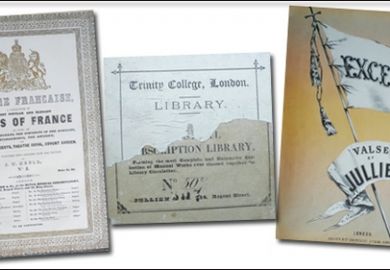
These items - now owned by the Trinity Laban Conservatoire of Music and Dance in Greenwich - are all linked to the crazily ambitious French composer and conductor Louis Antoine Jullien (1812-60).

21 June

Of around 20 surviving maces made for universities in the Middle Ages, three are owned by the University of St Andrews. Probably the finest and most valuable is the St Salvator's College Mace shown here.

These images are taken from the Bowen Collection, now held by the University of Bath, which was assembled as part of the research for a book on the origins and history of judo in the UK.

The crucifix behind the altar in the chapel at Leeds Trinity University College (shown here as a work in progress) has a number of unusual features.

These items form part of remarkable treasure trove found in the brickwork of an old fireplace last month when two maintenance workers were repairing the Brigham Hall dormitory at Mount Holyoke College in Massachusetts.

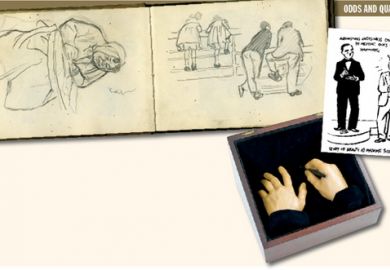
These signed drawings of pigs, many of them dated between 1903 and 1910, are held in the archives of the Royal Northern College of Music.

These images, held in the archives of the University of Strathclyde, come from the papers of William J. Ireland (1924-2002), a graduate of the Scottish School of Physical Education who went on to become a well-known teacher of country dance.

This photograph features a scene from the 1904 revival at the Moscow Arts Theatre of Maxim Gorky's play The Lower Depths, about a group of impoverished Russians living together in a shelter by the Volga river.

26 April

This sample comes from the laboratory where Sir Alexander Fleming (1881-1955) left a number of glass plates coated with bacteria overnight in 1928. It was this that led him to stumble upon the antibiotic powers of "mould juice" - later known as penicillin - and so make the breakthrough that formed the basis for one of the great revolutions in modern medicine.

19 April

This cast reveals the circulation within the heart of a greyhound. It was made by injecting coloured liquid acrylic into structures such as blood vessels and air-filled spaces and then allowing it to harden. When the soft tissue was soaked away, this remarkable map of the blood flow was created.

12 April

These formidable Victorian women all appear in a photograph album which forms part of the archives of the Association of Head Mistresses (AHM), now held in the Modern Records Centre at the University of Warwick.

This 19th-century stuffed cyclopic piglet and plaster cast of a rattlesnake - brought to Scotland by Buffalo Bill's Wild West Show in 1904 - are among the strange and sometimes shocking natural history treasures of the Bell Pettigrew Museum at the University of St Andrews.

29 March

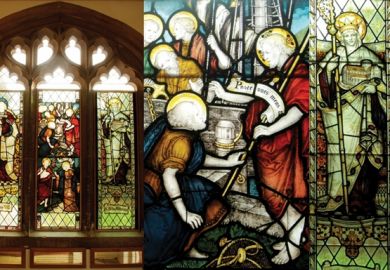
This stained-glass triptych of saints, including St Agnes and St Hilda, has been restored to its original splendour in the former chapel of what is now the University of Chichester.

22 March

This "flying machine" is suspended from the ceiling of the Athena Building in Teesside University, where it forms part of a suite of 26 pieces called Dream Migration.

15 March

John Gay's celebrated "ballad opera", The Beggar's Opera, was written in 1728. These striking wax figures - of Elsie French as Mrs Peachum and Violet Marquesita as Lucy Lockit - were created by Agatha Walker on the basis of a production at the Lyric Theatre, Hammersmith in 1920.

This sculpture by Francis May Favata depicting a child being lifted from the rubble after a bombing stands on the campus of the University of Plymouth, marking the site of one of the UK's worst civilian disasters during the Second World War.

These striking wire-mesh sculptures of naked, falling figures hanging from the ceiling often attract attention and comment from students and visitors at the University of Sunderland's automotive engineering department.

23 February

The Broadlands Archives at the University of Southampton include a huge quantity of material from Broadlands in Hampshire, the country residence of the 19th-century prime minister Lord Palmerston and later of Lord Mountbatten, the last viceroy of India.

16 February

The largest ever donation of material to the University of Oxford's Bodleian Library came, somewhat surprisingly, from a Chicago ragtime pianist.

9 February

These images are taken from an ornately designed leather-bound scrapbook, now in the collection of the Humanities Research Centre at Sheffield Hallam University, that Jane Webb Loudon (1807-58) seems to have put together for family and friends.

26 January

Both the beautiful leafy sea dragon and the repellent botfly larvae erupting from a horse's stomach come from the University of Reading's Cole Museum of Zoology, one of the finest in the country devoted to comparative anatomy.

19 January

Helen and Edith Chesebrough rest on the steps with their Airedale terriers - Rough, Radiance and Master Nobbler - in Burlingame, California in 1917. Three years later, Anita Blake poses with a lapdog and two borzois in the celebrated gardens of the Blake Estate in the San Francisco Bay town of Kensington, later bequeathed to the University of California, Berkeley.

12 January

In 2010, sculptor Tom Harvey created this work from the remains of a 250-year-old cedar tree - the oldest on the campus of The Open University - which had fallen victim to an infestation of the small cedar aphid.

5 January

This brass desk set embellished with ammunition shells belonged to Lieutenant General George Francis Milne (1866-1948), Commander-in-Chief of the British Salonika Army during the First World War.

15 December

John Hunter (1728-93) has been called the "father of modern surgery", since he was the first to apply a truly scientific methodology to the medical procedure.

8 December

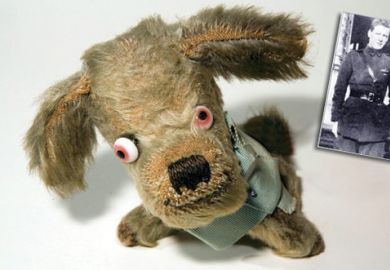
Adolphus was the mascot of fighter ace Maurice Leblanc-Smith (1896-1986), winner of the Distinguished Flying Cross, and accompanied him on many missions during the First World War.

24 November

These "neck pieces" - necklaces made entirely of hair - are the work of Kerry Howley, a recent jewellery graduate from Middlesex University.

17 November

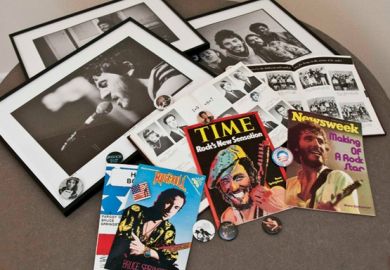
A substantial collection of material relating to New Jersey-born rock legend Bruce Springsteen has been acquired by Monmouth University in West Long Branch, US.

3 November

The bronze lamp in the form of an improbable bird takes its origins from the drawings of grotesque beasts by the Dutch designer and silversmith Arent van Bolten, dating from around 1620.

20 October

In 1894, a young Jewish artillery officer, Captain Alfred Dreyfus, was convicted of betraying French military secrets to the Germans and sentenced to solitary confinement in French Guiana. It soon turned out that he had been found guilty on trumped-up evidence.

13 October

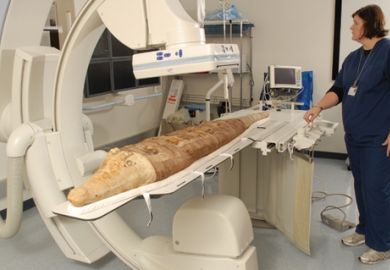
This mummified crocodile from the Greco-Roman period is held by the Phoebe A. Hearst Museum of Anthropology at the University of California, Berkeley and was recently the subject of large-scale conservation treatment and technical study.

6 October

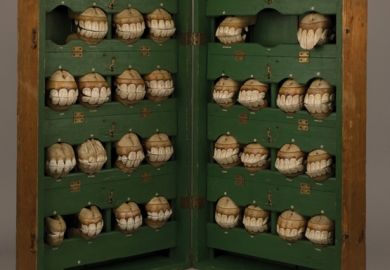
This collection of 29 horses' teeth was assembled by Louis Auzoux (1797-1880), a French doctor who made models of humans, animals and plants for use in teaching medicine and anatomy.

29 September

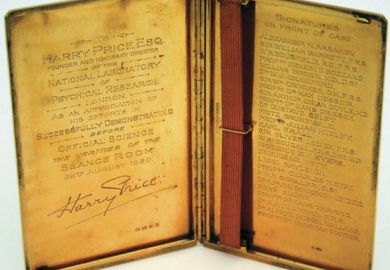
This 18-carat gold cigarette case belonged to Harry Price (1881-1948), a writer, amateur conjuror and ghost hunter who, in 1923, set up the National Laboratory of Psychical Research, in order "to investigate in a dispassionate manner and by purely scientific means every phase of psychic or alleged psychic phenomena".

22 September

This glass and steel cross, which now stands at the heart of the University of Chester's main campus on Parkgate Road, was originally created as an anguished response to the political climate of the 1980s.

8 September

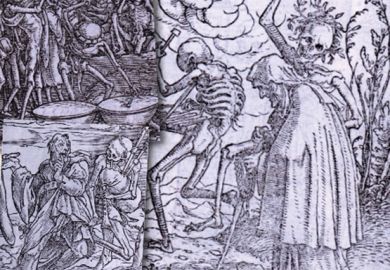
In the gruesome or grimly comic medieval Dance of Death, skeletons or decaying corpses are depicted rounding up the living.

25 August

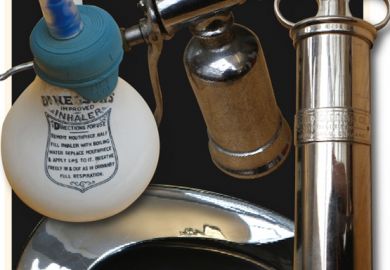
These instruments (see image, right) - inhaler, ether mask, bedpan, a syringe made by Philip Harris and Company and a device used during anaesthesia that contains a Sparklets bulb similar to those in soda siphons - are all held by the Seacole Library at Birmingham City University.

18 August

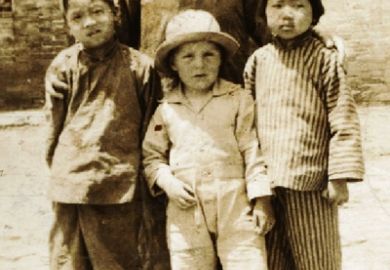
Gladys Aylward, the English missionary pictured with two of her adopted children (see image, right), became a household name when her heroic exploits escorting 100 orphans to safety through war-torn China were turned into a Hollywood biopic, The Inn of the Sixth Happiness (1958).

11 August