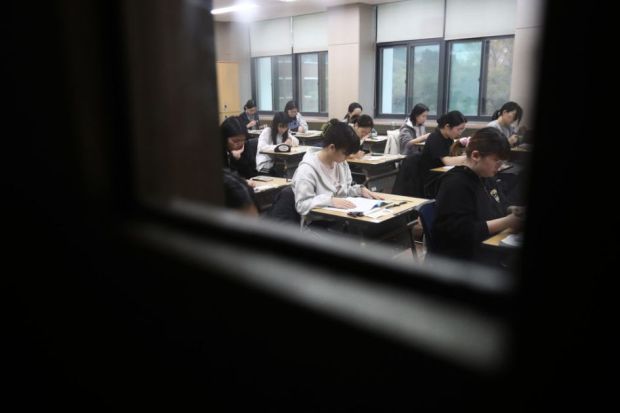
South Korea’s education minister has resigned over his handling of AI-assisted cheating in the nationwide university entrance exam, as broader debates about the adequacy and fairness of examination guidelines continue.
Education minister Choi Kyo-jin quit after he was accused of seeding confusion by introducing a series of last-minute rule changes in the week leading up to this year’s College Scholastic Ability Test (CSAT).
In a statement released through the Ministry of Education, Choi said: “Now that the CSAT has concluded, I feel a deep sense of responsibility and express my intention to resign.”
CSAT is a very high-stakes exam, which was sat by 500,000 students this year. The country grinds to a halt during parts of the test, with domestic air travel and construction suspended during the English listening assessment.
Amid mounting concerns about AI-assisted cheating in South Korea, the government introduced various changes in the week preceding the CSAT, which included sending three nationwide emergency alerts on exam day, causing phones to ring out loudly even if they were on silent mode.
Students had to cover up shirt buttons with stickers to block any hidden cameras and eyewear was inspected to ensure smart glasses were not being worn.
Guidelines about what writing equipment students could bring into the test centre were also changed just one day before the exam took place.
Choi said that he recognised these changes caused “inconvenience” to both students and teachers.
The ministry reported 111 candidates were found with unauthorised electronic devices during the test, 54 of which were detected through the nationwide phone alerts.
Before the CSAT, teaching groups voiced their opposition to the minister’s last-minute changes, saying that they would increase anxiety among students and did not leave staff with enough time to prepare.
Thousands of students also signed a petition calling for clearer rules on AI-assisted cheating.
Sunmu, an independent South Korean educational content creator and advocate for examination fairness, told Times Higher Education that anti-cheating measures, including covering shirt buttons, “should be evaluated for effectiveness and consistency” before being rolled out at scale.
“The government should establish clear, uniform and enforceable national guidelines,” they said.
Register to continue
Why register?
- Registration is free and only takes a moment
- Once registered, you can read 3 articles a month
- Sign up for our newsletter
Subscribe
Or subscribe for unlimited access to:
- Unlimited access to news, views, insights & reviews
- Digital editions
- Digital access to THE’s university and college rankings analysis
Already registered or a current subscriber?