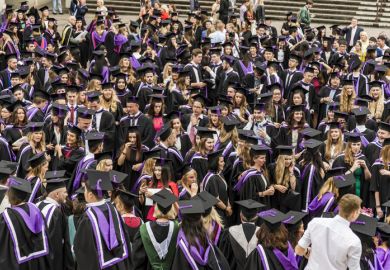
The advent of generative artificial intelligence (GenAI) has so far failed to dent Australian employers’ appreciation of graduates’ talents, new research suggests.
Supervisors’ overall perception of their degree-qualified recruits has barely changed in a decade also marked by the coronavirus pandemic, according to the latest Employer Satisfaction Survey (ESS).
Ratings of graduates’ adaptive and technical abilities are at record levels while perceptions of their foundation, collaborative and employability skills are not far behind. On most measures, graduates’ age, gender and ethnicity make little difference to the bosses’ views about their performance.
The findings come from the 10th ESS, which was been conducted annually since 2016. Almost 2,400 supervisors completed the latest survey between November 2024 and May 2025, appraising the performance of graduates from 132 higher education institutions.
The report has been published amid mounting concern that bots are rendering degrees worthless as GenAI spawns epidemic levels of cheating. Students routinely feed exam questions into ChatGPT and “deliberately mangle” a few of the answers to avoid arousing suspicion by achieving perfect scores, according to The Australian. “Welcome to the death of higher education,” it observed.
The ESS report says employer satisfaction across all areas of skills assessment has been “trending up” over the three years since ChatGPT’s launch in late 2022. In 2025, satisfaction rates in “all measured domains” were above 84 per cent. “These results suggest employers are highly satisfied with the overall quality of graduates from Australia’s higher education system,” the report says.
The ESS is one of the Quality Indicators for Learning and Teaching (Qilt) reports produced each year by the Social Research Centre (SRC) in Melbourne. SRC analyst Angela Baker said that although there was no sign so far that AI had sullied employers’ satisfaction with graduates, the next survey could tell a different story.
“AI is an unprecedented development,” she said. “It is changing so quickly. It’s hard to imagine…it’s not going to have an impact. It’s just what that impact is going to be. [It] may be positive or negative, depending on what sector you’re in, where you’re at in your career and that kind of thing.”
Baker said the SRC planned to introduce questions about AI in the Student Experience Survey and migrate them to other Qilt questionnaires.
The ESS also found that graduates were rated as being significantly better at collaboration if they were under 30, had studied as international students and had completed at least some of their courses on-campus.
Baker said these results suggested that collaborative skills – a measure capturing graduates’ ability to work well in a team, get on with colleagues and understand different points of view, among other things – were not fostered as well by online study, a mode of learning dominated by older and domestic students.
She said students on campus were more likely to do group work and engage with people from diverse backgrounds. “This isn’t about the quality of students, it’s about their learning experience. Institutions need to look closely at how teamwork, communication and problem‑solving are developed in online courses so graduates enter the workforce confident and ready to collaborate in real‑world settings.”
The Qilt surveys have found that employers’ overall satisfaction with graduates, unlike students’ satisfaction with their own experiences, did not decline during the pandemic years. The latest ESS also found that employers were significantly more likely than their graduate staff to say that higher education qualifications had been good preparation for the job, echoing previous years’ findings.
Employers “want to believe they hired the best candidates for the role”, Baker speculated. “[They] maybe don’t want to mark their employees down too low because it might make them feel they’ve made a wrong choice.”
Register to continue
Why register?
- Registration is free and only takes a moment
- Once registered, you can read 3 articles a month
- Sign up for our newsletter
Subscribe
Or subscribe for unlimited access to:
- Unlimited access to news, views, insights & reviews
- Digital editions
- Digital access to THE’s university and college rankings analysis
Already registered or a current subscriber?