A new wave of small, specialist research universities are gaining ground in China, offering alternative models for the country’s increasingly dominant higher education sector.
After emerging as a concept in the mid-2010s, the number of new research-focused institutions – usually heavily geared towards science and technology subjects – now numbers eight, with more in the pipeline.
Enjoying close ties to local government and strong industry partnerships, the universities operate under both public and private models and promise more hands-on opportunities for students, including more time in the lab and more exposure to research.
Enrolment sizes are small compared with traditional universities (standing at about 50 to several hundred students per year) and they attract students who are not entirely satisfied with the path offered by more established institutions.
Christopher Clarke, senior manager for global communications at the Southern University of Science and Technology (SUSTech), the first research university of its kind in China, said it was focused on doing things differently.
Founded with the support of the Shenzhen municipal government in 2012, SUSTech “is known for several innovations, including a modern governance system, a novel and comprehensive admissions system, the use of English as an instructional language alongside Chinese, and a curriculum rooted in fostering innovation and entrepreneurship”, said Clarke. The public university also aims to “excel across STEM disciplines” and foster international partnerships.
Yisu Zhou, professor of public policy and sociology at Duke Kunshan University, said SUSTech became a “prototype” for what was to come. Six years later, in 2018, the Chinese Academy of Science and the Shenzhen government agreed to build another university in the megacity: Shenzhen University of Advanced Technology (SUAT).
Both SUSTech and SUAT benefit from their strategic location in Shenzhen. Nearly 300 high-tech companies surround the SUSTech campus, which Clarke said helps foster “an entrepreneurial culture among students and researchers…developing graduates who can move comfortably between academia, industry and the public sector”. Enjoying close ties to industry is something the new research universities are doing “very, very differently”, said Zhou.
SUAT provost Zhao Wei said “the traditional university model in China has its limitations” when it comes to industry development.
“It’s very difficult for them to start launching multidisciplinary subjects. And it’s very difficult for them to turn around and focus on the disciplines which local industry needs more.”
Undergraduate students at SUAT are required to do research (what Wei called “capability development”) from day one. “We actually allocate one day a week for undergraduate research time. That means we only have classes Monday to Thursday. Every Friday, undergraduate students will go to labs to do research.”
All degree programmes and research are multidisciplinary, and Wei said the institution was not just about teaching skills but “capability”.
Zhou said this meant an emphasis on what every student “needs to survive”. “[It is about] how you define [a] research problem, how you define the approach, how you test your approach and eventually adjust the approach to get results”.
Wei recently scrapped English classes at the institution, instead choosing to teach the language via other means.
Rather than sitting through vocabulary and grammar instruction, students will be taught how to talk to foreign scientists or work in a team – all in English.
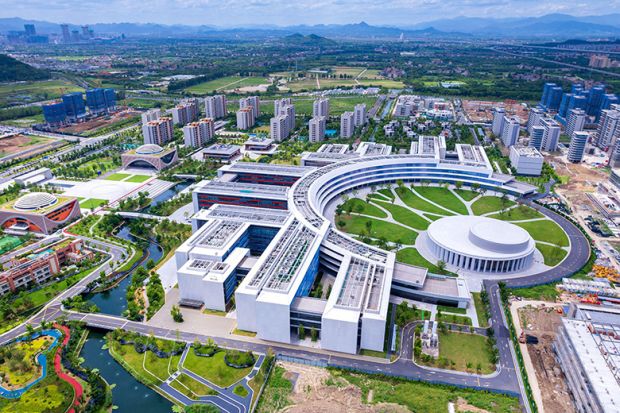
Both SUSTech and SUAT are public universities, but Westlake University in Hangzhou was established in 2018 mainly through private philanthropy. Its founding president, Yigong Shi, gave up a tenured professorship at Princeton University to return to China, and some suggest that Westlake is modelled on private US universities.
The institution has attracted some of the world’s top mathematicians, scientists and physicians, including many from the US. Complex geometry researcher Yuan Yuan left Syracuse University to take up a full-time professor role in Westlake last year, as did Qian Hong who exited his professorship at the University of Washington to join Westlake after more than 40 years in the US.
Zhou said that internationally competitive pay and grants are drawing scholars to Chinese research universities. “They are the first universities that pay faculty members really well in a time that university professors are not really well paid.” He added that salaries are not quite equal “but very close to those in Hong Kong and those in America”.
Westlake’s Shi told Times Higher Education that the goal “is to build a university that combines the strengths of the world’s leading research universities with the dynamism of China’s innovation ecosystem. Science has always advanced through the open exchange of ideas across disciplines, institutions, and national borders. That spirit has been part of Westlake from the very beginning.”
All undergraduate and graduate major courses are taught in English, students are immersed in research at an early stage and there is a heavy emphasis on STEM and multidisciplinary learning. Shi said that that the “most exciting” opportunities “lie where these disciplines converge”.
Shi also voiced similar views to Wei that “knowledge alone is no longer enough” in an AI age. He said Westlake students are taught “to ask meaningful questions, think independently, solve complex problems, and collaborate across disciplines and cultures. These are qualities that machines cannot easily replace.”
The more established institutions have been joined by three new research universities that have welcomed their inaugural cohorts of students in the past year: Eastern Institute of Technology, Ningbo (EIT), Great Bay University and Fuyao University of Science and Technology.
But more traditional institutions such as Tsinghua or Peking universities are not going anywhere, according to Zhou. He said that these newer research universities did “not set out to replace the existing universities but to prove that there are other ways to run universities…they are trying to get their share of the pie”.
The geography of these new institutions is important too. While China’s universities have mostly been located in or near Beijing and Shanghai, two of the newest research universities (EIT and Great Bay) have sprung up in the eastern Zhejiang province and the southern Guangdong province. These are areas which, to date, lacked prominent universities.
Zhou suggested that local governments in China are “keenly aware” of the potential of universities to act as an economic turbocharger. “That’s why they are pretty aggressive to attract this type of new start-up universities, if we can call them that.”
Register to continue
Why register?
- Registration is free and only takes a moment
- Once registered, you can read 3 articles a month
- Sign up for our newsletter
Subscribe
Or subscribe for unlimited access to:
- Unlimited access to news, views, insights & reviews
- Digital editions
- Digital access to THE’s university and college rankings analysis
Already registered or a current subscriber?