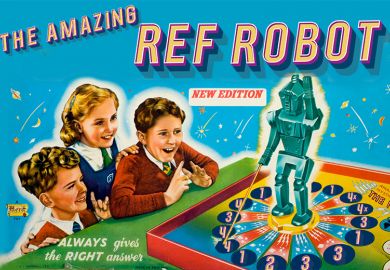
Many fear algorithms will displace academics but the technology is already eating itself and its long-term business model remains unclear, says Martin A. Mills. Here he explains why bots will not wipe out universities and why we must resist their damaging features for the good of students, society and AI itself
Without foreign research talent pouring into leading US institutions, America will fall further behind in tech race, says former US energy secretary Steven Chu
Leading light of Cambridge biotech industry Greg Winter says country should seize ‘once in a lifetime’ chance to poach American scientists fleeing Trump cuts
The task of reading and rating the thousands of outputs submitted to the UK’s Research Excellence Framework is notoriously Herculean. Could AI ease the burden – or would its use undermine the whole point of having REF panels? As Jisc consults on that question, four writers offer their views
Even extreme interest in Covid-19 science was not enough to overcome citation loss associated with switching to a different research track, say US economists
Science department will publish specific objectives with ‘corresponding key performance indicators’ for the £9.6 billion research funder this summer, reveals NAO report
European Commission president Ursula von der Leyen steps up efforts to attract American academics while taking aim at Trump’s ‘miscalculation’ of failing to support research
After the furore of Oxford’s election, no obvious frontrunner has emerged to take the high-profile role at Cambridge. Some say the institution needs a politically engaged figurehead, others want someone who can sort out internal fractures
With US academia under siege from the Trump administration, universities elsewhere are contemplating offering ‘asylum’ to disaffected researchers. Here, four former US academics now established abroad reflect on the potential culture shock that awaits US émigrés
Subscribing to nearly everything published by journals is no longer feasible in these financially straitened times but librarians can provide creative workarounds to ensure journal access, says Liam Bullingham
Plagiarism accusations that led to the downfall of black US academics and politicians have sparked criticisms of ‘sloppy’ writing practices. But these controversies actually reveal how academics are struggling with the many writing technologies now essential to their jobs, argues Genevieve Creedon
Forcing UKRI-backed researchers to publish their papers as preprints would save £40 million annually and ‘accelerate scientific progress’, says thinktank
Rethink on Research Excellence Framework’s demand that submitted monographs should be freely available follows fierce condemnation of a policy described as ‘unaffordable’ and ‘excessively bureaucratic’
Ever-expanding numbers of doctoral students may suit universities, but one’s twenties should be a time for broad learning and professional development, not for burying oneself in detailed research, says Lincoln Allison
Having brokered some of the world’s biggest pacts on global warming, MIT climate scientist Susan Solomon tells Matthew Reisz why she is optimistic that environmental damage can be reversed
The redundancies and course closures proposed at many struggling UK universities follow a decades-long drift away from the idea of higher education institutions as charities whose non-commercial public benefit needs to be supported by profit-making activity, argues Martin Mills
Scholarly inquiry is already improving UK society, but its full impact won't be felt until researchers better engage with policymakers, says Rita Gardner
Leading cell biologist says outstanding young researchers are missing out on funding as panellists are focusing excessively on open science contributions
Barack Obama’s favourite political thinker Yascha Mounk has made his career attacking right-wing populism. His latest target – identity politics fostered on US campuses – will surprise many of his acolytes, he tells Matthew Reisz
Affordable AI-powered writing software offers some hope to scholars unfairly criticised for their imperfect English, but more radical change is required, says Natalia Kucirkova
If Stanford’s now-departed president had fully faced up to dubious practices in his lab and insisted on corrections, his infractions of research integrity could have been forgiven, says David Sanders
At the heart of the debate about the global competitiveness of EU-funded research is the question of whether science should be a tool for industrial policy or a global power for good, says Jan Palmowski
Studying flocks of starlings helped Giorgio Parisi crack some of physics’ deepest mysteries. The Nobelist talks to Matthew Reisz about his unconventional methods, missed eureka moments and being Italy’s most in-demand scientist