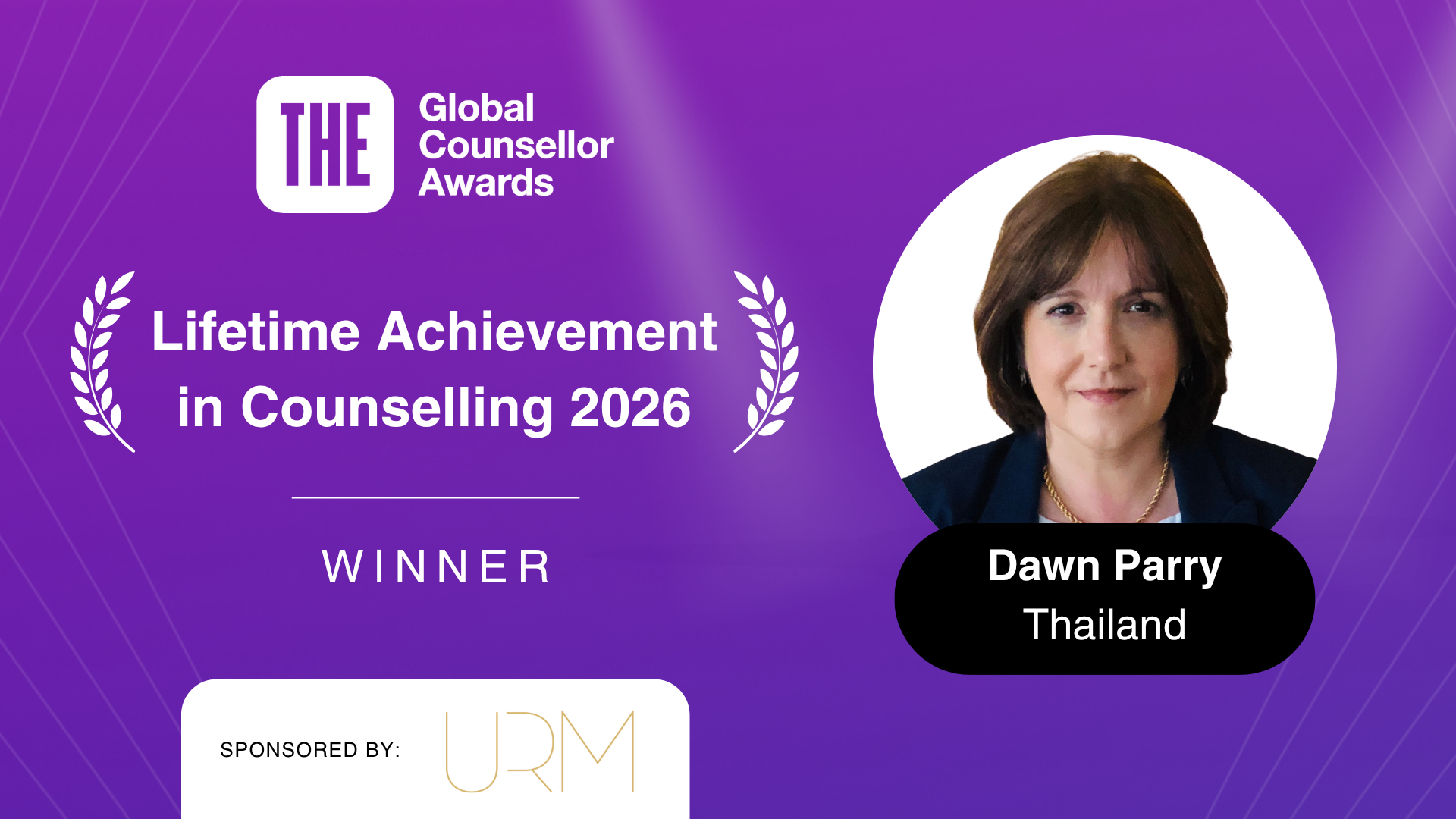
Global Counsellor Award winner 2026 - Dawn Parry
Dawn Parry is this year’s recipient of the Lifetime Achievement in Counselling award. She reflects on her career to date and why counsellors should always keep learning and building their professional networks

You may also like





Can you describe your feelings as you collected your award and explain what this accolade means to you?
Although I was not able to collect the award in person, my friend and colleague kindly accepted it on my behalf and sent it to me afterwards. I was kept closely updated by colleagues who attended the ceremony, and they told me how special the evening was. Even from a distance, I felt genuinely touched and very grateful.
Receiving the Lifetime Achievement Award was deeply moving. I have been a teacher for 23 years and a university guidance counsellor for 12 of those years, alongside other teaching and leadership responsibilities. Much of this work happens quietly, in conversations with students, families, colleagues and universities. It is not always visible work, so to have it recognised in this way meant a great deal.
For me, the award is not simply a personal accolade. It also recognises the importance of university guidance as a profession. Good counselling can change the way young people see themselves and their futures. It can help them find pathways that are ambitious, realistic and personally meaningful. I also see the award as a reflection of the many students, families, colleagues and university representatives I have worked with over the years. Counselling is relational work, and we don’t do it alone.
Looking back on your counselling journey, what has been one of your most meaningful student success stories, and what did it teach you about the impact of effective university guidance?
One of the most meaningful student stories for me involved a student who initially seemed disengaged from the university process. He was reluctant to attend meetings, late with documents and slow to complete applications. At first glance, it might have looked like poor organisation. But when we spent time talking properly, it became clear that he was despondent. He was applying for business courses in Australia, but had no real interest in that pathway.
Gradually, he revealed that music was the centre of his world. He had YouTube and Spotify channels, composed his own hip-hop music and had a real talent for music production. I encouraged him to speak honestly with his mother about how unhappy he felt, and we explored courses that matched his interests and abilities. His family listened, supported him and he went on to receive offers from excellent music courses, including at his dream university.
What stayed with me was the change in him. He became lighter, happier and more hopeful. Later, his parents thanked me for helping their son to feel happy again. That experience reminded me that effective guidance is not just about applications or rankings. It is about listening carefully enough to find the story beneath the surface. A narrative approach to counselling helps students to make sense of who they are, what matters to them and what kind of future they can imagine for themselves.
If you could give one piece of advice to new or aspiring university counsellors who want to make a lasting difference in students’ lives, what would it be and why?
My advice would be to listen carefully, keep learning and never be afraid to ask for help. University counselling is a dynamic and exciting profession. I still learn something new every day. Admissions systems change, new destinations emerge, qualifications are interpreted differently across countries, and students’ needs are never exactly the same from one year to the next. It is important not to stand still. Look for opportunities to learn, attend events, build networks and ask questions.
New counsellors should not feel that they have to know everything immediately. Some of the best learning comes from more experienced colleagues who are generous with their knowledge and willing to share what has worked, what has not worked and what they wish they had known earlier.
Above all, listen. Listen to students, families, teachers, universities and other counsellors. Technical knowledge matters, but the heart of the role is still human. Good counselling begins with listening carefully enough to understand the student in front of you.
Many counsellors play an important role beyond their own schools. How do you give back to the wider counselling community in your region, and why is this important to you?
I have always believed that university counselling works best when it is collaborative rather than competitive. One of the ways I have tried to give back is through helping to establish Northern Thailand College Counsellors (NTCC). In our region, many counsellors are working on their own, often with dual roles, limited experience or support and sometimes very large caseloads. Having a supportive professional network really matters. Through NTCC, we share information, resources, contacts and opportunities. We also help to connect schools with universities and to create more access for students in northern Thailand, rather than assuming that everything has to happen in Bangkok or in larger international school hubs.
My work with regional college fairs has also been part of this. These events help to bring universities to our area and create opportunities for students, families and counsellors to access information directly. They also allow counsellors to build stronger relationships with university representatives and with each other. I have always wanted these fairs to feel inclusive and regional, rather than simply promotional for one school. Holding them in a central, neutral location helps to ensure that all schools that wish to be involved can take part.
This also connects closely with my doctoral research, which explores marketisation, power and teacher experience in international schools. That research has made me even more aware of the pressures placed on schools, teachers and counsellors within competitive educational markets. For me, creating more collaborative and inclusive regional structures is one practical way of resisting isolation and competition, and of keeping the focus on students, professional care and shared ethical practice.
For me, giving back is about widening access, strengthening the profession and making sure counsellors do not feel isolated. When counsellors share openly and work together, students benefit. That is ultimately the reason for doing it.
The BMI Global Forum 2026 was all about human connections in counselling. What was your key takeaway from this event?
Although I was not able to attend the BMI Global Forum 2026 in person, colleagues who were there spoke warmly about the event and the strength of the connections made. The theme of human connection certainly resonates with my own experience of counselling.
For me, university guidance is built on relationships: with students, families, colleagues and universities. Systems, deadlines and applications matter – but it is often the human connection, the careful conversation and the trust built over time that make the greatest difference to students.