As is well known, scientific publishing is one of the most quietly extractive industries in modern life. A small number of companies control the infrastructure through which scientific knowledge is validated, disseminated and rewarded. Researchers produce the work, review it and edit it, mostly without pay, while universities and libraries buy that labour back at enormous cost. These firms’ profit margins rival those of major technology companies, even though the underlying research is overwhelmingly publicly funded.
Despite decades of critique and activism, this system remains remarkably stable. The movement to challenge it is large, morally persuasive and widely supported in principle yet it has struggled to translate outrage into systemic, durable change. In this sense, resistance to corporate publishing resembles many stalled reform efforts: plenty of correct arguments but little sustained coordination.
For a long time, opposition to this system has coalesced around a single demand: openness. Open access, open science, open data. Remove paywalls, the argument went, and the inequities of scientific publishing would begin to dissolve. Yet even though PLOS demonstrated long ago that high-quality, non-profit, open-access publishing is viable at scale, it remains the exception rather than the norm, and it is now clear that openness alone is not a sufficient challenge to corporate power. Many of the most powerful publishers operate fully open-access journals or offer open access options in their flagship titles, simply replacing subscription fees with article-processing charges (APCs). Their hegemony remains.
Scientists understand the harms. We know that APCs exclude researchers from the Global South and from underfunded institutions. We know that impact factor obsession distorts research priorities and encourages conservatism. We know that commercial consolidation has left universities with fewer choices and higher costs. And yet, individually, we continue to submit our best work to the very journals that reproduce these inequities, volunteer our labour as reviewers and editors, and treat prestige brands as unavoidable career currency.
This gap between belief and action is not hypocrisy: it is structural fear. Academic careers are precarious, globally uneven and governed by opaque evaluation systems. Acting alone is risky. Acting together requires trust, infrastructure and enforcement mechanisms that the open science movement has rarely built.
There is also a further complication: the blurred boundary between corporate and non-profit publishing. Many scholarly societies operate journals that are not fully open, charge high fees or depend financially on contracts with commercial publishers. Even societies committed to reform are often locked into revenue-sharing agreements that trade modest access gains for long-term dependence. Scientists cannot easily opt out of corporate publishing without also cutting themselves off from journals run by their own professional communities. This entanglement fragments accountability and diffuses responsibility. Everyone is implicated, and that paralysis serves concentrated power well.
So is resistance ultimately unrealistic? The Elsevier boycott of the early 2010s is certainly a sobering case. It attracted tens of thousands of signatures from researchers pledging to stop submitting, reviewing and editing for the publisher but within a few years it had mostly fizzled out. Many participants quietly returned to business as usual, and the company’s dominance only grew.
But the lesson of that failure is not that coordination is impossible. It is that individual moral resolve is not enough without institutional support. In the absence of mechanisms to align incentives and reduce personal cost, fear predictably overcame solidarity.
You can see the consequences of this organisational deficit in the uneven uptake of genuinely innovative publishing models. Preprint servers exploded during the pandemic, proving their scientific value. And eLife’s move away from the traditional accept-reject paradigm toward transparently reviewing submitted preprints offers a serious alternative to prestige-based gatekeeping. Many scientists praised the idea yet hesitated to participate, worrying that hiring committees or grant reviewers would not recognise the model.
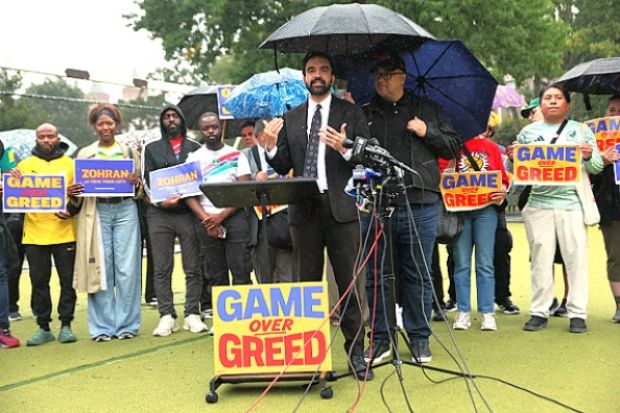
What is missing is not another manifesto but a political strategy. Recent insurgent campaigns, such as Zohran Mamdani’s mayoral run in New York, offer a useful analogy, not because science should imitate electoral politics but because they demonstrate how disciplined organisation can challenge entrenched power. Mamdani’s campaign was not driven primarily by persuasion or moral appeal. It was built through sustained fieldwork: identifying allies, building trust, concentrating effort where leverage existed and reducing individual risk through collective action.
Translating that logic to academia requires realism. Coordinating scholars across disciplines, institutions and national borders is far harder than mobilising voters in a single city. But corporate publishers do not depend equally on all academics. They rely disproportionately on labour from the elite institutions, flagship departments, senior scholars and editorial boards that set norms for everyone else. Collective action does not require universal participation; it requires strategic concentration.
This is where university senior leadership becomes decisive.
Decades of research on large-scale organisational change shows that durable transformation rarely emerges from bottom-up enthusiasm alone. It occurs most rapidly when norms are redefined at the centre and diffused outward: when authority, incentives and norms shift together. In universities, senior leaders – presidents, provosts, deans and governing boards – control the levers that individual researchers do not: promotion and hiring criteria, resource allocation, reputational signaling and contractual relationships with publishers.
Senior administrators must do more than issue statements supporting open access. They must embed publishing reform into the core governance of academic life. For instance, hiring, tenure and promotion guidelines can explicitly de-emphasise journal brand names and impact factors, aligning with initiatives such as Dora and responsible research assessment. Reviewing and editorial labour policies can be coordinated at departmental or institutional level, reducing the risk borne by individual scholars. Libraries and consortia can redirect funds away from “big deal” contracts and toward scholar-led, non-profit publishing platforms. Funders and universities can jointly invest in shared infrastructure, rather than duplicating payments to corporate intermediaries.
Bottom-up action still matters. Grassroots organising builds pressure, identifies alternatives and demonstrates demand. But without top-down institutional reinforcement, it remains fragile. As in Mamdani’s campaign, leadership willing to challenge entrenched power must be paired with disciplined and organised fieldwork.
Scientists already know the system is broken. What we have not yet realised is what every successful reform movement eventually learns: being right is not enough. Without organisation, even the strongest critique remains safely ignorable.
Open science does not need another manifesto. It needs organisation, leadership and the political will to reclaim the infrastructure of knowledge itself.
Mayank Chugh is assistant teaching professor of biology at the University of Maryland, Baltimore County, where he leads the Applied Molecular Biology and the ReForm labs. He also serves as an Early Career Advisory Board member at eLife and as chair of the board of directors at the Journal of Emerging Investigators, both organisations dedicated to advancing open science.
Register to continue
Why register?
- Registration is free and only takes a moment
- Once registered, you can read 3 articles a month
- Sign up for our newsletter
Subscribe
Or subscribe for unlimited access to:
- Unlimited access to news, views, insights & reviews
- Digital editions
- Digital access to THE’s university and college rankings analysis
Already registered or a current subscriber?