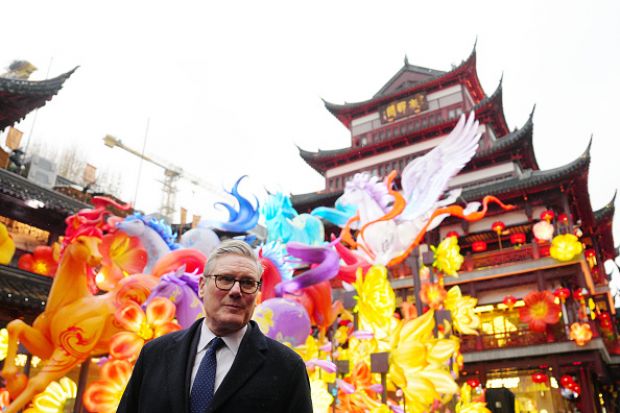
So much of the discourse around Keir Starmer’s visit to China at the end of January focused on anxiety around China’s increasing economic importance and growing political, scientific and cultural reach. The visit recognised that no geopolitical issue can be addressed without engaging with a country that has the world’s second-largest economy and nearly 20 per cent of its population.
It also highlighted something that is too often missed in conversations on China. The value of our bonds with the people of that remarkable country are hugely consequential. UCL has the privilege of welcoming over 10,000 Chinese students each year and as we approach Chinese New Year, we will be celebrating those bonds. However, we are also prompted to reflect on the threats to them posed by the growing unease about China that has grown up in the West in recent years – which amounts at times to Sinophobia.
The prime minister’s Beijing visit focused on business and cultural ties. Measures that make it easier for UK citizens to create links to China are hugely valuable, as are efforts to strengthen economic ties. At UCL, we see first-hand the benefit that Chinese students and staff bring socially, culturally and economically. They bring fresh ideas, a diverse cultural and social perspective, and extensive global networks, all of which benefit UK students and communities.
When they return home, the ties and cultural understanding they take with them provide a meaningful soft-power benefit to the UK. People-to-people links between our countries continue to help us develop intercultural understanding, critical to building business connections. They deepen expertise in the UK of how the Chinese government operates, which is invaluable to the UK’s national interest.
In addition, international students are estimated to contribute over £37 billion a year to the UK economy, and Chinese nationals are the biggest group among them. Contrary to some claims, their presence in the UK helps to fund places for domestic students, rather than restrict them.
It would be a great shame for the UK if we were to lose the benefits of our ties with China by allowing a culture of suspicion and dialogue of hostility to proliferate. This is a distinct possibility. The debate about China in the UK can make our Chinese students, staff and partners feel unwelcome and prevent them from fully taking part in UK society. At its worst, this manifests in the rise in anti-Asian racism that we have seen in the West, which has been linked to heated rhetoric on relations with China.
It is important to recognise the substantive concerns about the UK’s relationship with China. Many countries are concerned to understand Beijing’s apparent shifting sense of its position in the world, as well as its increased level of control over civil society in recent years. At the same time, we should not ignore differences in attitudes between China and the West.
There are, of course, a small number of instances where collaborative research poses national security risks. For these there should be, and are, proper controls. However, the majority of our research partnerships with China are about addressing shared societal challenges. Some of UCL’s most impactful work with Chinese partners has been on tackling ill health and climate change. For example, Yukun Zhou, who came to UCL as an international PhD student, has led work on AI that uses retinal images to predict disease, working with partners including Tsinghua University to ensure the model works in China and across Asia.
China’s increasing strength in science and research means we have a great deal to learn from its universities. Far from sharing secrets, the results of this research are most often communicated freely via open-access policies. While we must collaborate in a sensible and responsible manner, it is disingenuous to present China’s excellent research universities simply as agents of the Chinese state intent on spying and extracting, rather than as valued research and education partners.
On UK campuses, unease about China is most commonly focused on the idea that Chinese students cannot speak out on the issues they wish to, for fear that they are being judged by their fellow Chinese students and may face reprisals from bodies linked to the Chinese government.
Ironically, the experience of many of our Chinese students is that anti‑China sentiment in the UK has an impact on their ability to speak freely about the positives they see in their country and its culture.
They fear that their perspective won’t be taken seriously, that it may lead to distrust from their Western peers, and that many in the UK have made up their mind about the complex and fascinating country that is China to such an extent that they are unwilling to hear any alternative perspectives. The students rightly point out that, as in any other large and diverse group, there are a range of different opinions about their own country: their identity, culture and politics. An environment of self-censorship dulls the many benefits the Chinese community brings to the UK.
It is incumbent on us to ensure that Chinese students and staff are free to argue both for the qualities and against the injustices they see in China. It cannot be a one-way street. Freedom of speech and freedom of academic expression are fundamental to what it means to be a university and we uphold both robustly, including through our code of practice on freedom of speech. To maintain these values, we must ensure that safeguards are in place to prevent transnational repression. We must also ensure that our culture is one of truly open debate across the full range of global perspectives.
The importance of this explains my personal sponsorship of UCL’s Disagreeing Well programme, a core aim of which is to ensure UCL is a place where our community can discuss and debate with people who hold very different views.
In stamping out a culture of fear and Sinophobia, we live up to the best values of British society and ensure that the UK benefits from the many advantages that our Chinese students, colleagues, partners and friends bring to the UK.
Michael Spence is president and provost of UCL.
Register to continue
Why register?
- Registration is free and only takes a moment
- Once registered, you can read 3 articles a month
- Sign up for our newsletter
Subscribe
Or subscribe for unlimited access to:
- Unlimited access to news, views, insights & reviews
- Digital editions
- Digital access to THE’s university and college rankings analysis
Already registered or a current subscriber?