The UK’s spending on artificial intelligence (AI) research is to increase rapidly to almost £400 million a year by 2030 in a radical shake-up of how funding is awarded across the country’s main research funder.
Unveiling a new “strategic, outcome-focused” approach to budget allocations, UK Research and Innovation (UKRI) will no longer confirm the overall settlements of its seven research councils, plus Innovate UK and Research England, for the forthcoming financial period, as in previous years.
Instead UKRI has shared how it will split its £9.2 billion budget for 2026-27 across four “R&D buckets” – curiosity-driven research, strategic government and societal priorities, supportive innovative companies and enabling and strengthening UK R&D – with detailed “targeted investment” plans announced for applied research areas.
That aligns with the “three buckets” model set out by science minister Patrick Vallance in recent months which he has argued is vital for protecting basic research and attracting more investment for more applied research that can drive economic growth.
A fourth “R&D bucket” covers PhD funding, infrastructure spending and money for institutes and international subscriptions and partnerships.
Announcing the new model on 17 December, UKRI said £3.653 billion would be spent on curiosity-driven research in 2026-27, staying broadly flat across the four-year spending review period. Research councils have been given breakdowns for their curiosity-driven or applicant-led research but not for other income streams.
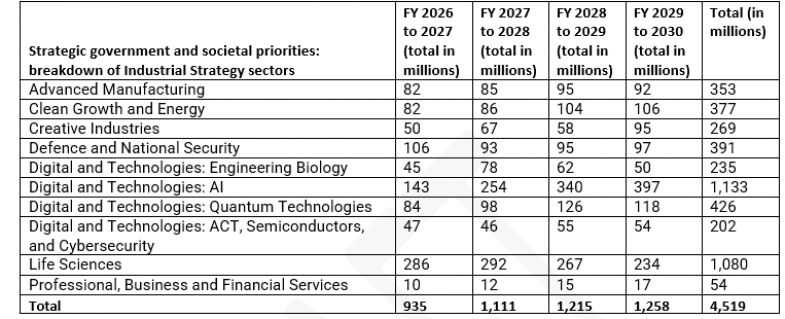
In contrast, funding for research focused on “strategic government and societal priorities” – including research aligned to the industrial strategy’s priority sectors – will increase significantly over the four-year spending review period ending in 2029-30. It increases from £1.924 billion in 2026-27 to £2.176 billion in 2029-30 – a 13 per cent increase.
The biggest beneficiary of this increase is AI research whose budget increases from £143 million in 2026-27 to £397 million in 2029-30. Funding for research in quantum technologies increases from £84 million to £118 million a year over the same period – one of 10 industrial strategy sectors allocated yearly amounts for research over the spending review period when UKRI’s overall budget will reach almost £10 billion a year.
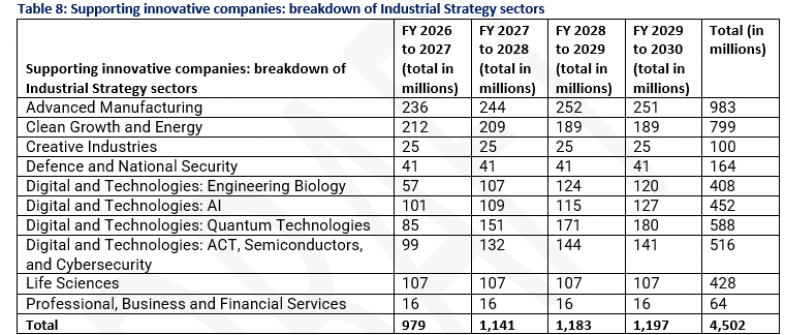
Similar breakdowns for investment in industrial strategy sectors have also been specified for bucket three – supporting innovative companies. This work is mostly carried out by Innovate UK, the UK’s innovation agency.
Describing the announcement as the “most significant change in how UKRI allocates funding and manages its budgets since the organisation was established” the research funder said the new model “is underpinned by key principles: greater transparency in decision making, clearer capital allocation, a stronger focus on growth, and a sharper alignment with societal and government priorities”.
“As a result of UKRI’s allocations, the overall level of funding available for universities, researchers and innovators throughout the spending review period increases,” it continued, stating: “Universities receive a large majority of UKRI funding and are expected to be among the key beneficiaries of this growing investment.”
Ian Chapman, chief executive of UKRI, said his organisation would “scale research and innovation investment to almost £10 billion per year and target world‑leading areas with the strongest return for the UK”.
“We’re aligning our budget to a new single mission, to advance knowledge, improve lives, and drive UK growth,” he said, adding the new guidance “sets out how we’ll be making choices in how we invest, by prioritising areas where the UK can be world-leading and by working closely with business”.
Paul Howarth, president-elect of the Institute of Physics, said he “welcome[d] the ambition for science to drive growth and solve our urgent national priorities” but the plans would raise uncertainty in the research community.
“We are yet to hear what these funding priorities will mean on the ground for vital research and crucial scientific infrastructure, and we are keen to see the detail which sits behind today’s announcement,” he said.
“While difficult choices may have to be made in the face of tough public finances, we must avoid any temptation to make hasty cuts to areas like early-stage research which may not drive instant reward but will lead to long-term growth – and potentially to Britain’s next big breakthrough.”
Register to continue
Why register?
- Registration is free and only takes a moment
- Once registered, you can read 3 articles a month
- Sign up for our newsletter
Subscribe
Or subscribe for unlimited access to:
- Unlimited access to news, views, insights & reviews
- Digital editions
- Digital access to THE’s university and college rankings analysis
Already registered or a current subscriber?