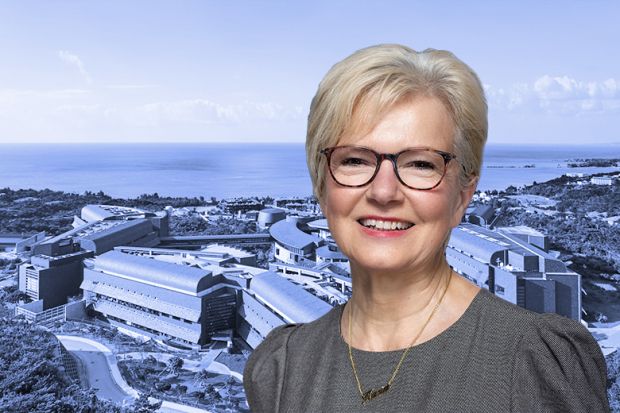
The outgoing head of a pioneering Japanese research institute dogged by staff discontent has insisted it was her decision to step down from the presidency – and that the initiative can still be a success.
In one of her most in-depth interviews since taking the job, Karin Markides, president and chief executive of the Okinawa Institute of Science and Technology (OIST), told Times Higher Education that she is leaving early to focus on taking OIST’s model “to the world”.
OIST announced earlier this month that Markides will conclude her term at the end of March, two years before her contract was due to expire, and move into a newly created position of executive adviser until May 2028.
Set up on a remote island in the Pacific Ocean in 2011, the unique graduate school guarantees academic staff five years of funding before they must pass peer review, removing the pressure to chase grants. It boasts a highly international staff body and punches above its weight in producing world-leading research, but is facing a critical government review that will shape decisions about its next phase of growth.
Markides, former president of Sweden’s Chalmers University of Technology and the American University of Armenia, took over at OIST in June 2023. She has faced complaints about “lack of vision” under her leadership – with critics pointing to staff satisfaction surveys that showed very low faith in management and lack of clarity on budget processes.
Managers at the institute have consistently blamed a “small group” of disaffected staff for such concerns, stressing that they are not representative of the wider culture at the school.
Markides said that the transition to a new role was her own idea. “It was my suggestion, and the board worked with me to make it workable,” she said.
She explained that she had made the decision because “I had recruited a good team of executives…I felt that now is the time. It was very important for me to give that freedom to the new leaders to take on this responsibility,” she said.
As executive adviser, Markides will focus on promoting OIST’s model internationally and building partnerships and international collaborations, as well as fundraising and alumni relations.
Physicist Daniel Zajfman has been appointed OIST’s interim president while its board begins the search for a permanent successor.
The new leader will join as the institution awaits the results of an external review commissioned by Japan’s Cabinet Office, expected later this year.
Markides said the coming year would prove pivotal in determining what OIST does next and whether it decides to expand or consolidate.
Originally aiming to recruit 300 principal investigators (PIs) – senior faculty who lead research units – OIST scaled back its ambitions and wants to reach 200 PIs by 2045. It currently has 96 and intends to have 100 by the end of this year.
Markides said the 200 PI target was not a forecast but “a backcast scenario” submitted to the government to test what would be required.
“We made several scenarios to see, is it even possible to go to 200? What does it take?” she said.
She added that expansion beyond roughly 100 PIs would require building another lab and a shift in funding assumptions.
Having previously provided generous public funding, the government’s enthusiasm has cooled of late, meaning below-inflation budget increases, and Markides acknowledged that financial sustainability will be a central challenge for her successor.
“Right now we get almost 90 per cent [of funding] from the government,” she said. “In this scenario, let’s say we get 30 per cent from external funding. Is it possible to build up to 200 in a decent time?”
She described reaching 200 PIs as potentially transformative. “We see that there is some kind of magic around 200,” she said. “Then our researchers can cluster around challenges in a different way. We can be more attractive for larger grants from foundations that we cannot do when we are smaller.”
Markides said she had been drawn to OIST to help consolidate the institution after a period of rapid growth and to lay the foundations for the next stage of its expansion.
She said the university must become “self-sustained to a higher degree” and “have resources and connections to more than just the government”. Research activities and collaborations “need to be more and more diversified”, she added.
A current professor at the university, who requested anonymity for fear of professional repercussions, said the leadership changes marked a watershed moment after prolonged dissatisfaction within parts of the university.
“Many of us raised concerns for years about governance, strategy and scientific vision, often without seeing meaningful change. This situation was no longer sustainable. The recent transition reflects that reality.
“What matters now is that we have a new president who is a first-rate scientist and who can reconnect leadership with research and the academic community.”
Staff and former staff have also privately questioned whether the prolonged tensions could push senior researchers to look elsewhere for jobs, damaging its ability to attract the top-level scientists it needs to achieve its ambitions.
Markides rejected suggestions that her departure could trigger an exodus of senior researchers, saying she saw “rather that more people want to be here than want to leave”. She noted that OIST accepts only 4 per cent of graduate applicants and attracts strong Japanese researchers, too.
She called OIST “a success” and said, when research output is normalised for size, it is “actually the best institution in Japan at this moment”. “I am very, very positive about the future,” she concluded.
Register to continue
Why register?
- Registration is free and only takes a moment
- Once registered, you can read 3 articles a month
- Sign up for our newsletter
Subscribe
Or subscribe for unlimited access to:
- Unlimited access to news, views, insights & reviews
- Digital editions
- Digital access to THE’s university and college rankings analysis
Already registered or a current subscriber?