
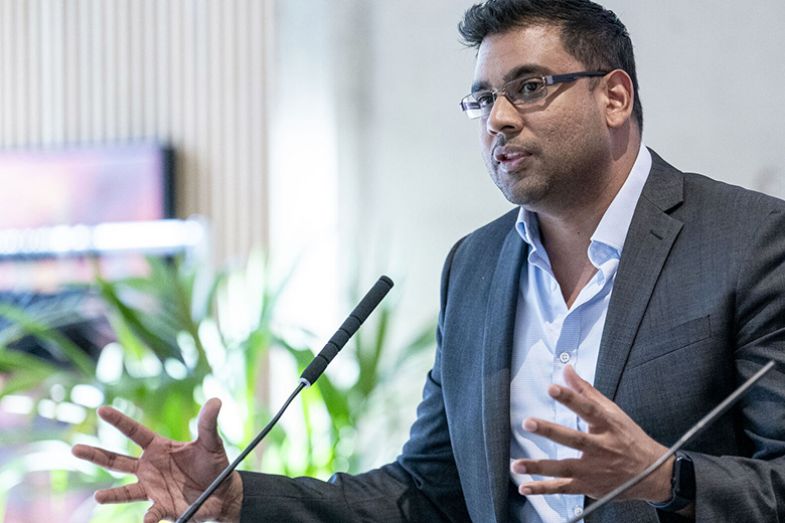
“Academics are often in the ‘comments section’ of the world,” according to Michael Muthukrishna, professor of economic psychology at the London School of Economics and Political Science.
“Things are happening. We try to comment on them; we write about them, often in retrospect, but we’re not actually moving anything,” he told Times Higher Education.
As Muthukrishna tells his students, academics have a duty to do more to inform responses – by answering “the most important questions where you have some sort of comparative advantage” but also, crucially, by “tell[ing] people about it. Both are very important. If you don’t find the best journal with the largest audience and [if you don’t] give the media team what they need [to publicise it], you might as well have not done the research, because no one knows about it. Equally, if you don’t do research that’s relevant, you are not really doing anything useful in the world.”
But even doing research that’s relevant is not necessarily enough to cut through with voters and policymakers. It is all too easy for academics’ writing to remain within an echo chamber of people with broadly similar worldviews and to fail to engage with, far less win over, those with very different stances.
For instance, many scholars had something close to an existential crisis in response to Donald Trump’s first election victory (and, to a lesser extent, to Brexit) and decided they needed to make a political stand, shifting their attention to populism, polarisation, the politics of race and similar themes. Some produced eloquent, well-researched books that were displayed prominently in high-street bookshops. Yet it seems doubtful that those books were bought by many Trump-inclined readers or, therefore, had any meaningful impact on the way people voted in 2024.
For research to really affect policy or public opinion, actively preaching to the uninformed and unconverted is necessary, Muthukrishna says. In 2023 he published an exceptionally bold and wide-ranging book, A Theory of Everyone: Who We Are, How We Got Here, and Where We’re Going, which sets out to demonstrate how a better understanding of human nature can help us address the crucial challenges of today. Whenever he believes his research has highlighted “some information that is important and could actually sway a conversation”, he makes every effort to engage with policymakers.
For instance, he has “helped the [British] Home Office in its Flag It Up anti-corruption campaign because I had been doing research on anti-corruption [and] some of the implications were at the cutting edge and I thought [they] would help move the needle”. He has also had meetings at the UK Department for Education “about the lack of preparedness of British children when it comes to the era of AI”, and he was the principal author on a United Nations Development Programme report, The Next Great Divergence: Why AI May Widen Inequality Between Countries, published in December last year.
But there is also another string to Muthukrishna’s bow. He is on the books of the Academic Speakers Bureau (ASB), launched by the London School of Economics in 2024.
This, according to a spokesperson, is “the only speakers’ bureau in the UK exclusively dedicated to academics”. It is “designed to connect world-renowned academics”, based both at the LSE and beyond, “with corporate and public-sector clients seeking high-quality, research-led speakers, focused on the social sciences...As Susana Mourato, vice-president and pro-director for research at LSE, notes: ‘The Academic Speakers Bureau brings academic expertise to the people and organisations shaping our world – turning research into insight, and insight into impact.’”
While academic speakers would be unlikely to be invited to address a government or corporation that was uninterested in devising policies and procedures with a view to the facts, Muthukrishna considers speaking engagements to be integral to the pursuit of as wide an impact as possible. And speakers’ bureaux can help to grease those wheels.
In many cases, Muthukrishna uses LSE’s mainly to negotiate contracts and sort out logistical details with clients who have approached him independently. But it has also generated work for him, including not only training programmes for Mastercard but also consultancy assignments with the Ministry of Finance in India, “applying behavioural insights for the public good”.
But what of other speakers’ bureaux? Could they be of use to academics, too?
Perhaps not the standard ones, which are largely designed to promote people with the skills to keep people amused over dinner or to host corporate events. Some form part of major commercial publishers, such as Macmillan, Penguin Random House and Simon & Schuster, but they inevitably put the stress on “big names” and flag up only the occasional televisual academic, alongside sports stars, politicians, influencers, investigative journalists and “serial entrepreneurs”.
The major exception is PUP Speaks, set up by Princeton University Press in 2021. Its founding head, Katie Stileman, sees the bureau as “part of our mission as a university press: placing people with the best information and knowledge within public conversations – to share information in a way which is impactful and sustainable”.
Compared with publishers’ traditional press operations, whereby each individual book is promoted by its own publicist around the time of its publication and then largely forgotten about, PUP Speaks aims “to support authors longer and better” and “keep academics out there between books”, so that “the relationship is now about them and their profile rather than just particular books”.
The bureau now has a stable of about 50 scholars and can provide training where necessary, “often encouraging authors to stress the story of how they did their research rather than just a lot of data”, Stileman says. Unlike professional speakers’ bureaux, it always ensures that books are available for the audience to buy – which is important to those academics who are more concerned with their status as writers than as public figures. But, like other speakers’ bureaux, PUP Speaks still takes 20 per cent of the speaking fees – because book sales do not by themselves generate enough income to cover its time and effort in setting up the event.
So how can the bureau help academics hoping to “move the needle” on important policy questions?
Roosevelt Montás, John and Margaret Bard professor in liberal education and civic life at Bard College, is the author of Rescuing Socrates: How the Great Books Changed My Life and Why They Matter for a New Generation (2021). As the title indicates, he is a keen proponent of a fairly traditional model of “liberal education”, but he is eager to distance himself from efforts by some Republican politicians “to legislatively impose” a canonical curriculum. Rather, he sees his task as driving change from within universities by winning over faculty members and senior administrators.
“When I started,” reflected Montás, “the main resistance came from the academic left, and I felt I was arguing against an ideologically inflected rejection of liberal education. Now I am arguing about an ideologically inflected embrace of the Great Books from the right.” And although most of its support had been logistical, PUP Speaks had been enormously helpful in “allowing me to spread my impact further. Without them, I just could not do the number of events I do now. They have freed me to do more.”
Kate Clancy, professor of anthropology at the University of Illinois, takes a similar line. She is the author of the 2023 book Period: The Real Story of Menstruation and campaigns on issues such as sexual harassment in science and the ways that vaccine and drug treatment trials sell women short by ignoring the menstrual cycle.
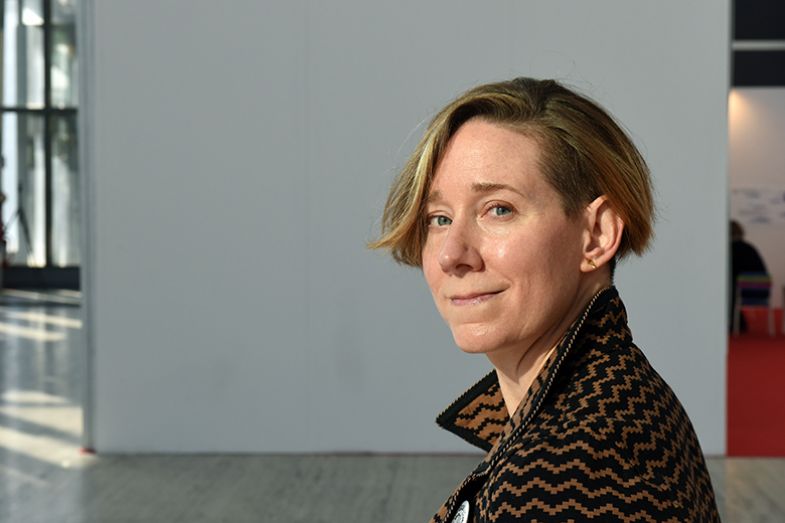
PUP Speaks, she said, “do great outreach that can get me in front of bigger audiences. They also handle the stuff I’m terrible at, like speaker agreements and working out fees...The administrative load either needs to be dealt with by others who are better at it than me, or it doesn’t happen. And if it doesn’t happen I miss the opportunity to give talks.”
And while she concedes that the audience for those talks is likely to be people who largely agree with her, she hopes the talks have a kind of ripple effect by giving those who attend them “the evidentiary basis, or the courage, or the argument they need to take this out to the next layer of people who I cannot reach but they can”.
Is that aspiration realistic? Zena Hitz, a tutor at St John’s College in Annapolis, Maryland, believes she has witnessed an important cultural shift in which her outreach work could well have played at least a small part.
She has long been committed to defending the value of learning for its own sake in the humanities. But when she started writing about education around a decade ago, she recalled, this was considered “irresponsible and self-indulgent”.
Instead, those wanting to defend the humanities claimed that such subjects taught students “how to speak truth to power” or trained them for citizenship. Or they would point out economic benefits, such as that “Silicon Valley loves philosophy majors!” Though many people may have believed “as a matter of private opinion” that learning matters for its own sake, “it was absolutely taboo to argue in public for it”, according to Hitz.
Hence, when she wrote her first online essay on these themes in 2016, “Freedom and Intellectual Life”, she did so “with fear and trembling”. Yet the essay was “picked up by a big philosophy blog” and an editor at Princeton University Press asked her to turn it into a book.
This became Lost in Thought: The Hidden Pleasures of an Intellectual Life, published in 2020 and very much designed to be public-facing. Hitz was also taken on by PUP Speaks, which organised “many, many events” for her to promote her ideas. As well as at liberal arts colleges, these often took place at “beleaguered units” of universities, such as humanities centres and great books core programmes. However, she also spoke at a Catholic leadership conference and at the Nexus Institute in Amsterdam, the latter “on a panel with other writers as well as international politics types to discuss the future of culture in light of the war in Ukraine”.
By now, there has been a “a sea-change in permissible arguments for learning, universities and the humanities”, Hitz believes. There are “numerous ‘influencers’ on Substack promoting reading the great books” and such books are prominent in “the new ‘civics’ programmes in the US”. The year that Lost in Thought came out also saw the publication of Scott Newstok’s How To Think Like Shakespeare: Lessons from a Renaissance Education and Francis Su’s Mathematics for Human Flourishing, which developed broadly parallel arguments.
“I would never have dreamt 10 years ago that we’d see the initiatives or have the conversations we are seeing today,” Hitz said. And while she freely acknowledged that there are many factors underlying the change – including anxieties about the impact of smartphones and social media, as well as the effects of isolation during Covid – it remains plausible that books such as hers, and the opportunities provided by PUP Speaks to spread their messages, played a role in shifting the dial.
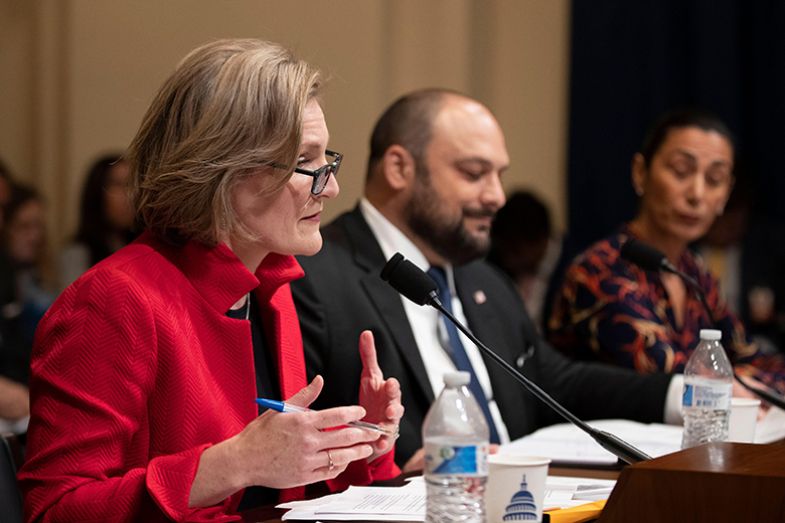
Most striking of all is the case of Cynthia Miller-Idriss, a professor in the Schools of Public Affairs and Education at the American University in Washington, DC.
Her book Hate in the Homeland: The New Global Far Right was published in October 2020 but rose to particular prominence three months later when, in the wake of the 6 January assault on the Capitol, Miller-Idriss “got about a thousand invitations to speak – something absurd. Within a couple of weeks, I couldn’t even read all the emails.”
Fortunately, she had just been selected as the pilot author for PUP Speaks, so she “basically started clicking forward to them – and they helped me manage it...This proved crucial in navigating the world of public engagement and finding ways to make my time work better.”
Most publishers try to arrange events for their authors to address the central themes of their newly published books, but Miller-Idriss tends to give talks about broader themes, such as “the prevention of political violence, online harm and how people get exposed to conspiracy theories”. The key message of her latest book, Man Up: The New Misogyny and the Rise of Violent Extremism, published in September, is that “60 per cent of mass violence attackers have a history of domestic and intimate partner violence, but we ignore these earlier warning signs”.
Though her political perspective is fairly clear (and so uncongenial to some people), Miller-Idriss is happy to engage with certain kinds of conservative outlet because she believes that important issues, such as parental concerns about online harm to their children, “cut across ideological lines”. She remembers “talking in a school with a bunch of 16-year-olds about a content-moderation failure on Meta which flooded feeds with really violent content. I could tell there were parents in the room who had their arms folded at the back, exuding scepticism about me. But as soon as the kids started talking about the live-stream murders and suicides they were seeing, and the teachers were saying ‘Are you telling me that you saw a murder on your screen over lunch and then had to take my math test?’, the whole thing changed. The parents and teachers were leaning in.
“I find it very rewarding to have those conversations when there are Trump supporters or others in the room. It’s an opportunity to reach across those boundaries…And it is helpful to hear their questions so you can pre-emptively engage with their concerns [such as the claim that most political violence comes from the left] and reframe the arguments in a way they will understand.”
Another benefit for her of giving talks in schools or faith communities, as opposed to purely academic settings, is that it has “often generated ideas for new things I want to study”, Miller-Idriss said. “That is because of the kind of questions I am asked: the way people respond to my discussions about how algorithms shape how content comes to them across social media. I get ideas about things I’m missing or something that has changed – for example, when pupils describe how numb or apathetic they feel about the violence they see online.” She is also able to draw on “stories and anecdotes from those audiences” even in “briefings with the FBI” that are specifically designed to shape policy.
There are always going to be huge challenges for academics seeking to live up to Muthukrishna’s ideal and to “turn research into insight, and insight into impact”. But by opening up opportunities to engage with – and even learn from – powerbrokers and political opponents, perhaps academic speakers’ bureaux have something unique to offer. And perhaps they are something that academics should push more publishers to establish.
Register to continue
Why register?
- Registration is free and only takes a moment
- Once registered, you can read 3 articles a month
- Sign up for our newsletter
Subscribe
Or subscribe for unlimited access to:
- Unlimited access to news, views, insights & reviews
- Digital editions
- Digital access to THE’s university and college rankings analysis
Already registered or a current subscriber?