
Why process mapping matters in higher education



Created in partnership with

Created in partnership with
You may also like
Clarity and collaboration are essential in complex university environments, where academic and professional services teams work across multiple functions to deliver teaching, research, student support and regulatory compliance. One practical way to improve how these teams work together is through process mapping.
Process mapping helps teams visualise how work happens from start to finish. It identifies process duplication, delays, confusion and opportunities to streamline activity. Just as importantly, mapping creates a shared understanding across teams, enabling more effective and efficient working towards common goals.
I have been running process mapping workshops at my institution since last May, gaining overwhelmingly positive feedback and insights into additional processes requiring mapping. Based on these, here are examples of how collaborative process mapping can improve understanding, efficiency and cross-team working in higher education.
Improved collaboration and communication
When staff map processes together, silos begin to break down. Colleagues gain insight into each other’s roles, responsibilities and pressures. This builds empathy, strengthens communication and fosters trust.
Shared visual maps also reduce jargon and misunderstanding. They provide neutral, accessible ways to explain workflows to colleagues across professional and academic areas. Instead of relying on assumptions or informal explanations, teams can refer to clear visual representations of how work flows.
- Don’t forget HR when building a student-centred university
- How to integrate development pathways for higher education professionals
- Why university leaders must listen differently in one-to-ones
Mapping clarifies expectations, highlights constraints and identifies where flexibility is possible. Conversations shift from focusing on obstacles to concentrating on outcomes and solutions.
Staff development and recognition
Process mapping develops valuable skills in facilitation, problem-solving and continuous improvement. It makes professional expertise visible by clearly showing where decisions are made and where value is added.
Process improvement work is also a form of leadership. Recognising and celebrating colleagues who improve processes reinforces a culture of innovation and shared responsibility, which is particularly important in times of institutional change.
The MAP-IT success framework
To support structured improvement, I developed the MAP-IT success framework, which provides a clear pathway to achieving sustainable and measurable change.
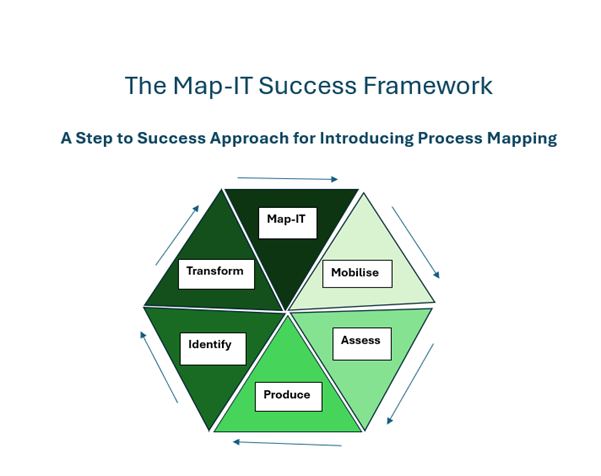
1. M – Mobilise leadership and stakeholders
Visible leadership support is essential in universities, where there is a high level of local control and established ways of working. To secure buy-in, mapping should be positioned as supportive rather than evaluative. Those who do the work are the experts. Workshops should focus on real processes from participants’ own areas, ensuring staff leave with tangible outputs and immediate value.
Effective mobilisation includes:
- aligning mapping to strategic priorities
- using real, locally owned processes
- producing visible outputs
- providing follow-up support.
2. A – Assess high-impact processes
Focus on cross-functional processes that affect students, compliance or efficiency. In universities these often include:
- assessment workflows
- programme approvals
- student onboarding
- recruitment to enrolment transitions
- confirmation of acceptance for studies (CAS) issuance to international students.
These processes typically span admissions, academic departments, compliance teams, finance and registry, making them ideal candidates for mapping.
Example: CAS process
The CAS process is high risk, time sensitive and compliance driven. Errors or delays directly affect students and regulatory standing.
Mapping the current (“as is”) process often reveals:
- repeated compliance checks
- manual spreadsheet tracking alongside system records
- delays at handoff points
- unclear approval authority
- historic steps no longer required.
Through collaborative review, teams can clarify ownership, remove duplication, reduce manual tracking and establish clearer service expectations. This improves turnaround times and accountability while maintaining compliance.
3. P – Produce collaborative visual maps
Workshops begin with a short explanation of mapping principles, followed by participants creating an “as is” map of a live process. A draft map can be prepared in advance and refined collectively.
Standard maps typically include:
- start and end points
- activities
- decision points
- directional flow
- swim lanes to show roles or teams.
Swim lanes are particularly valuable for cross-functional processes, as they make handoffs, often the source of delay, clearly visible.
Collaborative mapping ensures accuracy, surfaces informal workarounds and builds shared ownership. It shifts mapping from static documentation to an active improvement tool.
4. I – Identify improvement opportunities
Once visualised, inefficiencies become easier to diagnose. Common issues include:
- duplicate approvals (having more than one person review and approve the same step or decision, where one approval would be sufficient)
- manual data re-entry
- email-based handoffs without tracking
- bottlenecks concentrated in one role
- legacy steps that remain in the process.
The visual map enables structured questioning:
- Does this step add value or mitigate risk?
- Is it required for compliance?
- Who owns this decision?
- Could it be simplified or automated?
Mapping also improves technology decision making. Universities often purchase software reactively in response to operational pressure. Without understanding the underlying process, technology can simply digitise inefficiency.
Mapping first helps determine:
- whether new software is genuinely required
- whether process redesign alone resolves the issue
- what functional requirements are necessary
- where automation adds measurable value.
This reduces unnecessary expenditure and ensures digital investment is evidence based rather than reactive. Importantly, because inefficiencies are visible in the process, rather than attributed to individuals, discussions remain objective and constructive.
5. T – Transform through implementation and review
Mapping delivers value only when improvements are implemented and sustained.
Each redesigned (“to be”) process should have:
- a named process owner
- clear accountability
- defined service standards or KPIs.
For cross-functional processes, a single accountable lead is essential even when tasks are distributed.
Process maps should be stored in a central, accessible digital repository, with version control to track changes and ensure everyone uses the latest version, which is then linked to relevant policy documentation. Visibility reinforces legitimacy and reduces siloed practice.
Review cycles should be proportionate:
- annual review for stable processes
- six-monthly review for high-risk processes
- immediate review following regulatory or system change.
Embedding review ensures continuous improvement rather than one-off redesign.
The MAP-IT framework offers a structured yet practical approach to improving complex university processes. By making processes visible before investing in solutions, universities can enhance the student experience, reduce regulatory risk, avoid reactive spending and build a sustainable culture of continuous improvement.
Helen Jones is the learning and information services project officer at the University of Chester.
If you would like advice and insight from academics and university staff delivered direct to your inbox each week, sign up for the Campus newsletter.
Additional Links
For further advice and insight on this topic, see our spotlight guide: Connecting the dots between academic and professional services staff.
