
Software engineers with people skills grow from cardboard cities


Created in partnership with

Created in partnership with
You may also like
We often assume that teaching a digital subject such as software engineering requires an entirely digital toolkit comprising a computer, software, programming languages, unified modelling language diagrams, GitHub and online discussion forums. But is constant digital immersion the best way for software engineering students to develop the soft skills they will need in the workplace?
Not necessarily. Students do not need a computer to learn how to design, manage projects, delegate, communicate and negotiate effectively. When we allow them to step away from technology, they can gain skills in surprising and engaging ways.
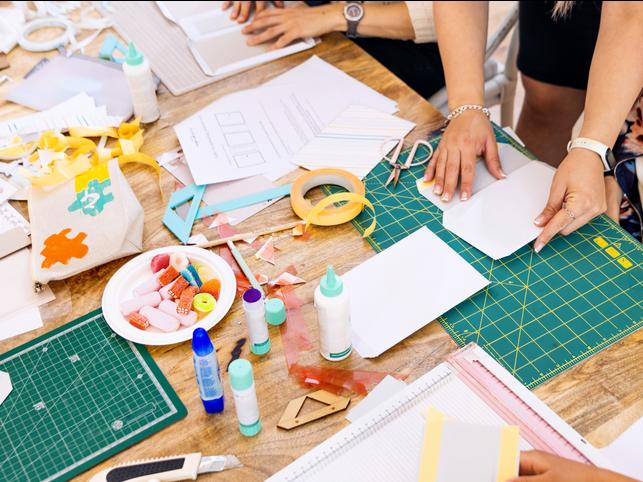
My colleagues and I introduced a “cardboard city” team project early in our undergraduate software engineering module. We run this game-based exercise for 350 students who work in teams of between seven and nine to design and build a physical city, complete with buildings, roads and car parks, within three hours. They are armed only with basic stationery: cardboard, paper, pens, scissors and glue.
This is much more than a craft project. It is a powerful lesson in student-centred learning and a reflection of the software development life cycle. It has become a much-anticipated part of the course.
Why cardboard works
At the start of the module, students receive the 10-week assignment specification: they must work in teams to produce a web-based application featuring user authentication, role-based access control and administrative oversight. However, in week two, most students have no idea how to work together on a project of that scale. Introduced at this stage, the cardboard game solves four problems at once.
First, it acts as an icebreaker. Students who do not yet know each other must immediately collaborate. Within minutes, they discover each other’s strengths: who is good at planning, who enjoys craft work, who naturally steps up to coordinate.
Second, the game mirrors the software development process. We provide the user requirements (a city with roads, buildings and car parks). Students then design the layout, negotiate roles, assign tasks, build the product and, finally, present their city. This echoes exactly what they will do over the following 10 weeks.
Third, the cardboard game reassures students. With only three hours to build it, having a complete city at the end shows students they can complete the much larger software project.
Fourth, it helps manage expectations. By experiencing a compressed, playful version of the development cycle, students gain an understanding of how they will need to work, communicate and compromise over the coming weeks.
- Spotlight guide: Soft skills for hard times
- Solving the soft skills crisis using artificial intelligence
- Four simple steps to running a successful team task
How students approach the city-building activity
During the three-hour session, students must assign the following roles among themselves:
- Architects to draw the designs
- Builders to cut and assemble the cardboard
- Painters to decorate the buildings.
Multiple students can take the same role, reflecting real team structures.
Some students instinctively gravitate towards the cardboard and start constructing. Others pull out their phones to research city zoning laws or architectural ideas. Many simply sit together, sketching and debating the city’s layout. All students practise the same skills in different ways simultaneously.
For many, this is a return to the kind of hands-on learning experienced in childhood. Manipulating physical materials, such as cutting, gluing and building stimulates parts of the brain responsible for memory and problem-solving in ways that a keyboard and mouse cannot. In a world of overwhelming digital stimuli, these tangible objects provide fresh and powerful cognitive triggers.
Building transferable skills and confidence
When these same teams transition to their final software project to develop a fully functioning web-based booking system, their confidence is palpable. They have already built something complex together. They have experience of breaking down a problem, assigning roles, communicating effectively, negotiating compromises, resolving conflicts and refining a design.
The architects now become software designers, builders become software programmers and painters turn into web designers and developers.
One student reflected that the game made the software engineering process feel intuitive. Another noted that learning to compromise on where to place a cardboard car park made later compromises about database designs feel much less intimidating.
A pedagogical tool for all disciplines
This experience showed us that giving students agency over how they learn ignites curiosity and creates memorable, shared experiences – something that a lecture alone rarely achieves. It made the principles of software engineering tangible, collaborative and, above all, fun.
Educators across disciplines can harness the power of hands-on, low-tech simulation, whether teaching organisational behaviour via debates or software engineering using cardboard. Learning does not have to be purely digital. It is physical, social and playful. And sometimes, the best way to understand a complex system is to build one – with your hands.
Nanlin Jin is associate professor of computing at Xi’an Jiaotong-Liverpool University, China.
If you would like advice and insight from academics and university staff delivered direct to your inbox each week, sign up for the Campus newsletter.
