

Making executive education flexible by design




Cranfield University’s approach to digital executive education has evolved since it was first approached by a global bank in 2019 to develop a programme. Its digital strategy was rolled out in 2020, which has since become a stackable and flexible offering for businesses looking to upskill and retain employees. “We wanted it to be career-focused so that when people went through each step of the programme, it was something that helped them with their career,” said Graham Bell, director of digital education at the university, during a session, held in partnership with Instructure – the maker of Canvas – at the 2026 THE Digital Universities UK event.
Students can build up from short learning modules to award-bearing qualifications such as postgraduate diplomas and master’s degrees. Bell outlined examples of how businesses are adopting this approach, such as a supply chain programme that started as a small certificate course and is now a postgraduate certificate that includes leadership components focused on challenges businesses face. Another employer has built a cost-efficient course for a small group of employees where they can study certain units in their own time and attend others in person at Cranfield University.
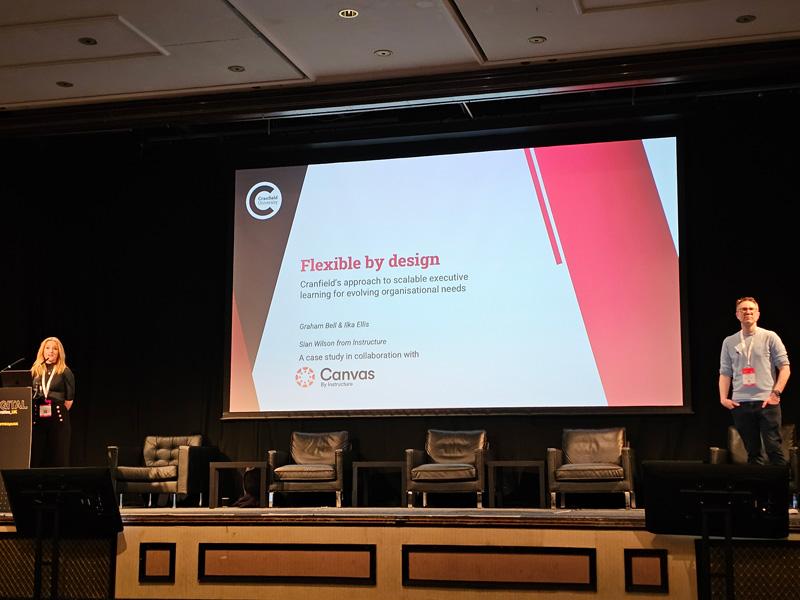
Ilka Ellis, commercial learning design lead at Cranfield University, spoke about how the institution has built its course offering using Canvas, the learning management platform offered by Instructure. “We use an approach that helps us to contextualise easily and makes developing courses manageable without compromising academic rigour,” she said. When it comes to programme structure, some units remain fixed while others can change. This framework supports discussions with external organisations, as faculty members can easily outline the core elements and those open for modification.
The courses include fictional examples, real case studies from publicly available information and tasks that learners could apply immediately within their organisations. The university also brings in voices of industry-leading practitioners through live and recorded videos. “[Our students] have all been at work for a long time. They want to develop within the workplace and they want to hear how it can be done,” Ellis said. The university has a studio for recording video content and faculty members can use AI to assist with creating animations and designing assessments. Feedback and assessment mechanisms can be built in at the end of each module.
The resources required to develop customised, stackable and award-bearing programmes for clients are remarkably lean. “Ideally, we have a committed faculty member, one learning designer and one creative content designer working on a module at a time,” Ellis said. “The academics are the source and examples come through the help of organisations and research partners.”
The programmes are designed to be globally available and support lifelong learning. “We wanted to give people a flexible path, so they could choose which modules they wanted to take in whichever order they wanted,” said Bell. “Many of our clients in executive education are global clients, so we needed to make sure that they could approach this anywhere and anytime.”
The speakers:
- Graham Bell, director of digital education, Cranfield University
- Ilka Ellis, commercial learning design lead, Cranfield University
Find out more about how Instructure supports flexible, lifelong learning.
