

How stylometry works in StrikePlagiarism.com — and why it changes authorship verification


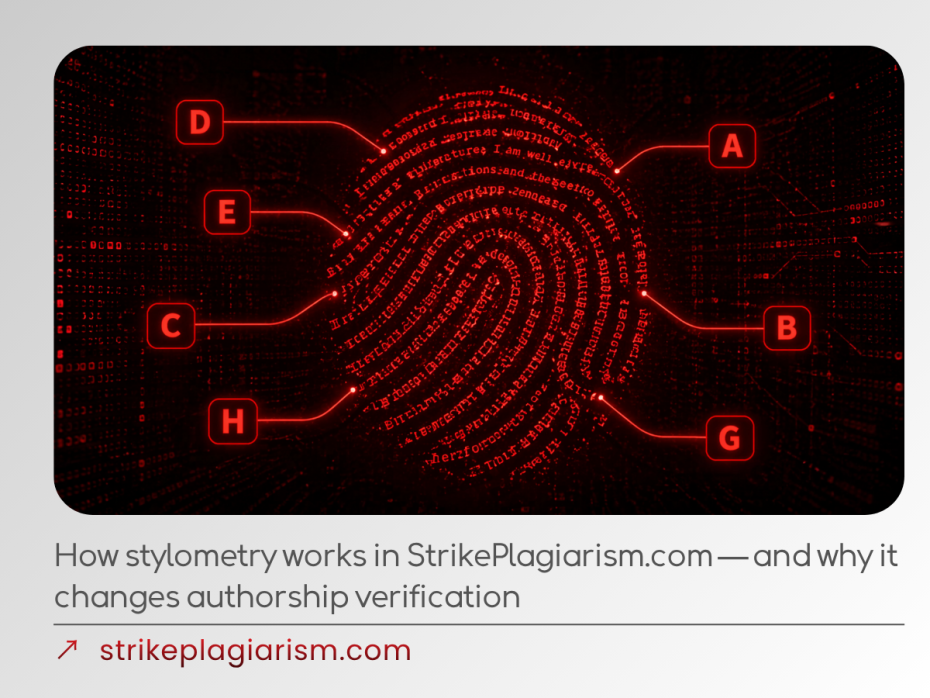

How stylometry works in StrikePlagiarism.com
Stylometry in StrikePlagiarism.com analyses writing behaviour across the entire document, focusing on consistency rather than isolated fragments.
The system evaluates writing behaviour through:
- consistency of style across sections,
- patterns in sentence structure and vocabulary usage,
- natural variation versus abrupt stylistic shifts,
- deviations that may indicate external influence or multiple authorship.
Instead of searching for identical text, the system determines whether the document maintains a coherent authorial profile.
When inconsistencies appear — such as sudden changes in tone, complexity or structure — these sections are automatically highlighted for further review.
Designed to detect complex authorship patterns
Modern academic writing is no longer linear. Content is often:
- generated using AI,
- paraphrased or rewritten,
- translated across languages,
- or created through hybrid human–AI interaction.
In these conditions, similarity scores alone provide limited insight.
Stylometry in StrikePlagiarism.com is designed specifically to address this complexity. It detects disruptions in writing behaviour that remain visible even when surface-level similarity disappears.
This makes it possible to identify potential authorship inconsistencies in cases where no direct sources are found.
Part of a multi-layered verification system
Stylometry in StrikePlagiarism.com operates as one component of a broader, multi-layered analysis framework.
It works in combination with:
- similarity detection,
- AI-generated content analysis,
- text manipulation identification.
Each layer provides a different type of signal. Stylometry adds the behavioural dimension — helping interpret whether the document is consistent with a single, authentic author.
Supporting real academic decisions
Stylometry in StrikePlagiarism.com does not replace academic judgement. It strengthens it.
By highlighting sections where writing behaviour changes, the system enables:
- faster identification of high-risk fragments,
- more focused and efficient review,
- more confident and evidence-based academic decisions.
This ensures that evaluation is based not on a single metric, but on multiple, complementary indicators.
Why this matters
As AI-generated and manipulated content becomes increasingly difficult to detect through text comparison alone, understanding how a document was created is becoming essential.
Stylometry in StrikePlagiarism.com introduces this behavioural layer — allowing institutions to move beyond surface-level analysis and evaluate authorship with greater clarity and confidence.
StrikePlagiarism.com → Real detection. Real integrity.
