
We must stop treating internationalisation as something dependent on an aeroplane


Created in partnership with
Created in partnership with
You may also like
Popular resources
I’m a firm believer in the transformative influence of studying abroad. I will always encourage any student considering an international placement to seize the opportunity, especially as my own life was shaped by experience in Germany and France, and later China and Japan. Those encounters formed my world view and set the course for my career in international higher education.
But we must acknowledge a difficult truth. Although study abroad remains a very powerful route to long-lasting international experience, it is not the most accessible. Only a very small percentage of UK students take up international mobility opportunities, despite what we have gained from the increased flexibility of the UK’s Turing Scheme and, now, through rejoining Erasmus. Against a backdrop of catastrophic decline in language provision, cost-of-living pressures and widening participation commitments, we cannot continue to rely on physical mobility as the primary route to global learning.
Universities have a responsibility to equip all graduates, not just the mobile minority, with the cultural intelligence and global competence employers increasingly demand, even if that engagement is more on-campus than overseas.
Time for a strategic shift
The policy context has recently shifted. Published in January 2026, the UK government’s refreshed International Education Strategy, with its focus on connecting young people through education, is a welcome development. Its language creates greater space for global learning and arguably encompasses some of the ambitions associated with internationalisation at home.
- What the ‘overseas elective’ can teach us about adapting student exchanges for 2026 and beyond
- Make multiculturalism an enriching learning experience
- Why ethical internationalisation starts with listening
Yet the strategy stops short of giving internationalisation at home the prominence it deserves. Its clearest commitment to developing globally capable UK learners is still expressed primarily through opportunities to study, work and volunteer abroad. These experiences are immensely valuable, but they will never reach every student. The strategy does not explicitly identify how international and intercultural learning should be embedded in the curriculum or made available through students’ everyday experiences on UK campuses and online.
In the next stage of implementation, the government needs to turn the strategy’s welcome language about global learning into an inclusive institutional commitment. Internationalisation at home should be recognised as a form of active 21st-century knowledge diplomacy, one that supports a future-ready workforce and strengthens the UK’s global reputation for employability skills.
It’s an approach that would be more collaborative and less colonial in tone and intent than traditional “soft power” framings. It would also better reflect how most UK students encounter international education: not principally through travel but through their curricula, campuses, communities and interactions with internationally diverse peers.
So what is the solution?
At Universities UK Global Mobility Conferences, I have argued that this is a little like designing a good restaurant menu. Diners have different appetites. Some want two starters; others go straight for a main. Some prefer familiar flavours; others experiment.
An internationalised student experience framework can function in the same way. It can offer a transparent, flexible and inclusive range of international learning and engagement opportunities. A student without the finances, free time or confidence to study abroad can still choose meaningful on-campus or digital global experiences. A student with extensive international experience can opt for more advanced or intensive opportunities. The point is choice, coherence and agency.
Smaller opportunities might include a single collaborative class with students at an overseas university, an internationally focused case study, a multilingual group task, an online discussion with an international employer, a short intercultural mentoring relationship or a locally-based project involving a culturally diverse community.
These do not necessarily require the creation of additional modules or significant new demands on students’ time. Many can be built into existing courses by adapting a seminar activity, assessment brief, group project or reading list so that students engage with international perspectives and work across cultural or linguistic differences.
For example, students might compare how the same professional challenge is approached in two national contexts, work in virtual teams with peers studying elsewhere, interview someone with experience of another education or workplace culture, or evaluate the cultural assumptions embedded within a familiar theory or case study.
A business module might ask students to adapt a product or service for a different market; a health programme might compare culturally shaped understandings of care; and an education course might involve students in examining how a common policy issue is addressed in different systems. When these activities are intentionally sequenced across a programme, relatively modest encounters can accumulate into a substantial and progressive international learning experience.
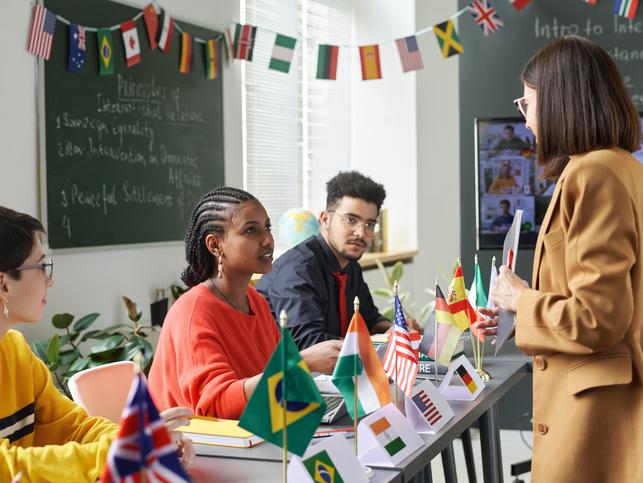
Not every international encounter needs to replicate the intense culture shock of living abroad. Smaller, structured opportunities, from teamwork to interactions with international peers, can build intercultural maturity over time.
The important point is that these experiences should not simply expose students to difference and assume that learning will automatically follow. They need clear objectives, appropriate preparation, supported interaction and opportunities for reflection.
Students might begin with relatively low-risk encounters, such as discussing contrasting perspectives within their existing class, before progressing to sustained collaborative projects involving external partners or international peers.
How to make students aware
In my own experience, often universities already offer a considerable range of internationally oriented activities. But students might encounter them by chance or fail to recognise their relevance to their academic and professional development.
An institutional framework forces universities to map this landscape, articulate its purpose and ensure it is accessible in different ways for different students.
This approach is not always about inventing new initiatives. In many cases, it is about organising and elevating what already exists so the whole becomes greater than the sum of its parts.
This might mean bringing together opportunities that currently sit separately across academic schools, careers services, students’ unions, language centres and international offices, and presenting them to students as part of a coherent international learning journey.
Existing activities such as language exchanges, internationally focused student societies, guest lectures, volunteering projects, cultural events, employer challenges and peer-mentoring schemes can all become more meaningful when their international and intercultural learning outcomes are made explicit, supported through guided reflection and formally recognised.
A conversation café, for example, can be elevated from an informal social activity to a structured opportunity to develop intercultural communication when students are given carefully designed prompts, encouraged to reflect on different perspectives and helped to articulate the skills they have developed.
Similarly, an international guest speaker can become more than a one-off lecture if the session is connected to course content, followed by comparative discussion and incorporated into a related assessment or reflective task.
Institutions can also recognise participation through digital badges, portfolio evidence, transcript supplements or employability awards, helping students understand and communicate the value of these experiences.
As cultural intelligence research shows, it isn’t so much the location of the activity but rather its design that influences its impact. In this way, we can help more students learn to work and live alongside diverse communities and equip graduates with transferable skills that strengthen both local societies and international collaboration.
If we are serious about preparing graduates for a global workforce, we must stop treating internationalisation as something dependent on an aeroplane. The vast majority of our students will never study abroad. But every one of them can develop the global competence and cultural intelligence employers expect if universities take internationalisation at home more seriously, invest in institutional frameworks and present students with a menu that genuinely nourishes their global potential.
Anthony Manning is associate dean of international at Arden University.
If you would like advice and insight from academics and university staff delivered direct to your inbox each week, sign up for the Campus newsletter.
