
How to evolve with GenAI: an educator’s guide


Created in partnership with
Created in partnership with
You may also like
With GenAI, educational practice is experiencing its own Cambrian explosion. Many applications have emerged in a short space of time, creating a more diverse educational ecosystem. This growth is fuelled by breakthroughs in large language models, the rapid adoption of cloud computing, and learners’ growing digital literacy, alongside the urgent need for educational innovation after Covid-19.
In response, educators must develop the skills to harness GenAI, rather than dismissing it. This process requires ongoing collaboration between educators, institutions and stakeholders. Concerns around regulation, effectiveness and equitable access to GenAI resources all shape the gradual and complex transformation of education.
Experimental body plans in the educational ecosystem
In the Cambrian period, life experimented with countless body plans – some disappeared quickly, others became the foundation of modern species. From a technological perspective, GenAI has made the leap from zero to one. But as it emerges in education, we need to cultivate it carefully and reflect. Like evolution, this process is not linear but fluid – marked by trial, error and diverse experimentation. As educators, we must explore how to use GenAI within the contexts of our disciplines, despite our uncertainty.
Early evidence from the evolutionary testing ground
To find out more, I spoke to colleagues involved in developing courses for the artificial intelligence and machine learning stream. They provided insights into how educators are adapting to GenAI, indicating which practices are taking root and which are still being tested.
- ‘GenAI and critical thinking can – and should – work together’
- Use GenAI to slow down and reflect more deeply
- What your students are thinking about artificial intelligence
The majority of those I spoke to recommend using GenAI before class – for example, to summarise readings or provide pre-study support – and after class, to deliver personalised feedback and exercises. Only a fifth consider in-class use, reflecting caution about GenAI’s value for real-time discussion and interaction. This suggests that course developers see GenAI as best suited for supplementary and extended learning, rather than as a tool for core instruction.
These findings show that educators recognise the potential value of GenAI while remaining cautious about risks to student thinking and ethical practice. Their early experiments are contributing to a growing evidence base that will help shape a long-term, responsible strategy for integration – a process that, like biological evolution, advances through diverse experimentation and the selective retention of what truly enhances learning. For colleagues developing courses, these insights highlight that critical reasoning and ethical awareness are key to building resilient pedagogical designs.
Navigating the evolutionary testing ground
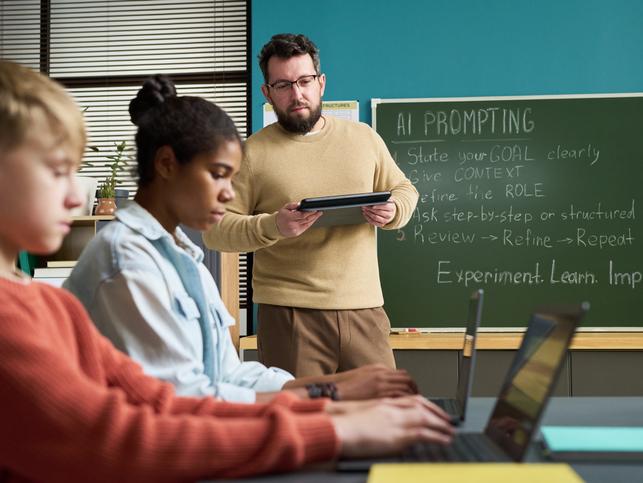
In this early Cambrian period of GenAI in higher education, educators are explorers, testing new body plans for teaching and learning. Some experiments will thrive and reshape our future classrooms; others will fade after brief trials. Focus on small and structured adaptations that build on enduring pedagogical principles, rather than chasing every new tool.
- Pre-class preparation: use GenAI to generate reading summaries, visual explanations or quiz questions, then ask students to critique the accuracy and completeness of these outputs. This not only helps them prepare but cultivates critical evaluation skills – the intellectual skeletal system that supports deeper learning.
- In-class interaction: treat GenAI as a creative sparring partner. For instance, have students compare their own solutions with GenAI ones or identify the biases in the tool’s reasoning. Activities like these make visible the strengths and weaknesses of both human and machine cognition – a crucial step in shaping the muscular co-ordination of the future learning body.
- Post-class review: invite students to use GenAI tools to revise their notes, translate concepts into forms that resonate with them or generate practice examples. Then, require a short reflection on what GenAI helped clarify and where it failed. These reflections provide formative feedback loops while supporting learners who might be introverted, multilingual or cross-cultural – expanding the inclusivity of the educational ecosystem.
- Safeguards and ethics: every evolutionary leap needs boundaries. Discuss with students how to verify information sources, respect privacy and avoid over-reliance when using GenAI platforms. Established evaluation models and academic integrity policies act as the regulatory genes that prevent harmful mutations, such as misinformation or algorithmic bias.
By weaving these experiments into existing courses, educators can tell what truly adds adaptive value and what is merely a passing gimmick. Over time, the practices that genuinely enhance learning will become the evolutionary breakthroughs shaping the next stage of higher education’s GenAI ecosystem.
Education lies not only in technological advancement but also in deep humanistic reflection. It evolves gradually, while GenAI accelerates along a fast-moving track. Let’s recognise the unstoppable momentum of change, while also preserving the most precious elements of education: care for people, respect for thought and the nurturing of creativity that keeps our educational ecosystem alive.
Lin Yue is a lecturer at the University of Adelaide.
If you’d like advice and insight from academics and university staff delivered direct to your inbox each week, sign up for the Campus newsletter.
