
Wearing the Sun: How Photovoltaic Fiber Technology Could Revolutionize Vietnam's Textile Industry and Global Sustainable Energy
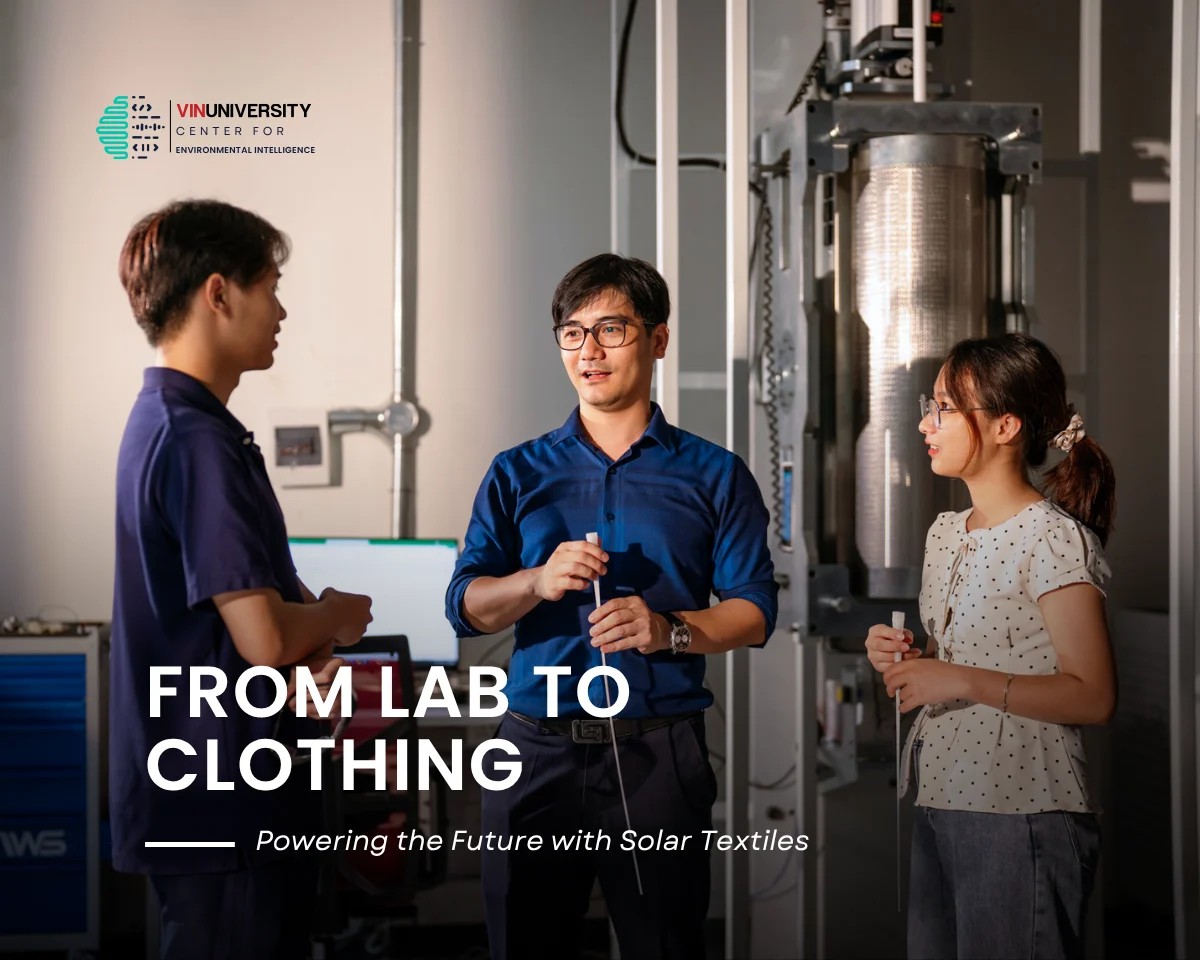
Researchers at VinUniversity's Center for Environmental Intelligence (CEI) are redefining what clothing can do. Led by Dr. Nguyen-Dang Tung, the project "Developing Scalable Fabrication Process of Photovoltaic Fibers and Textiles" transforms ordinary threads into multifunctional, energy-generating fibers using advanced 3D printing and thermal drawing techniques. Hollow fibers house delicate semiconducting layers, with organic semiconductors and high-melting-point metals integrated through an electroplating process, enabling garments to generate electricity simply from sunlight exposure. The implications extend far beyond personal electronics — applications span healthcare wearables, military gear, and smart surfaces. The research carries particular strategic significance for Vietnam: with textile exports exceeding USD 34 billion in the first nine months of 2025 alone, solar textiles could add transformative high-tech value to the sector, positioning Vietnam as a global leader in sustainable, next-generation manufacturing.

Sponsored by

Sponsored by
The Challenge: Energy crisis calls for innovative solutions
In just a few decades, our daily lives have become deeply electrified. Cars run on rechargeable batteries, watches track our health, phones constantly accompany our every movement, and even medical devices like pacemakers depend on uninterrupted access to power. According to a recent International Energy Association report, global electricity demand in 2024 surged by 4.3%, a record increase in the past decade.
As this trend continues, one reality becomes inescapable: the way we generate, store, and carry energy must evolve to keep pace. The need does not simply stop at readily available power sources; the future demands innovative portable portable energy solutions that can be seamlessly woven into how we live, work and move.
Among the technologies poised to answer this need, organic photovoltaics (OPVs) stand out. They use organic semiconductors to convert sunlight into electricity, offering exceptional advantages such as light weight, flexibility, and low environmental impact. Yet, despite decades of research and promising laboratory breakthroughs, OPVs have struggled to scale into real-world applications, largely due to limitations in fabrication methods and material durability.
That is where Dr Nguyen-Dang Tung’s “Developing scalable fabrication Process of Photovoltaic Fibers and Textiles” project begins.
The Innovation: Solar Inside the Fiber
The approach is both simple in concept and ambitious in execution: turning ordinary threads into multimaterial fibers that can hear, see and talk.
Using advanced 3D printing and thermal drawing techniques, the team design hollow fibers that can house delicate semiconducting layers. Organic semiconductors and high-melting-point metals are then integrated through electroplating process. Treating the fiber as both substrate and encapsulation layer creates a protected environment where the solar device can operate efficiently and durably.
The resulting solar textiles can be woven into clothing or functional surfaces that generate electricity simply by being exposed to sunlight. This innovation unlocks a range of large-scale applications across multiple sectors, including:
- Wearable power sources for personal electronics and healthcare devices
- Smart agriculture sensors channeling from tarpaulins or crop covers
- Emergency response and military applications where lightweight energy is critical
- Decentralized power generation for disaster relief or off-grid communities
Vietnam’s opportunity: From low-cost labor to high-value innovation
Vietnam ranks among the world’s leading textile exporters. The Vietnam Textile and Apparel Association (VITAS) reports that the sector’s exports reached over USD 34 billion in the first nine months of 2025 alone.
Vietnam’s competitiveness relies largely on its geological advantages and low production cost. The emergence of solar textiles presents a unique opportunity to add high added value to the picture. By fusing Vietnam’s robust textile manufacturing ecosystem with frontier research in materials and renewable energy, the nation could position itself as a pioneer in high-tech sustainable textiles, supporting the national goals in green growth, energy security, and climate resilience.
Looking ahead
Of course, challenges remain. Scaling up functional fiber production requires significant advances in manufacturing, quality control, and real-world durability. But the potential rewards are enormous.
The path from lab to clothing is not straightforward, but it is one worth walking. By reimagining solar technology as part of the textiles we wear and use daily, we take a bold step toward a future where our clothes not only protect us from the elements, they also power us through them.
References
Abouraddy, A. F., Bayindir, M., Benoit, G., Hart, S. D., Fink, Y., & Joannopoulos, J. D. (2007). Towards multimaterial multifunctional fibres that see, hear, sense and communicate. Nature Materials, 6(5), 336–347. https://doi.org/10.1038/nmat1889
International Energy Agency. (2025). Global energy review 2025. IEA. https://www.iea.org/reports/global-energy-review-2025
Tran, T. B. N., & Tran, T. P. T. (2018). Vietnam’s textile and garment industry: An overview. Business & IT, 8(2), 45–53. https://doi.org/10.14311/bit.2018.02.05
VnExpress. (2025, October 10). Dệt may qua thời chỉ gia công hàng giá rẻ. VnExpress. https://vnexpress.net/det-may-qua-thoi-chi-gia-cong-hang-gia-re-4949496.html
Yan, W., Page, A., Nguyen-Dang, T., Qu, Y., Sordo, F., Wei, L., & Sorin, F. (2018). Advanced multimaterial electronic and optoelectronic fibers and textiles. Advanced Materials, 30(47), 1802348. https://doi.org/10.1002/adma.201802348