
SLiDER – Smart Local Early Warning Systems for Community-Based Disaster Risk Reduction: Bridging the Last Mile of Disaster Early Warning
VinUniversity researchers is buidling SLiDER – A Smart Local Early Warning Systems for Community-Based Disaster Risk Reduction. This is a research initiative designed to bridge the divide between advanced national-level forecasting and localized real-world response. Going beyond solely improving predictive accuracy, the project reframes early warning holistically through detection, communication, and community efforts. To achieve this, the project integrates Artificial Intelligence (AI), Internet of Things (IoT), Machine Learning (ML), Geographic Information Systems (GIS), and remote sensing, along with participatory design and local knowledge. This interdisciplinary approach results in a socio-technical system that strengthens disaster preparedness and supports more resilient, participatory response systems.

Sponsored by

Sponsored by
In recent years, the global capacity to predict natural disasters has improved with increasing accuracy. Civilians are rarely left unaware of approaching dangers: alerts of incoming storms or floods appear across news outlets and broadcast systems well before impact.
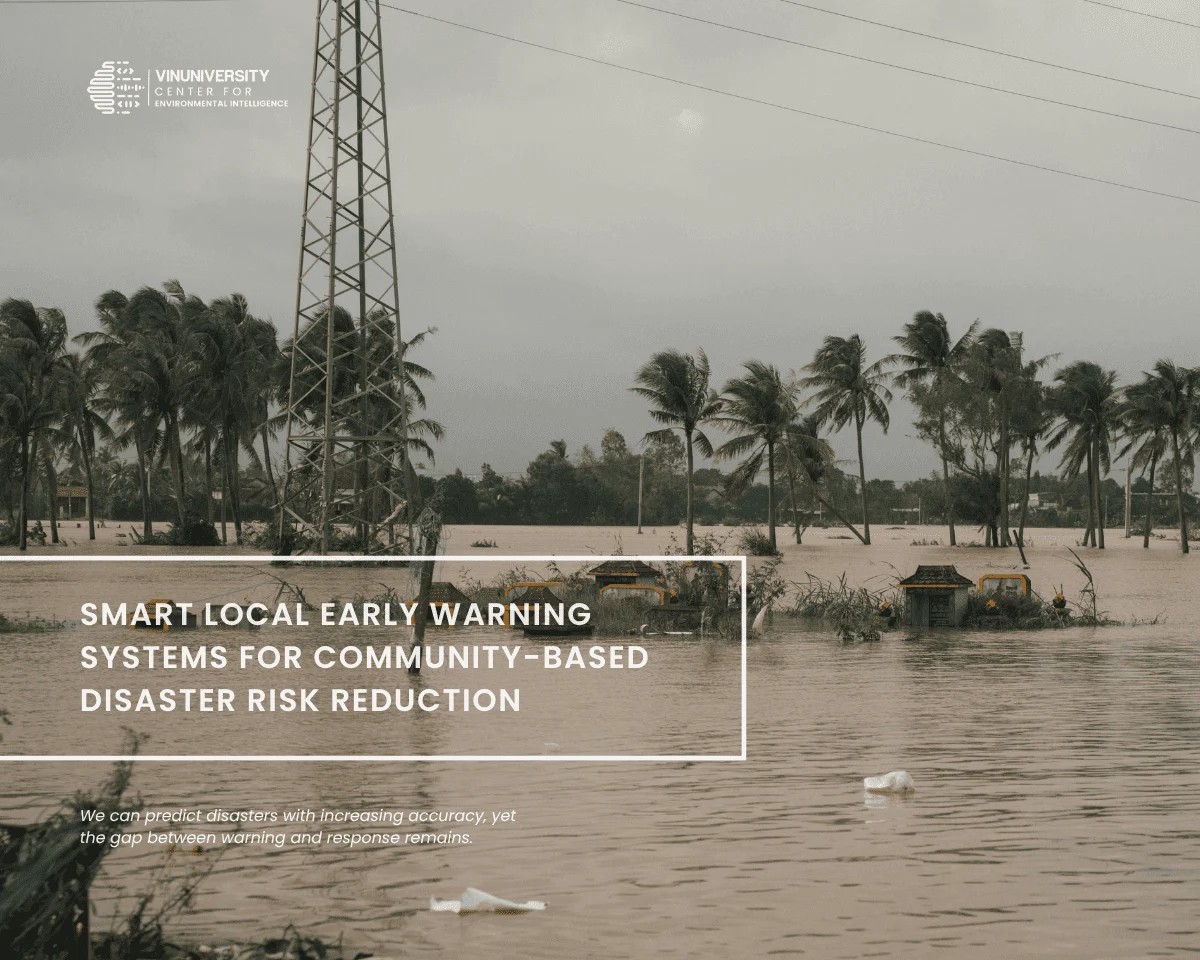
And yet, despite this progress, recent years continue to rank among the most severe for natural disasters. Economic losses have reached record-breaking levels, and thousands of families have been affected. We can predict disasters, but disaster response still falls short.
Technology Advances, Communities Fall Behind
Vietnam’s hydrometeorological forecasting system has improved significantly in recent years, driven by advances in artificial intelligence, big data, and remote sensing. High-resolution numerical models now provide forecasts at granular spatial scales, while AI enhances short-term storm predictions and satellite systems achieve high detection accuracy.
But where technology accelerates, communities do not always keep pace.
In many disaster-prone areas, warnings remain difficult to access or interpret. Information may arrive through the wrong channels or leave little time to translate into decisions. The result is a persistent gap between prediction and response, a “last mile” problem that technology alone cannot solve.
From Prediction to Implementation
SLiDER – Smart Local Early Warning Systems for Community-Based Disaster Risk Reduction is a research initiative designed to bridge the divide between advanced national-level forecasting and localized real-world response. Going beyond solely improving predictive accuracy, the project reframes early warning holistically through detection, communication, and community efforts.
To achieve this, the project integrates Artificial Intelligence (AI), Internet of Things (IoT), Machine Learning (ML), Geographic Information Systems (GIS), and remote sensing, along with participatory design and local knowledge. This interdisciplinary approach results in a socio-technical system that strengthens disaster preparedness and supports more resilient, participatory response systems.
How It Works
SLiDER operates through a three-layered framework:
- Localized Early Warning System
Historical and real time data from environmental sensors are processed through AI-based and physics-informed models to accurately identify potential hazards. - Multi-channel Alert
Information is translated into accessible warnings and delivered through multiple channels: mobile applications, SMS alerts, and community-based dissemination. This diversifying approach ensures that warnings reach vulnerable populations in remote or resource-constrained areas. - WARN Hubs
Perhaps the most critical layer, this phase focuses on enabling practical follow-up. Through co-design workshops, training sessions, awareness campaigns and feedback activities, communities are equipped to both receive warnings and actively participate in disaster risk management. In doing so, they move from passive recipients to collaborators and co-owners of the system, enhancing trust and preparedness.
Grounded in Local Realities
A defining feature of SLiDER is its emphasis on localization. The project pilots in Vietnam’s central or Mekong delta regions, addressing most pressing high-risk areas. Research activities begin with vulnerability mapping and data collection to understand local exposure and preparedness gaps. This ensures that the system is dynamically tailored to the specific needs of each community. Real-world testing and simulation drills will further refine and support its scalability and transferability in other regions.
Rethinking “Early Warning”
In many ways, SLiDER challenges conventional definitions of early warning systems, shifting the focus toward a more nuanced question: ‘What good is a warning if it does not, or could not, lead to action?’
The project team offers a straightforward answer: For early warnings to be effective, they should be understandable, trusted, and executable – qualities that can only be achieved through community engagement.
This approach is particularly timely. As Vietnam strengthens its capacities in disaster risk mitigation and emergency response, the need for systems that connect advanced forecasting technology to clear actionable steps has never been more urgent. SLiDER closely aligns with these efforts, offering a model where warnings do not end as information but begin as decisions.
References:
[1] Phuong, C. (2026). A hard year of natural disasters. VnEconomy. https://en.vneconomy.vn/a-hard-year-of-natural-disasters.htm
[2] Vietnam News. (2025). Forecasting capacity, technology key solutions for disaster response. Vietnam News. https://vietnamnews.vn/environment/1777600/forecasting-capacity-technology-key-solutions-for-disaster-response.html
Tags :