
The University of Queensland’s breakthrough in copper processing
A University of Queensland spin-out is helping to meet soaring global copper demand with a low-carbon breakthrough

Sponsored by the University of Queensland


Sponsored by

Sponsored by
Image credit: University of Queensland.
Copper is a hugely important metal with a whole host of critical uses. Electrical wiring, plumbing and, more recently, renewable energies all depend on large quantities of the metal. However, accessing substantial quantities of high-quality copper isn’t easy – and it can be costly. James Vaughan, an associate professor at the University of Queensland (UQ) in Australia, is combining scientific research with commercial partnerships to advance copper processing practices.
“Banksia Minerals Processing was founded in 2024 to enable the commercialisation of this UQ invention,” Vaughan explains. “It represents a significant breakthrough in copper recovery, offering a more efficient, lower-energy and environmentally friendly alternative to conventional methods.”
The technology at the heart of the new copper process was developed by Vaughan, with his co-inventor David Mann and UQ’s Hydrometallurgy Research Group, over approximately three years. It built on the group’s extensive experience, including previous copper projects with major companies like Glencore and BHP.
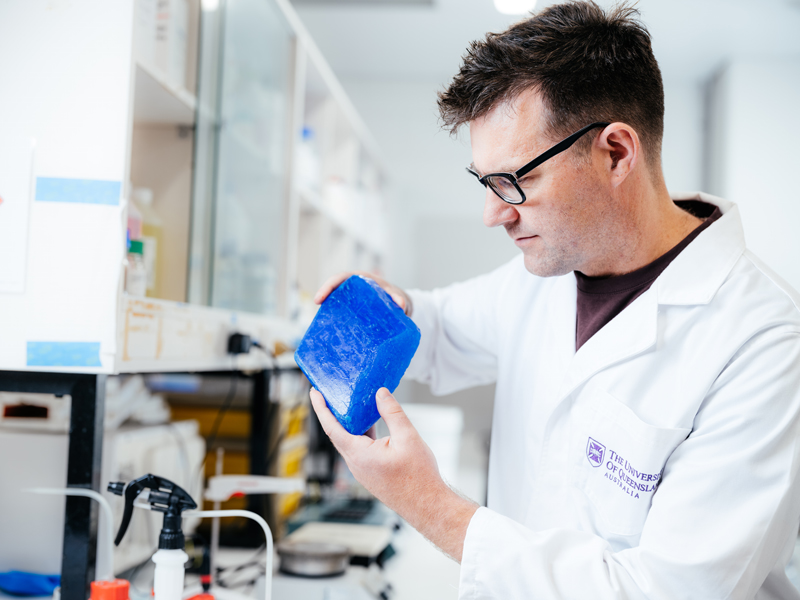
“The core innovation of the copper recovery process revolves around recovering copper metal from a solution using chloride-based hydrometallurgical processing,” Vaughan says. “Conventional methods typically entail dissolving minerals in aqueous solutions – often sulphuric acid. However, this necessitates solution purification and relatively high energy electrowinning – a process where metal is electrodeposited from solutions in an electrolysis cell – resulting in additional costs to obtain the metal.”
Applying electrowinning to a chloride solution, the UQ research team discovered the conditions and materials required to produce a smooth, high-purity copper deposit, unlocking several benefits. It has resulted in a streamlined copper recovery method that uses less energy than conventional methods, halving the amount of electricity used compared with electrowinning copper from sulphate solutions.
“As opposed to smelting copper, the new process represents a direct method for recovering high-purity copper that does not emit any harmful gases, such as sulphur dioxide,” Vaughan says. “This offers a significant environmental advantage because, in contrast, conventional smelters only capture about 90 to 95 per cent of the sulphur dioxide they generate, leading to unavoidable emissions.”
Even considering the potential benefits of the technology, to ensure the process that can be applied in industry, further derisking through a staged development approach is a key goal for the spin-out. In this regard, UQ’s culture of innovation has been highly supportive. UniQuest, the institution’s commercialisation group, was instrumental in brokering the deal that led to the technology transfer agreement with Banksia Minerals Processing.
The evolution of the technology is particularly timely given the global demand for copper and the threat of closure facing existing infrastructure, including Queensland’s only copper smelter. Banksia’s approach means low-quality copper can now be processed, as can more complex copper concentrates, including ores with impurities like arsenic, which are currently of limited use for conventional smelters.
“Banksia Minerals Processing has the potential to unlock a large number of stranded assets and open new copper resources that were previously deemed unviable,” Vaughan explains. “The company is currently planning a capital raise for a continuous integrated pilot phase, aiming for the first commercial-scale version of its technology to be operational by 2030.”
With any academic endeavour, the ultimate goal has to be the delivery of real-world impact, Vaughan says. “Research is great for generating breakthrough ideas but commercialisation is usually the next step to creating the products and services that can truly change the world. Combined, the research being carried out at UQ and the commercial output of Banksia Minerals Processing are bringing the world closer to meeting both its environmental and economic goals.”