
Making lab-grown blood at scale: the collaborative model bridging research and healthcare
Lab-grown blood could transform care for people who struggle to find compatible blood. A SMART CRC collaboration with The University of Queensland and Lifeblood is helping to make this a reality

Sponsored by the University of Queensland

Sponsored by

Sponsored by
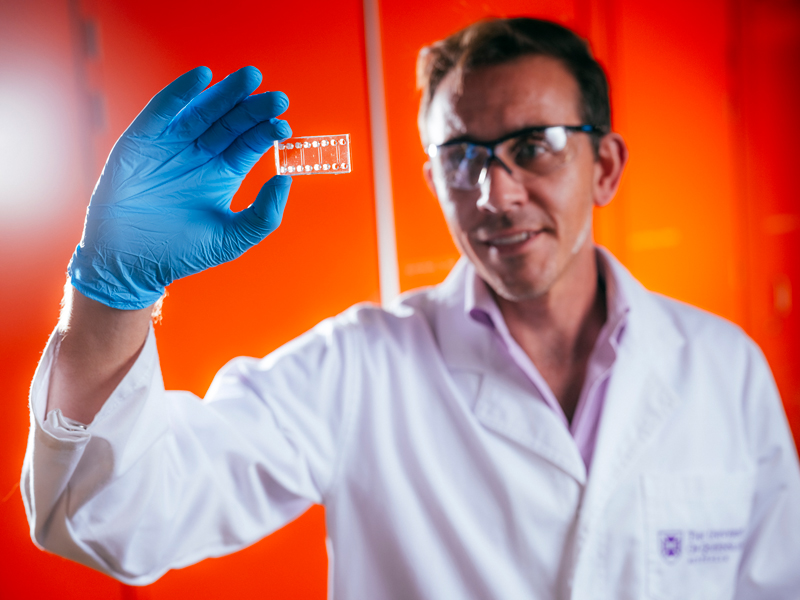
Image: University of Queensland biomedical engineer Mark Allenby
Blood donations save millions of lives every year. However, patients with rare blood types and health conditions often struggle to find a matching donor. For these individuals, the only option is to wait and hope that a match is found in time. But hope is on the horizon: lab-grown blood.
Manufacturing red blood cells in a laboratory rather than harvesting them from a human donor offers numerous benefits. Now, a pioneering collaboration between The University of Queensland (UQ), the Australian Red Cross Lifeblood and the Solutions to Manufacturing Advanced Regenerative Therapies Cooperative Research Centre (SMART CRC) is aiming to create a path towards scalable, cost-efficient lab-grown blood.
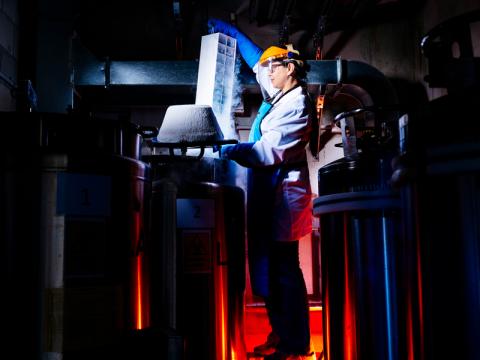
Image: University of Queensland PhD researcher Astrid Nausa Galeano collecting a cryovial of cells from a liquid nitrogen storage tank. Credit: The University of Queensland
“For certain patients, lab-grown blood could be an exciting opportunity to complement donation,” explains Mark Allenby, a biomedical engineer at UQ. “Lab-grown red blood cells could hold various advantages over a typical blood donation, including that all the cells have just begun their four-month lifespan.”
Despite benefits ranging from a longer shelf life to solving rare blood type shortages and easing donor dependency, the cost of lab-grown blood is prohibitive. It currently requires a few weeks and around £40,000 to manufacture just a few teaspoons of lab-grown blood. If scientists grew the same amount of blood as is found in a typical donation, it would require a tennis court covered with cell culture flasks and a million-pound budget.
“Outside of regulatory approval, a big hurdle right now is scale,” says Rebecca Griffiths, research programme head for cellular therapies at Lifeblood. “The human body can grow about 2 million red blood cells a second. So, you can see we need to be able to make lots of cells quickly. This is the focus of much of our research – improving the manufacturing efficiency of lab-grown blood.”
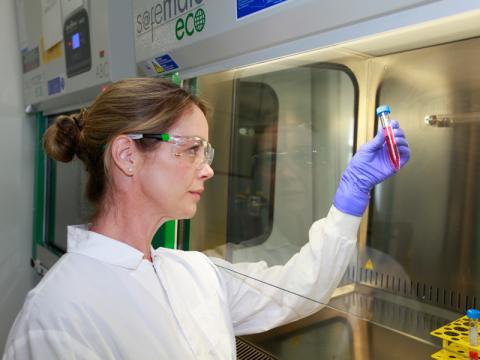
Image: Lifeblood researcher Becky Griffiths with lab-grown blood. Credit: Australian Red Cross Lifeblood
To address this challenge, researchers are turning to collaborative models that break down traditional silos between academia and industry. This is where SMART CRC plays a pivotal role. Established to overcome the barriers that can prevent promising regenerative therapies from reaching patients, SMART CRC is a $238 million (£179 million) Australian initiative between industry, government and research to fast-track the development and translation of regenerative therapies to get treatments to patients sooner. The project between Lifeblood, UQ and SMART CRC is a four year, $2.5 million (£1.85 million) collaboration to produce lab-grown red blood cells at scale.
“One of the biggest challenges in regenerative therapies is not simply discovering promising new therapies but also turning those discoveries into treatments that can be manufactured reliably, efficiently and affordably,” says Simon Cool, CEO of SMART CRC and professor of bioengineering. “A scientific breakthrough alone is not enough. Collaborative models like SMART CRC help solve the practical barriers to collaboration between researchers, government and industry.”
The implications of this research extend far beyond haematology. As Allenby and his team optimise their processes before scaling up for clinical-grade certifications, their engineering solutions could pave the way for more affordable, advanced therapies across the broader healthcare landscape.
“Our research involving lab-grown blood is also relevant to many emerging cell and gene therapies promising to remedy previously incurable diseases, but that cost hundreds of thousands and even millions per dose – a cost out of reach for many patients in need,” Allenby says. “Without engineering more efficient manufacturing technologies, these lifesaving therapies will remain unable to reach the patients who need them.”