
How research at the University of Queensland is driving innovative vaccine development
At the University of Queensland, research into an insect-specific flavivirus platform offers hope of commercial-scale vaccines for vector-borne diseases

Sponsored by the University of Queensland


Sponsored by

Sponsored by
Image credit: University of Queensland.
University research has a long history of leading to healthcare breakthroughs. The invention of MRI technology, the discovery of insulin and the development of antibiotics can all trace their roots to work undertaken within the higher education sector. At the University of Queensland (UQ) in Australia, research into a novel approach to vaccine development promises to be the latest.
Jody Hobson-Peters, associate professor, and Henry De Malmanche, research officer, are both based in the School of Chemistry and Molecular Biosciences at UQ. They are working on an insect-specific flavivirus platform, a recombinant platform for flavivirus vaccines and diagnostics. It’s hoped that this research will support the development of safe, adaptable and scalable vaccines for various mosquito-borne diseases.
“The flavivirus platform is based on engineered insect-specific, or more accurately, mosquito-specific viruses,” explains Hobson-Peters. “These viruses occur naturally within mosquito populations but, critically, they lack the capacity to replicate in mammals, meaning they are essentially harmless. Our core innovation lies in creating chimeras – hybrid viruses – that are modified to look identical to a human or veterinary pathogen while retaining the non-pathogenic replication machinery of the insect-specific virus. This means they are safe to handle and manufacture.”
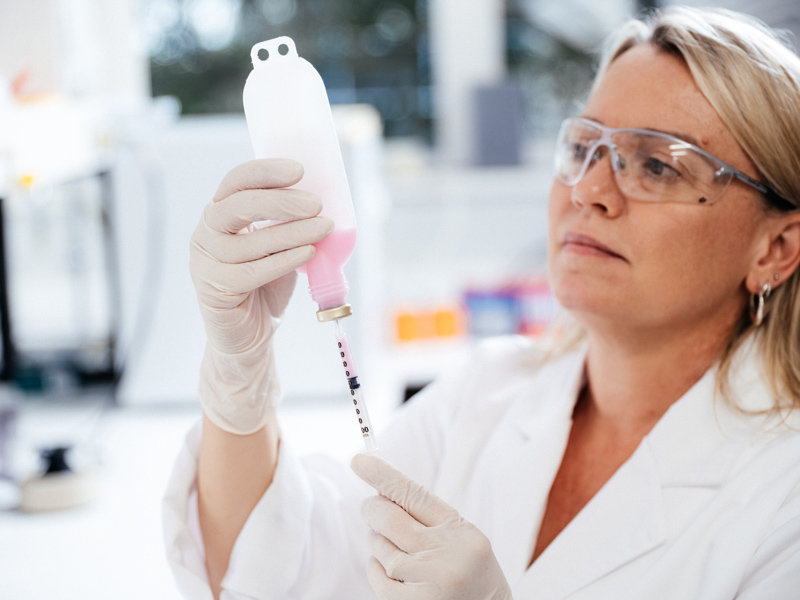
The platform enables the easy exchange of genes that code for the exterior proteins of the virus with those of significant human and veterinary pathogens, including Japanese encephalitis, Dengue and Zika. This process produces essential vaccine particles that look identical to the target pathogen. Since the immune response primarily targets the proteins found on the outside of viruses, this mimicry makes the vaccine particles exceptionally potent.
University resources, particularly UQ’s Protein Expression Facility (PEF), have been instrumental in preparing the flavivirus platform for industry-scale production. The PEF, based in the Australian Institute for Bioengineering and Nanotechnology, offers state-of-the-art resources, including scalable bioreactor models for testing manufacturing processes prior to full scale-up.
The research being undertaken by Hobson-Peters, De Malmanche and their teams is highly relevant due to the significant impact of vector-borne diseases, which account for over 17 per cent of all infectious diseases worldwide. These are not only transmitted by mosquitoes but also by ticks and Culicoides flies.
“Our platform has a wide scope, being suitable for both mosquito-borne and tick-borne pathogens,” Hobson-Peters explains. “The constant and often massive outbreaks of diseases like Dengue, Chikungunya and Japanese encephalitis demonstrate the immediate need and relevance of this research, which aims to protect a large number of people and livestock.”
As many healthcare advances have shown, the greatest impact often arises from collaborative endeavours. Partnerships with government and industry have been vital in driving the translation of UQ’s flavivirus platform from the lab to the real world. One key partnership has been with the Australian pork industry, which was recently impacted by outbreaks of Japanese encephalitis but lacked a veterinary vaccine.
“The team has also recently partnered with a veterinary vaccine manufacturing company, Tréidlia Biovet,” explains De Malmanche. “They have licensed the technology to this industry partner, who can then manufacture commercial or research-grade veterinary vaccine batches. This partnership is what has enabled the technology to move closer to commercialisation.”
The primary future focus is on readying the platform for human vaccines, with the ultimate goal of combating mosquito-borne disease globally. Through their work on the veterinary vaccine, the UQ team has already achieved significant milestones in transitioning the platform from a laboratory-scale operation to one that is industry-ready.
“The overarching hope is to use our unique, innovative platform to enable cheap, safe and effective vaccines for both humans and animals against mosquito-borne viral disease,” says Hobson-Peters. “Another key ambition is for the platform to be rapidly deployed to respond to new or novel outbreaks of mosquito-borne diseases, acting as a next-generation vaccine platform that is ready for quick deployment.”