
Upcycling waste for greener construction materials
Researchers at the United Arab Emirates University have transformed three sources of waste into one remarkable composite with insulating properties that could support sustainable, energy-efficient construction
Sponsored by United Arab Emirates University


Sponsored by
Sponsored by
Our world is overflowing with waste. Creating a more sustainable society is not just a question of minimising waste generated by industry and consumers but also finding ways for it to be reused. We need to take this waste, process it and turn it into something new – something economically valuable.
Although this great abundance of waste is a problem, it nonetheless creates opportunities – particularly for materials scientists, for whom waste can be an invaluable resource. At the United Arab Emirates University (UAEU), researchers have created an all-new composite material comprising three waste products – ground volcanic rock, polylactic acid and date palm waste – combined with silica sand as a filler. The resulting material is hugely promising for supporting energy-efficient construction. UAEU has already filed a patent for the composite.
Ali Al Marzouqi, dean of UAEU’s College of Graduate Studies, believes it opens another waste-to-resource pathway that can support the university’s goal of contributing to a circular economy. And there is no shortage of supply. “We have over 40 million date palm trees, and every tree generates about 20 kilogrammes of waste,” says Al Marzouqi. “Then, of course, plastic and polymer waste is everywhere.”
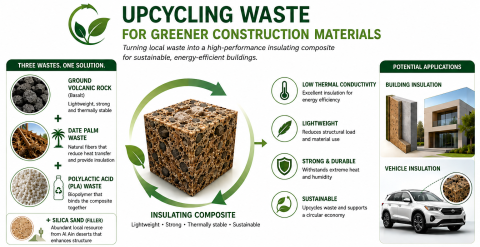
Each of these materials is found in the local region and was selected for its unique properties. The ground volcanic rock is basalt, which means it is super lightweight, thermally stable and strong. Meanwhile, date palm waste has properties that reduce heat transfer, making it an excellent material for insulation. The polymers bind the composite together, and the deserts around Al Ain city provide the silica sand.
Researchers at UAEU have a strong track record of developing new materials from date palm waste. This composite, however, was something completely new. Combining three waste materials was a significant undertaking. “The real surprise that we had was to be successful in making this composite actually exist,” says Waleed Ahmed, associate professor in the Engineering Requirements Unit at UAEU. “We hadn’t ever thought that combining three waste materials would be a successful idea. Maybe two is possible, but with three, it needs a massive effort and experimentation before it becomes a successful idea.”
The project was funded entirely by UAEU. It required collaboration between scientists from many departments. “This is the strength of our team,” says Ahmed.
The next step is to trial the composite more widely to see how it performs in the real-world environmental conditions of the UAE, where there is extreme heat and humidity. Besides construction, one use for the composite might be found in insulating vehicles. In a region that relies on air conditioning to cool its buildings and transport systems, more effective insulation is essential for lowering energy consumption.
“There’s a lot to be done in the next step of the process, but we are very excited,” says Al Marzouqi. “Because we will be helping the community. The most important thing is that we are using waste generated by industry and reducing some of the burden on them”