
Understanding multiple sclerosis: The search for answers to an epidemiological puzzle
The global prevalence of multiple sclerosis is on the rise, and this has serious consequences for those who live with the disease and our healthcare systems. At the United Arab Emirates University, researchers are building a profile of the disease by studying risk factors such as Epstein-Barr virus and low vitamin D levels

Sponsored by United Arab Emirates University

Sponsored by

Sponsored by
Multiple sclerosis (MS) is a complex and serious autoimmune disease for which there is no cure, and its prevalence is rising globally – especially in countries with advanced economies. Scientists need to know why. Understanding multiple sclerosis is key to mitigating its effects with better diagnostics, improved treatments, or even a cure.
The good news is that scientists are learning all the time. Gulfaraz Khan, a professor at the United Arab Emirates University’s College of Medicine and Health Sciences, specialises in viral pathology with 30 years of experience. Since 2010, MS has been one of his main focuses of research.
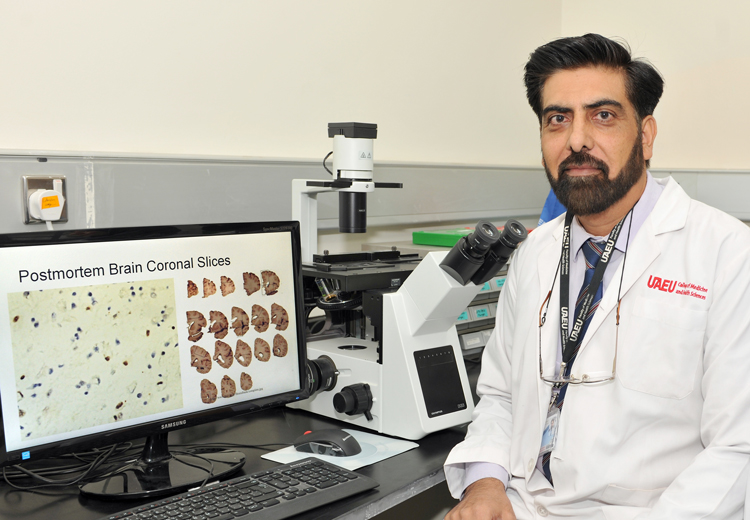
Building on epidemiological data that identified a link between Epstein-Barr virus (EBV) and MS, Khan began by examining brain tissue in MS patients. Early findings were encouraging but he needed more brain samples. He found them by posting on LinkedIn. “Of all the places, LinkedIn,” he says. “Some people responded, ‘I’ve got 10 samples. I’ve got 20 samples.’ But I wanted serious numbers.” He was in luck. A neurologist from Colorado in the US had been collecting brain tissue since the early 1970s and was willing to donate.
“The excitement was overwhelming,” says Khan. “We analysed something in the order of a thousand brain samples from MS and non-MS patients. We found that 90 per cent of the patients had the virus in the brain. You could directly see the virus-infected cells in the brain. That was one of the biggest studies of its kind ever conducted and it was published in 2018.”
A subsequent study by Harvard involving 10 million subjects further supported Khan’s findings. The EBV link was clear. “But when 90 per cent of the world’s population has EBV – a virus that we have for life, lying dormant in our cells – the question is why some people develop MS and the majority do not? What is the mechanism by which EBV leads to the development of MS? Could a vaccine against EBV prevent MS? And why is it on the rise? These are some of the fundamental questions we need to address,” says Khan.
One theory is that sunlight plays a part. Sweden, Canada and Norway have the world’s highest prevalence of MS. Khan’s research revealed regional disparities, even within the same country. Northern states in the USA had a higher prevalence than southern. “That brings us to vitamin D,” he says. “If there’s less sunlight, could it be that vitamin D is lower and therefore playing a role? Low vitamin D may exacerbate MS. How does vitamin D interact with EBV?” Khan asks.
There are many other factors to consider, such as genetics, lifestyle and age. Longer life expectancies and better diagnostics might account for the rising global prevalence. Khan hopes that eventually science will give MS nowhere to hide, that it could be mapped to within a five-mile radius, worldwide, yielding data that explains its epidemiology and risk factors in full. But he cautions that this research is complex. In science, there are no easy answers. “I can bet my life on it, it’s not going to be a single factor,” he says. “It is going to be multiple factors that seem to come together.”