
Save the date: how sustainable innovations are transforming biowaste
Researchers at the United Arab Emirates University are turning waste from date palm production into advanced materials, using novel methods of extracting nanocellulose from material that might otherwise be burned, and proving why – in a circular economy – there is no such thing as waste
Sponsored by United Arab Emirates University

Sponsored by
Sponsored by
The United Arab Emirates is the world’s fifth-largest producer of dates. You will find 120 varieties grown on farms across the country. It is a great agricultural success story, but the UAE’s date palm production also has the potential to support a number of the UAE’s sustainability initiatives. Scientists are exploring groundbreaking techniques that can transform date palm waste into advanced biomaterials that can be used in green construction, or biofuels that could provide a viable alternative to hydrocarbons.
At the United Arab Emirates University (UAEU), researchers have pioneered several approaches for turning date palm waste into something useful, and it is a win-win for the environment. Basim Abu-Jdayil, a professor at UAEU’s Department of Chemical and Petroleum, believes date palm waste could be an economically significant biomass. And there is plenty of it to go around.
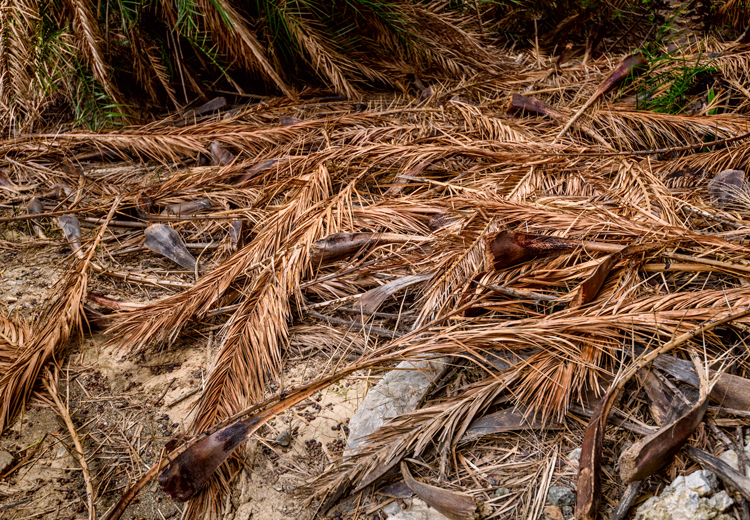
“We have a lot of this date palm waste – approximately 40 million trees – and each tree produces 20 to 30 kilograms of waste,” says Abu-Jdayil. “Most farmers burn it.”
In the laboratory, however, Abu-Jdayil and his research colleague Mohammad Jawaid, also a professor in the Department of Chemical and Petroleum Engineering, are turning this waste into lignin, green thermal insulation and bio-resin.
They are refining the methods for extracting nanocellulose from date palm waste. Nanocellulose can be used in myriad real-world applications, particularly in advanced materials and the creation of lightweight composites. You can make eco-friendly cutlery and packaging out of it. It is biocompatible; the biomedical sector has already found a number of uses for it, such as implant design and biosensors. Above all it is strong. Its strength-to-weight ratio is better than steel.
Traditional methods of extracting nanocellulose from date palm waste involve hydrolysis using sulphuric or hydrochloric acids, an approach that can suffer from low yields, the corrosion of equipment and the generation of pollutants. Abu-Jdayil and Jawaid’s approach uses a green solvent – ionic liquid and natural deep eutectic solvents – which offers a more sustainable and equally efficient alternative.
Scaling these initiatives remains a crucial question. It will require collaboration, investment and long-term commitment from key stakeholders. There needs to be a campaign to raise awareness of the socio-economic benefits of using green materials, and regulations placed in building codes that promote sustainable materials. Date palm waste is theoretically free, but it costs money to collect, ship and store it. Projects such as this need infrastructure and a market to support them, and a regulatory framework that incentivises companies to use these materials.
The UAE is steadily progressing toward a more sustainable and waste-conscious future. According to Jawaid, biowaste materials have significant potential for use in industries such as construction, building materials and packaging. A recent policy announcement to ban single-use plates, food bowls and plastic cutlery by 2026 reflects this shift.
Date palm biowaste, in particular, holds promise as a viable alternative in the biodegradable packaging sector. With the implementation of appropriate policies and regulations, the adoption of such eco-friendly solutions is expected to grow.