
Not a drop to waste: how computational power is helping conserve at-risk water supplies
Saltwater intrusion in groundwater supplies is a real and present concern for arid regions. Scientists at the United Arab Emirates University have taken a deep learning approach to designing a predictive model that can support water management

Sponsored by United Arab Emirates University

Sponsored by

Sponsored by
Water is a desert community’s most precious resource, and it is under increasing pressure. In the United Arab Emirates, the desert aquifers that provide coastal cities with fresh groundwater are becoming ever more vulnerable to the effects of climate collapse and human activity. These great reservoirs of groundwater can be contaminated by saltwater intrusion from rising sea levels, or over-pumping from spikes in demand. Science can protect them.
Mohsen Sherif, deputy vice-chancellor for academic affairs and professor of water resources at the United Arab Emirates University (UAEU), leads a research team that has developed a deep learning framework that serves as a predictive tool to improve water management. This predictive tool maps saltwater intrusion spatially and forecasts its variations throughout the hydrological year. “The water shortage problem in the United Arab Emirates is at the top of the agenda for research because of the current emphasis on food security and agricultural productivity,” says Sherif. “Without sufficient water, you cannot achieve full food security at a country-wide level.”
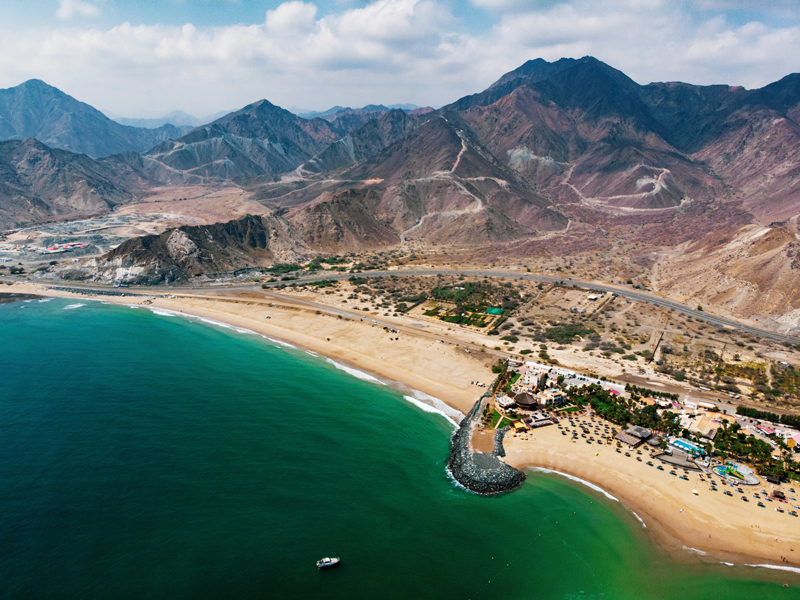
Sherif’s team trained the AI models using more than 14,000 daily records from 16 coastal wells in the Emirate of Fujairah, on the UAE’s east coast. Partners in government agencies helped the team find the data they needed.
Faisal Baig, a postdoctoral fellow in the Desert Environment Research Center, co-authored the paper. He describes the UAE as an especially challenging environment. It’s an arid land with no permanent river, where rainfall is unpredictable and surface water evaporates quickly under a hot desert sun. “Because the reliable surface water is limited, pressure on the groundwater resources is naturally much greater,” he says. “This groundwater acts as a strategic buffer in a country where we do not have surface water availability throughout the year.”
Modelling seawater intrusion is computationally demanding. The UAEU team designed a hybrid ensemble model comprising four deep learning neural networks and fine-tuned it using performance weighting to improve its predictive accuracy.
This is a complex environmental problem to model, but the research group found that such complexity was not always best served by the most state-of-the-art AI model. “The best model is the one whose structure matches the behaviour of the environmental system that is under study,” says Baig. For predicting groundwater salinity, the model that tracks how conditions evolve proved to be more valuable.
Predicting saltwater intrusion is only part of the challenge. This information can inform policy choices, particularly around human activities that exacerbate saltwater intrusion. “Anthropogenic activities are the main driver through over-extraction or over-pumping,” says Assaad Hassan Kassem, who co-authored the paper during his doctoral studies. “Integrated water resource management is very important in order to optimise the process and exploit these resources properly and in a sustainable way.”
Moving forward, the team aims to scale their efforts by adapting these methodologies for use locally and globally. Applying similar predictive frameworks will improve the management of water resources, particularly when it comes to protecting vital groundwater supplies..