
How carbide slag could be a key material for carbon capture
A waste material such as carbide slag is only waste because we have yet to find a use for it. Researchers at the United Arab Emirates University have successfully demonstrated how it can be used to support carbon capture on an industrial scale

Sponsored by United Arab Emirates University

Sponsored by

Sponsored by
Industry produces significant amounts of carbide slag, much of which ends up in landfill where it can contaminate groundwater supplies. But this waste could be put to use instead. Carbide slag’s alkalinity and extreme reactivity make it a promising substance for carbon capture.
In nature, alkaline earth metals react with carbon dioxide in the atmosphere to form stable carbonate minerals. The rising levels of carbon dioxide in our atmosphere require a more urgent response, and so scientists have developed a mineral carbonation process that takes just hours to do what takes nature years. At the United Arab Emirates University (UAEU), researchers have demonstrated that carbide slag is a viable candidate for industrial carbon capture.
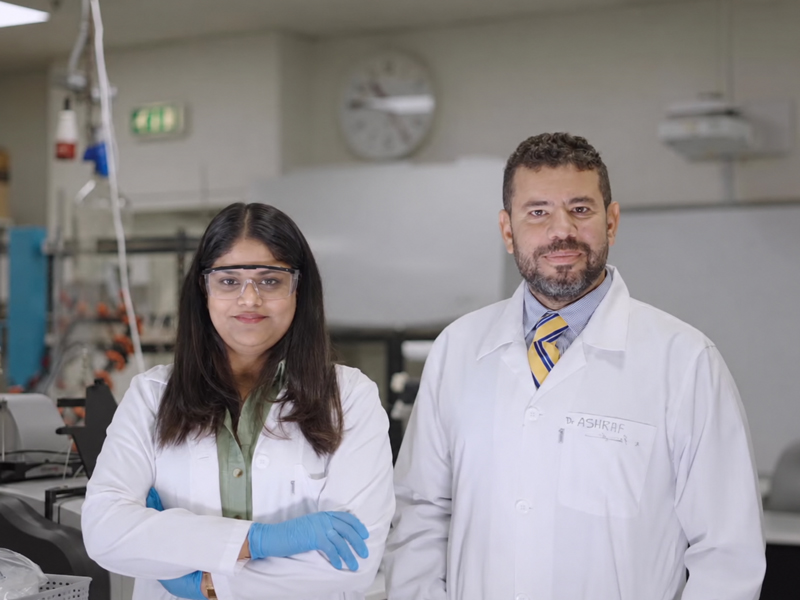
Manisha Sukhraj Kothari spent five years on the project, which later became her PhD thesis. The project started when UAEU’s industry partners reached out to the university with a problem.
“They wanted to do something with this waste material and they did not know what to do,” says Kothari. “They had to pay waste management companies to dispose this waste. So, they came up with the problem, and we came up with the solution.”
Kothari and her team learned that the composition of the carbide slag was scientifically significant. The carbide slag was rich in calcium hydroxide, which reacts with carbon dioxide to form calcium carbonate, a base material used in construction – particularly for cement production. Next, they had to work out how to accelerate this reaction.
Some methods require unsustainably high temperatures. With so many variables involved – including temperature, pressure and liquid-to-solid ratio – the team set up experiments and used software that allowed them to do the work of up to a thousand experiments in just 50.
If this carbon sequestration process is going to make a difference, it needs to be applied in industry. Ashraf Aly Hassan, associate professor of civil and environmental engineering at UAEU, says the science is the easy part. Finding industrial partners to further develop the technology and scale it for commercialisation is the greater challenge. Many investors might say they are interested – they can see the potential – but being interested and being willing to risk their capital are two different things.
“You cannot get it proven and ready on an industrial scale unless you actually try it out,” says Aly Hassan. “You always are stuck in this loop. Who will adopt it? Or who will pay for it to demonstrate that it works so that it’s proven? And then others can adopt it and use it.”
There are also more avenues of scientific enquiry to follow. The team has demonstrated the potential of carbide slag, but they want to understand how this reaction behaves in real industrial conditions. Emissions contain other pollutant gases. They need to learn how the other chemicals in this gas might compete with carbon dioxide and affect the reaction.