
THE Connect podcast: How immersive technology enhances learning outcomes and student engagement
Queen’s University Belfast is ushering in a new era for its teaching with immersive learning environments that allow health and social care students to dig deeper into their subjects and develop essential workplace skills – and it all begins with clearly defined learning goals and collaboration

Sponsored by Queen's University Belfast

Sponsored by

Sponsored by
Digital technologies present universities with the means to transform the learning experience. The question is how to fully exploit the opportunity. All too often, digital innovations are rolled out then abandoned – and they fail because they have been designed without the direct involvement of those who will be using them.
At Queen’s University Belfast, the Centre for Technological Innovation, Mental Health and Education (TIME Centre) involves everyone. On an episode of the THE Connect podcast, TIME Centre director Paul Best explained how the university’s tech partners work with clinicians, health and social care professionals and educators to develop tools that offer more immersive and authentic educational experiences.
“That means that research questions, the design and the technology, and also the evaluation methods are all shaped by real-world needs,” Best said. “Our work becomes less abstract by working with the people who are going to take it and use it.”
Once a tool is developed, the TIME Centre rigorously tests it. This builds trust in the technology, gathering evidence that novel modes of training are helping students prepare for clinical settings – and ultimately improving patient care and outcomes.
Healthcare is inherently interdisciplinary. A patient’s journey might see them in consultation with a social worker and psychologist, before receiving specialist treatment. Janine Stockdale, lead midwife for education at Queen’s University Belfast, believes one of the TIME Centre’s greatest strengths lies in its cross-disciplinary approach to designing the digital tools that are augmenting students’ learning environments.
“We have really benefited from engaging with team members across the university, and across multiple professional disciplines,” Stockdale said. “The issues that were grappling with are so complex. You just can’t stay within a disciplinary silo and hope to do anything meaningful.”
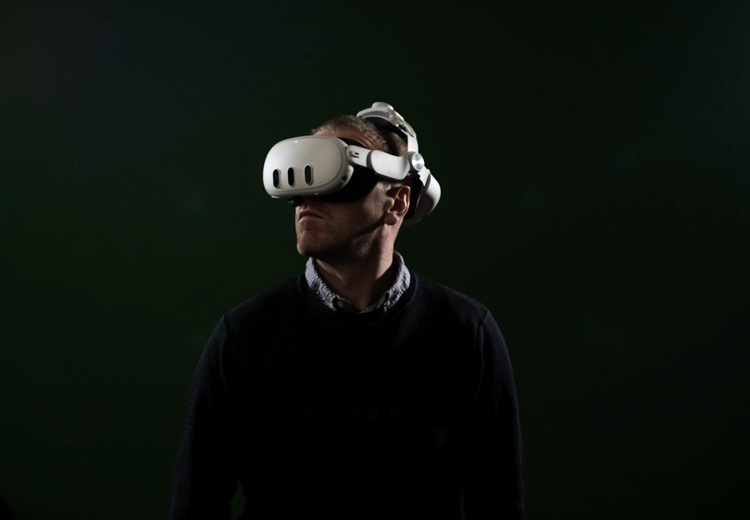
Technology is allowing the TIME Centre to offer truly immersive learning experiences. Students might wear headsets to be presented with a 360-degree simulated environment. Learning scenarios can be presented in virtual reality (VR), and with AI, learning design can go where the human cannot, simulating real-world scenarios in areas such as child psychology. “That’s very difficult for us to replicate. We can’t really bring child actors in,” Best said. “Role playing it always feels a wee bit fake.”
What makes these immersive teaching modalities so effective is that their design is guided by learning goals, placing the student’s experience at the heart. “You’ve got to put a lot of effort into getting those learning goals absolutely right,” Stockdale said. “If you don’t, you lose their psychological safety from the beginning. They need to know exactly why they’re going into something like a VR environment.”
The technology is impressive. But the novelty of the modality cannot overshadow the lesson that is being taught. The TIME Centre’s educators build trust and buy-in from students by discussing learning goals and explaining the impact of these immersive experiences – and that’s making the most of the technology’s potential.