
Opening a New Era of “Food as Medicine”! Chair Professor Jian-Kang Zhu’s Team at MUST Develops a Multi-Nutrient-Fortified Functional Tomato Containing Seven Key Nutrients
Recently, Chair Professor Jian-Kang Zhu, Vice-Chancellor and President of Macau University of Science and Technology (MUST), together with a research team from the Southern University of Science and Technology (SUSTech), published a major research finding in the prestigious international academic journal Proceedings of the National Academy of Sciences of the United States of America (PNAS).

Sponsored by
Sponsored by
Using advanced precision breeding technology, the team successfully developed a new generation of “functional tomato”, known as the 5m tomato, which is rich in seven key nutrients. Even more remarkably, animal experiments showed that the tomato has significant potential to inhibit the growth of colorectal cancer cells.
If we want to make our everyday diet more nutritious, vegetables that people eat every day are an ideal vehicle. As one of the most widely consumed vegetables in the world, tomatoes were a natural choice for the scientists. Although ordinary tomatoes already contain a number of beneficial nutrients, their concentrations are relatively low. Trying to obtain sufficient daily nutrients simply by eating ordinary tomatoes could require consuming a very large quantity.
Scientists have previously attempted to “upgrade” tomatoes using genetic modification, but these efforts often focused on improving individual nutrients. For example, increasing vitamin C could come at the expense of lycopene levels.
This time, Chair Professor Jian-Kang Zhu’s team used precision breeding technology as a highly targeted “molecular tool”. Rather than introducing any foreign genes, the researchers precisely modified the tomato’s own genes. For the first time, they achieved the simultaneous enhancement of multiple nutritional pathways within a single tomato.
To create the tomato, code-named 5m, the research team precisely regulated four nutrient-biosynthesis pathways in the tomato, successfully increasing the levels of seven health-promoting nutrients.
First is vitamin D. By modifying a key gene, the team enabled the tomato to accumulate precursors of vitamin D, which can be converted into active vitamin D3 after exposure to sunlight or ultraviolet light. Ordinary tomatoes do not contain these compounds. Vitamin D is important for maintaining healthy bones and supporting immune function.
Next is GABA, a compound associated with stress relief. By modifying a key enzyme, the researchers increased the GABA content by more than fivefold. GABA has been associated with stress reduction, improved sleep and blood-pressure regulation.
The researchers also enhanced a group of carotenoids with antioxidant and eye-health benefits. By removing restrictions on their biosynthesis, they increased lycopene levels sevenfold, raised beta-carotene — a precursor of vitamin A — by nearly fourfold, and substantially increased lutein and other compounds associated with antioxidant and anti-ageing effects.
Finally, the researchers increased vitamin C. By removing the “brakes” imposed by two genes, they doubled the tomato’s vitamin C production.
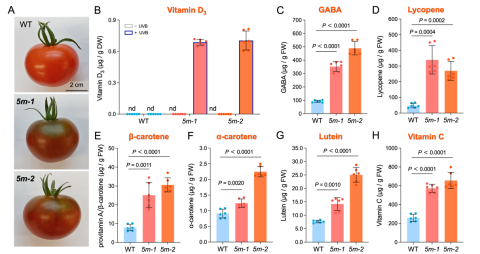
Precision breeding significantly increases seven functional metabolites in tomato fruit
The 5m tomato developed in the laboratory has a distinctive and appealing reddish-brown appearance.
The research team calculated that the tomato has a very high nutritional density. Eating just one 5m tomato (approximately 30 grams, about the size of a cherry tomato) each day could provide the recommended daily amount of vitamin A and lycopene. Eating four could provide the recommended daily amounts of vitamin C and vitamin D.
Even though the concentrations of these nutrients have increased several-fold, the 5m tomato plant’s height, fruit size, sweetness and taste are comparable to those of ordinary tomatoes. This means that the nutritional improvements do not require sacrificing the tomato’s taste.
Beyond its enhanced nutritional profile, the research team also explored the potential of the tomato for disease prevention and health management.
In in vitro cell experiments, extracts from the 5m tomato demonstrated strong activity against colorectal cancer cells, significantly inhibiting their growth and migration.
To investigate whether these effects could also be observed in living organisms, the researchers established colorectal cancer tumour models in mice and conducted a 21-day tomato-feeding experiment.
The results showed that, compared with mice fed ordinary tomatoes, mice fed 5m tomatoes had significantly smaller tumour volumes and lower tumour weights.
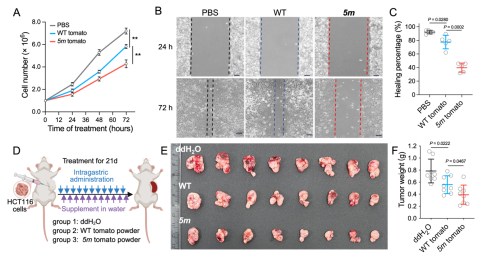
5m tomatoes significantly inhibit the growth of HCT116 cells and tumours in mice
These findings suggest that the substantially increased nutrients in the 5m tomato may work together rather than independently.
The increased levels of lycopene, vitamin C and beta-carotene form a strong antioxidant network that can help eliminate free radicals and suppress chronic inflammation, while vitamin D3 plays an important role in immune regulation. Together, these components may produce a synergistic health-protective effect.
The significance of this research lies not only in the creation of a “super tomato”, but also in its potential to provide a model for the future development of “Food as Medicine” and proactive health management.
Compared with chemically synthesised pills, nutrients naturally contained within food are delivered within plant cells and can be consumed as part of a tasty, natural diet. This represents a shift from the concept of “taking supplements” to “eating the right foods.”
In the future, this precision breeding technology could potentially be extended to staple crops such as rice, wheat and maize — foods that people consume every day.
Perhaps in the not-too-distant future, instead of relying on a table full of health supplements, people could simply incorporate more nutrient-enhanced “super crops” into their daily meals to support their health in a simple and natural way.
Paper and Research Team Information
Journal: Proceedings of the National Academy of Sciences of the United States of America (PNAS)
Paper title: Multiplex gene editing enables the multi-biofortification of essential vitamins and other health-promoting phytonutrients in tomato
Paper: https://www.pnas.org/doi/10.1073/pnas.2603937123
Research team:
Hong Yechun, Yu Zongjun, Zhu Wenbo and Sun Jialei from SUSTech are co-first authors of the paper. Hong Yechun and Chair Professor Jian-Kang Zhu of MUST are co-corresponding authors.
The research was also supported by Zhu Zeyao, Cao Minjie, Lü Yuxuan, Lang Zhaobo, Liu Pengpeng, Wang Zhen and other scholars.
The research received funding from several sources, including the National Natural Science Foundation of China and ky research and development programmes of the Ministry of Science and Technology of China.