
Expanding academic collaboration in Central Asia
Harbin Institute of Technology’s partnership with institutions in Uzbekistan and Kyrgyzstan will ensure fruitful educational collaboration and talent exchange for years to come

Sponsored by Harbin Institute of Technology

Sponsored by

Sponsored by
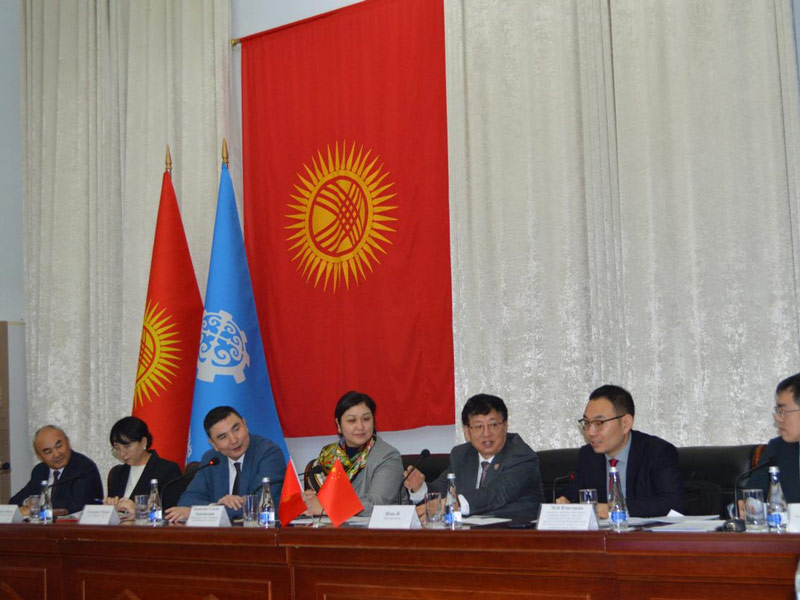
In January 2026, Yi Shen, vice-president of Harbin Institute of Technology (HIT), led a delegation to Uzbekistan and Kyrgyzstan in a bid to boost collaboration and exchange among the Shanghai Cooperation Organisation (SCO) states. The visits were part of a wider effort to enhance educational, research and talent exchange between China and Central Asian countries.
Shen and a team of senior researchers first visited New Uzbekistan University (NUU) in Tashkent, where they attended a science and technology seminar. The event brought together doctoral researchers and scientists to explore collaboration in engineering and applied sciences. The universities are keen to build on this foundation through more exchange programmes and visits. In 2025, a group of 20 NUU students completed academic visits to HIT, with another 100 scheduled to attend HIT’s Global Summer School in 2026.
The next stop for the delegation was Kyrgyz State Technical University in Kyrgyzstan, where they met with Yu Jun, Chinese ambassador to Uzbekistan, and Sun Dapeng, counsellor at the Chinese Embassy in Kyrgyzstan. A key focus of the visit was promoting joint talent training through the China-SCO Doctoral Training Innovation Center. This is a collaborative platform designed to facilitate exchanges between faculty and students at different institutions. Its objectives include strengthening educational cooperation and promoting innovation in fields such as AI, energy and digital economy.
The centre was inaugurated in 2025 with an opening ceremony at HIT, welcoming its first cohort of 120 doctoral students from elite universities in SCO member states. They come from institutions such as HIT, Peking University and Tsinghua University in China, Saint Petersburg State University in Russia, Kyrgyz State Technical University and Belarusian National Technical University. Batir Tursunov, deputy secretary general of the SCO, called it “a milestone in educational integration”. Tursunov believes it will advance talent cultivation, support innovation strategies and promote better integration of industry, academia and research, giving new impetus to scientific and educational cooperation.
Shen stated that HIT is keen to expand its areas of cooperation, deepen scientific and educational collaboration and strengthen interdisciplinary projects with other universities.
Advancing such joint initiatives is important for China’s wider educational strategy, as the country focuses on increasing its impact in global academic research and the number of world-class graduates. Jie Chen, secretary of the party committee at HIT, said that the centre will foster a “high-calibre, global-minded and interdisciplinary pool of young talent in science, technology and the humanities”.