
Building a bridge between global cultures
Hosted by Harbin Institute of Technology, the first international ice dragon boat race was the centrepiece of a series of culturally enriching activities between UK and Chinese universities

Sponsored by Harbin Institute of Technology


Sponsored by

Sponsored by
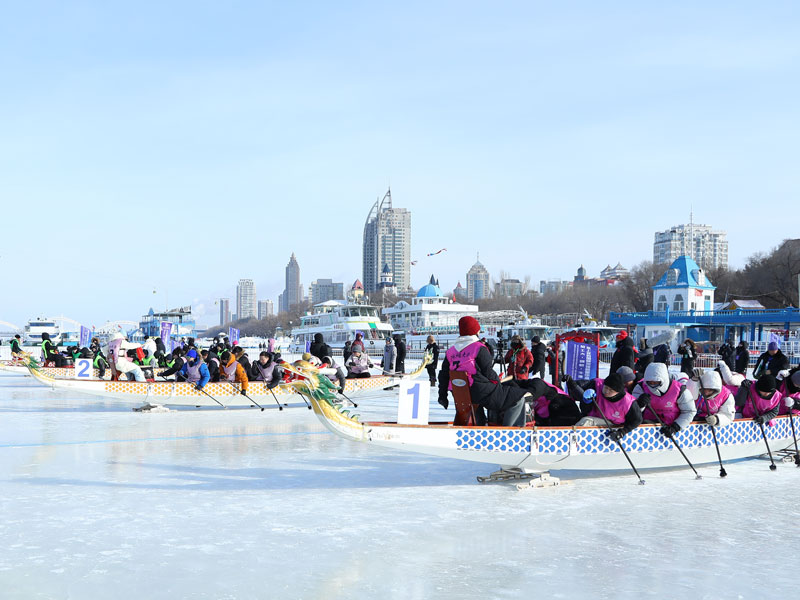
In January 2026, Harbin Institute of Technology (HIT) in China hosted the inaugural international ice dragon boat race as part of a wider youth cultural exchange initiative. Unlike traditional water dragon boating, ice boating requires athletes to use ice picks to propel the boat forward on solid ice. Fourteen teams participated in this first-of-its-kind event, which took place on the frozen Songhua River in Harbin.
Called the HIT-Cambridge-Oxford Cup, the event brought together students and representatives from various institutions, including the universities of Oxford and Cambridge in the UK, several C9 League universities in China and universities from Hong Kong and Macao.
“Dragon boats embody unity, progress and excellence in traditional Chinese culture, which align perfectly with the British spirit of courage, courtesy and responsibility,” said Jie Chen, secretary of the party committee at HIT. The university’s vice-president, Yong Shuai, attended the ceremony and presented badges to participants from the UK.
Students from different universities performed a song and dance routine and participated in an interactive self-portrait game where they were paired up to sketch their teammates. They learned about traditional Chinese fish skin painting, which involves intricate techniques of material selection, processing, cutting and pasting. They also visited the HIT Museum, the university’s Aerospace Museum and the Space Environment Simulation and Research Infrastructure located in Harbin. One of the highlights was a visit to the Warm Corridor at HIT, an interconnected walkway system designed to protect students and staff from the extreme cold in Harbin.
Edward Townsend, a student at the University of Cambridge, said the event was an eye-opener. “Through visiting the HIT Museum and the aerospace museum and exchanging ideas with HIT students, I gained a deeper understanding of HIT’s outstanding achievements in aerospace and other fields,” said Townsend. “I was deeply inspired by HIT students’ dedication to academic pursuits and their innovative spirit.”
Elena Andree, a student at the University of Oxford, said that the experience gave her a new understanding of Chinese higher education and the campus culture at HIT. “I not only learned intangible cultural heritage skills but also gained friendships that transcend national borders,” she said. “HIT is like a melting pot, allowing people from different cultural backgrounds to blend together and grow together. This will be a very precious memory in my life.”
Officials from China’s Ministry of Education celebrated the event for broadening international cooperation and cultural connections through education and sport. One of the main objectives of China’s 15th Five-Year Plan is to expand the impact of the country’s higher education sector globally. "I hope that the gathering on ice would serve as a positive beginning for youth exchanges between China and Britain, as well as an important link for universities to expand cooperation and jointly nurture talent,” said Yang Dan, director of the ministry’s Department of International Cooperation and Exchanges, in a video address shown during the opening ceremony.