
When Do Green Absorptive Capacity and Ambidextrous Open Innovation Foster Sustainable Performance
Researchers identify key capabilities driving environmental performance and competitiveness in Korean manufacturing firms

Sponsored by
Sponsored by
As sustainability becomes a core requirement for businesses, many firms still struggle to effectively implement green practices. In a recent study, researchers from Korea examined how companies can better absorb and apply environmental knowledge by surveying and analyzing data from 200 Korean manufacturers. They found that green absorptive capacity—combined with inbound and outward open innovation—significantly boosts environmental performance and competitiveness, providing a practical framework for businesses and policymakers aiming to accelerate sustainable transformations.
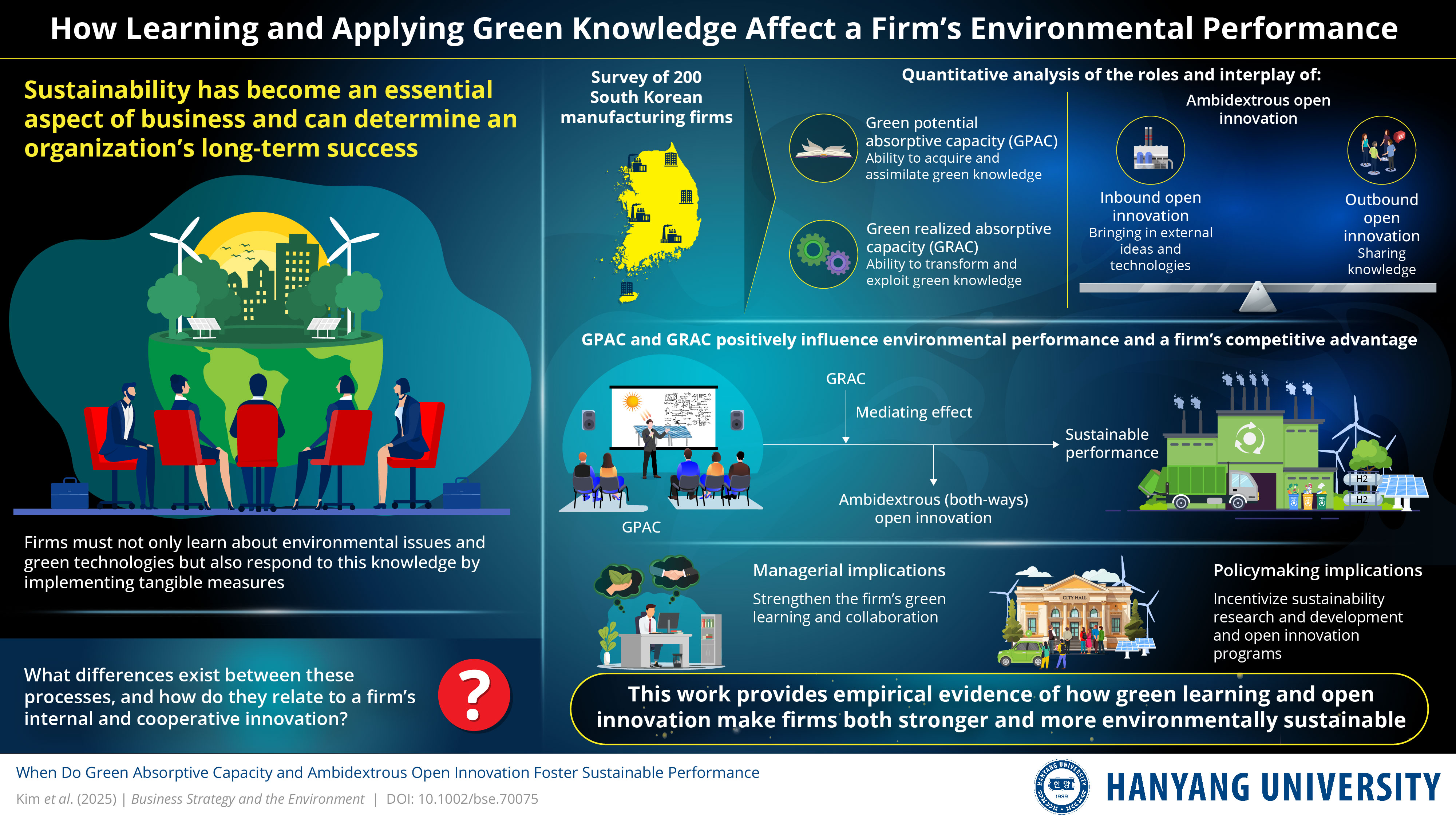
Image title : How Green Absorptive Capacity and Open Innovation Drive Sustainable Performance
Image caption : A visual summary of the study's background, research approach, and key findings, highlighting how firms can effectively absorb and apply green knowledge alongside collaborative innovation to enhance environmental performance and competitiveness.
Image credit : Associate Professor Taewoo Roh of the School of International Studies at Hanyang University
License type : Original Content
Usage restrictions : Cannot be reused without permission
In an era defined by urgent environmental challenges and evolving global regulations, businesses worldwide are facing unprecedented pressure to adopt sustainable practices. Driven by international agreements, environmental, social, and governance investing, and increasing regulatory demands, sustainability is no longer just a corporate social responsibility initiative, but instead a fundamental requirement for long-term competitiveness.
Despite this growing imperative, many firms still grapple with the transition to a truly sustainable model. While they may invest in green technologies or express environmental commitments, the effective translation of green knowledge into tangible improvements remains a challenge. Simply being aware of green technologies is often not enough; the process of “going green” is complex and demands specific capabilities and strategic approaches that are not fully understood. On top of this, the role of collaboration with other organizations in regard to this process is also unclear.
To address these knowledge gaps, a research team led by Associate Professor Taewoo Roh of the School of International Studies at Hanyang University, Korea, has explored the intricate relationships between a firm's green knowledge absorption capabilities, interorganizational learning, and sustainable performance. Their latest paper was published on July 8, 2025, in the journal Business Strategy and the Environment .
The study introduces a more nuanced understanding of an established concept known as green absorptive capacity, separating it into two distinct but complementary components: green potential absorptive capacity (GPAC) and green realized absorptive capacity (GRAC). GPAC refers to a firm's ability to acquire and assimilate green knowledge from external sources, such as sustainability seminars or published academic research. GRAC, on the other hand, encompasses the ability to transform and exploit that acquired knowledge by putting insights into practice, like investing in energy-saving equipment or redesigning processes for reduced environmental impact. The research also investigated the role of ambidextrous open innovation, which involves both inbound open innovation (learning from external partners) and outbound open innovation (sharing internal sustainable innovations with others).
To understand the relationship between these concepts, as well as their influence on a firm's competitiveness and environmental performance, the researchers conducted an empirical study involving 200 manufacturing firms in Korea. They collected data through a survey distributed to personnel responsible for technological and green innovation and analyzed the responses using structural equation modeling.
The findings confirmed that both GPAC and GRAC significantly contribute to a firm's environmental performance and competitive advantage. More specifically, a firm's ability to acquire green knowledge, known as GPAC, positively influences its capacity to apply that knowledge, or GRAC. Both capacities, in turn, directly enhance environmental outcomes and strengthen competitiveness. Furthermore, the study found that a stronger competitive advantage also positively impacts environmental performance, suggesting a reinforcing cycle where success in one area can fuel the other.
The researchers also found that companies achieve even greater success when they combine GPAC and GRAC with ambidextrous open innovation. Firms that developed both types of green learning capabilities and combined them with active collaboration significantly outperformed their peers in both reducing their environmental footprint and strengthening their market position. “ Our study provides novel insights into the mechanisms driving sustainable performance, offering theoretical contributions and practical implications for firms striving to enhance their environmental and operational outcomes ,” highlights Dr. Roh.
The findings offer significant insights for both corporate decision-makers and environmental policymakers. For managers, the study underscores the importance of strategically cultivating both GPAC and GRAC. “ Companies can use the study's framework to evaluate and strengthen their internal capacity to absorb green knowledge and apply it in practice ,” notes Dr. Roh. Meanwhile, for policymakers, the study highlights the need for programs and incentives that support both the absorption and application of green knowledge, as well as fostering green research and development partnerships between industry and academia. Strengthening legal frameworks to mitigate like technology leakage could also encourage risks greater participation in open innovation initiatives, accelerating environmental progress.
“ Looking ahead 5 to 10 years, this type of research could play a vital role in accelerating progress toward global climate and sustainability targets, such as achieving net-zero emissions and advancing the UN's Sustainable Development Goals ,” concludes Dr. Roh, “ By demonstrating how companies can effectively absorb, apply, and share green knowledge while fostering open innovation across industries, our work provides a practical framework for systemic change. If widely adopted, these strategies could help transform entire sectors. ”
Reference
Title of original paper:
When Do Green Absorptive Capacity and Ambidextrous Open Innovation Foster Sustainable Performance
Journal:
Business Strategy and the Environment
DOI:
About the author
Taewoo Roh is an Associate Professor of Strategy and International Business at the School of International Studies, Hanyang University, Korea, whose research centers on institutional theory within nonmarket strategy, environmental sustainability, green management, global strategy, and business ethics. He has published over 90 peer-reviewed articles in diverse international journals, including esteemed outlets such as Technovation , Journal of Business Ethics , International Business Review , Business Strategy and the Environment , IEEE Transactions on Engineering Management , Technological Forecasting and Social Change , the Journal of Environmental Management, European Journal of Marketing, Journal of International Management , Management International Review , Journal of Business Research , and Industrial Marketing Management , among others.
About Hanyang University
Hanyang University has pioneered higher education in Korea since 1939.
Rooted in the philosophy of 'Love in Deed and Truth,' we aim to cultivate global innovators.
Through cutting-edge R&D, international collaboration, and sustainable innovation,
Hanyang is positioning itself as a global hub for academic excellence and societal impact.