
Water-insensitive NIR-I-to-NIR-I down-shifting nanoparticles enable stable biomarker detection at low power thresholds in opaque aqueous environments
Researchers develop low power, water-insensitive, near-infrared-responsive nanoparticles for stable and sensitive detection of biomolecules in water-based diagnostics

Sponsored by

Sponsored by
Researchers develop low power, water-insensitive, near-infrared-responsive nanoparticles for stable and sensitive detection of biomolecules in water-based diagnostics
Near-infrared (NIR) based systems hold promise in diagnostics, but their performance is often severely affected by the presence of water. To overcome this, researchers from South Korea developed “water-insensitive” NIR-I-to-NIR-I down-shifting nanoparticles. Compared to traditional NIR systems, these nanoparticles operate at a 15-fold lower power level and enable stable, high-sensitivity detection—even in opaque, water-rich biological samples. This breakthrough opens doors to applications for low power diagnostics in healthcare, environmental and nuclear industries.
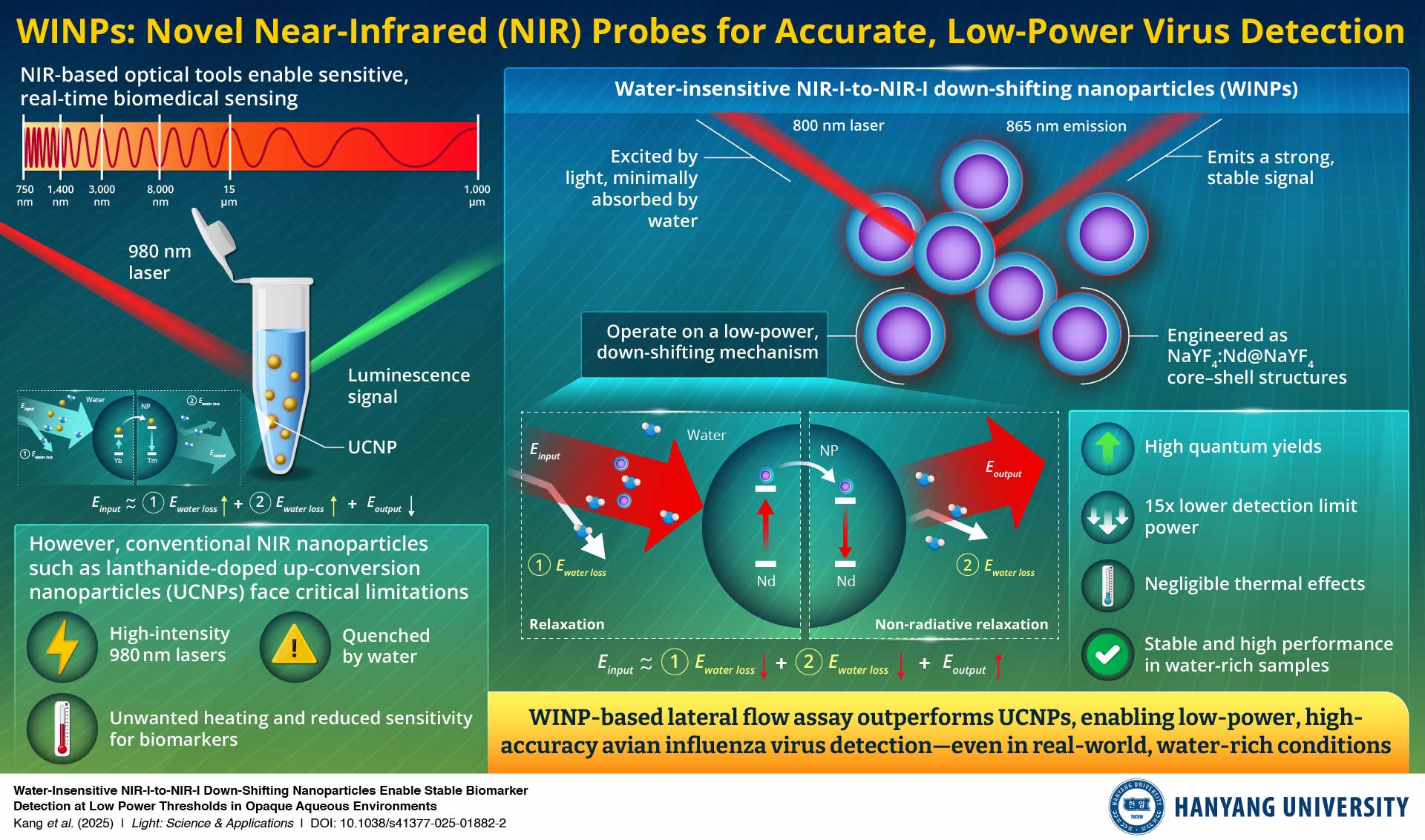
Image title: NovelWater-insensitive NIR probes for accurate, low power virus detection in aqueous environments
Image caption: Researchers developed water-insensitive near-infrared nanoprobeswhich enable stable, low power detection of biomolecules in water-rich biological samples without experiencing water quenching.
Image credit: Professor Joonseok Lee and Dr. Dongkyu Kang from Hanyang University
License type: Original Content
Usage restrictions: Cannot be reused without permission
Near-infrared (NIR) light, which typically ranges from 700 nm to 2500 nm in wavelength, has emerged as a powerful tool in modern biomedical imaging and diagnostics. With its ability to efficiently penetrate biological tissues with minimal scattering and background noise, NIR light has been widely used in optical tools for sensitive detection of biomolecules and deep tissueimaging. However, since most of the biological samples contain significant amounts of water,NIR-based systems often struggle in real-world applications because water absorbs and quenches NIR signals. In particular, the 980 nm wavelength, which is frequently used to operate up-conversion nanoparticles (UCNPs), becomes less effective due to absorption by water.
To address this challenge, a research team led by Professor Joonseok Lee and Dr. Dongkyu Kang from Hanyang University, Republic of Korea, in collaboration with Dr. Sang Hwan Nam from the Korea Research Institute of Chemical Technology, South Korea, developed water-insensitive NIR-responsive nanoparticles (WINPs), which emit and absorb light within the NIR-I window (700-900 nm). These nanoparticles operate via a down-shifting mechanism by converting light absorbed at 800 nm into an emission of 865 nm while minimizing energy loss due to water absorption. Their findings were published in Volume 14 of Light: Science & Applications on July 3, 2025.
“Water absorbs light around 980 nm, a wavelength commonly used to operate UCNPs, which reduces its effectiveness . Unlike conventional NIR-based UCNPs systems, our WINPs are specifically optimized to absorb at 800 nm to avoid interference from water molecules ,” says Prof. Lee explains the novelty of their research.
The WINPs were engineered into core–shell structures (NaYF₄:5%Nd@NaYF₄), where the core of the nanoparticles was made of a crystal called sodium yttrium fluoride ( NaYF₄). To make it responsive to NIR light, it was doped with 5% neodymium ions (Nd³⁺) so that the particles could absorb 800 nm light and emit a stable signal at 865 nm. The core was then coated with a thin layer of undoped NaYF₄ to form a shell encapsulating the core. This shell helps protect the core and boosts performance by reducing energy loss.
The nanoparticles were then structurally optimized using single-particle-level spectroscopy and were extensively characterized under both dry and aqueous conditions to validate their performance consistency and water insensitivity. Traditionally, UCNPs are commonly used in NIR-based diagnostics which suffer from significant photothermal effects and luminescence quenching in water. In contrast, WINPs demonstrated comparable performances in both dry and aqueous environments.
“WINPs consistently maintained their signal strength and photoluminescence lifetimes across different conditions, showing less than 4% fluctuation even under continuousirradiation. Comparatively, UCNPs experienced signal losses of up to 60% under the same conditions.” Explains Dr.
To test real-world applications of WINPs, the team applied WINPs in a lateral flow immunoassay (LFA) which is a simple, paper-based diagnostic test similar to at-home COVID-19 kits. They used this technique with WINPs to detect avian influenza viruses in 65 clinical samples (40 positive and 25 negative controls), including opaque swab specimens. Notably, under a low power density (just 100 mW/cm²), the WINP-based LFA achieved 100% sensitivity, even in turbid biological samples.
Overall, the study marks a milestone in NIR-based technologies and could be a valuable reference for researchers studying NIR light and light-water interactions. While primarily explored for diagnostics, the implications of this research extend far beyond clinical applications.
Importantly, because WINPs emit in the NIR-I region (865 nm), they can be detected using widely available, cost-effective silicon-based camera device, eliminating the need for expensive, specialized optical detectors. This feature significantly enhances their commercial and clinical utility, lowering barriers for adoption in laboratory, point-of-care, and field settings.
With further development, WINPs could be applied to numerous water-based industrial applications—like real-time biosensing of molecules in wet environments or even nuclear applications, such as distinguishing water from heavy water.
Prof. Lee and Dr. Kang concludes, “ Water is integral to biology and industry and therefore, developing NIR systems that function well in water has been a long-standing challenge. With WINPs, we offer a practical, energy-efficient solution—inspiring new frontiers for NIR technologies.”
Reference
Title of original paper:
Water-insensitive NIR-I-to-NIR-I down-shifting nanoparticles enable stable biomarker detection at low power thresholds in opaque aqueous environments
Journal:
Light & Science Applications
DOI:
About Professor Joonseok Lee
Dr. Joonseok Lee is a Professor at the Department of Chemistry at Hanyang University, Republic of Korea, and an Adjunct Professor at the Department of Materials Science and Engineering, where he leads the Advanced Nanoscale & Biological Materials Laboratory (ANB Lab) . He holds a Ph.D. in Materials Science and Engineering and his research spans biosensing, healthcare, security, and advanced nanomaterials. With more than 70 peer-reviewed publications, Prof. Lee is widely recognized in the field of nanomaterials and earned several awards, including the Argonne Director's Fellowship and Top 100 R&D achievements from the Governments (Ministry of Science and ICT).
About Dr. Dongkyu Kang
Dr. Dongkyu Kang is a postdoctoral researcher at the Department of Chemistry at Hanyang University, Republic of Korea, and a member of the ANB Lab. His research interests include nanomaterial development, surface engineering, and applications in bioimaging and sensing. In a short span of 6 years, Dr. Kang has authored over 10 peer-reviewed publications and continues to actively contribute through interdisciplinary collaborations at the interface of materials science and analytical chemistry. In the current study, he led the design, synthesis, and characterization of the optical nanoparticles.
About Hanyang University
Hanyang University has pioneered higher education in Korea since 1939.
Rooted in the philosophy of 'Love in Deed and Truth,' we aim to cultivate global innovators.
Through cutting-edge R&D, international collaboration, and sustainable innovation,
Hanyang is positioning itself as a global hub for academic excellence and societal impact.