
Synthesis, performance, and reaction mechanisms of titanium dioxide-silicon carbide as a step-scheme heterojunction photocatalyst against formaldehyde in air
Researchers develop an economic and energy-efficient nanomaterial that can degrade formaldehyde using UV light

Sponsored by

Sponsored by
Researchers develop an economic and energy-efficient nanomaterial that can degrade formaldehyde using UV light
Indoor air pollution poses serious health risks due to contaminants like formaldehyde. Researchers from Hanyang University developed a titanium dioxide–silicon carbide composite photocatalyst that efficiently degrades formaldehyde with UV light. To assess real-world feasibility, the catalyst was integrated into a portable air purifier and operated under realistic indoor environmental conditions. This catalyst outperformed existing technologies. It is recognized as a durable and affordable solution for indoor air quality management with remarkable stability across numerous uses.
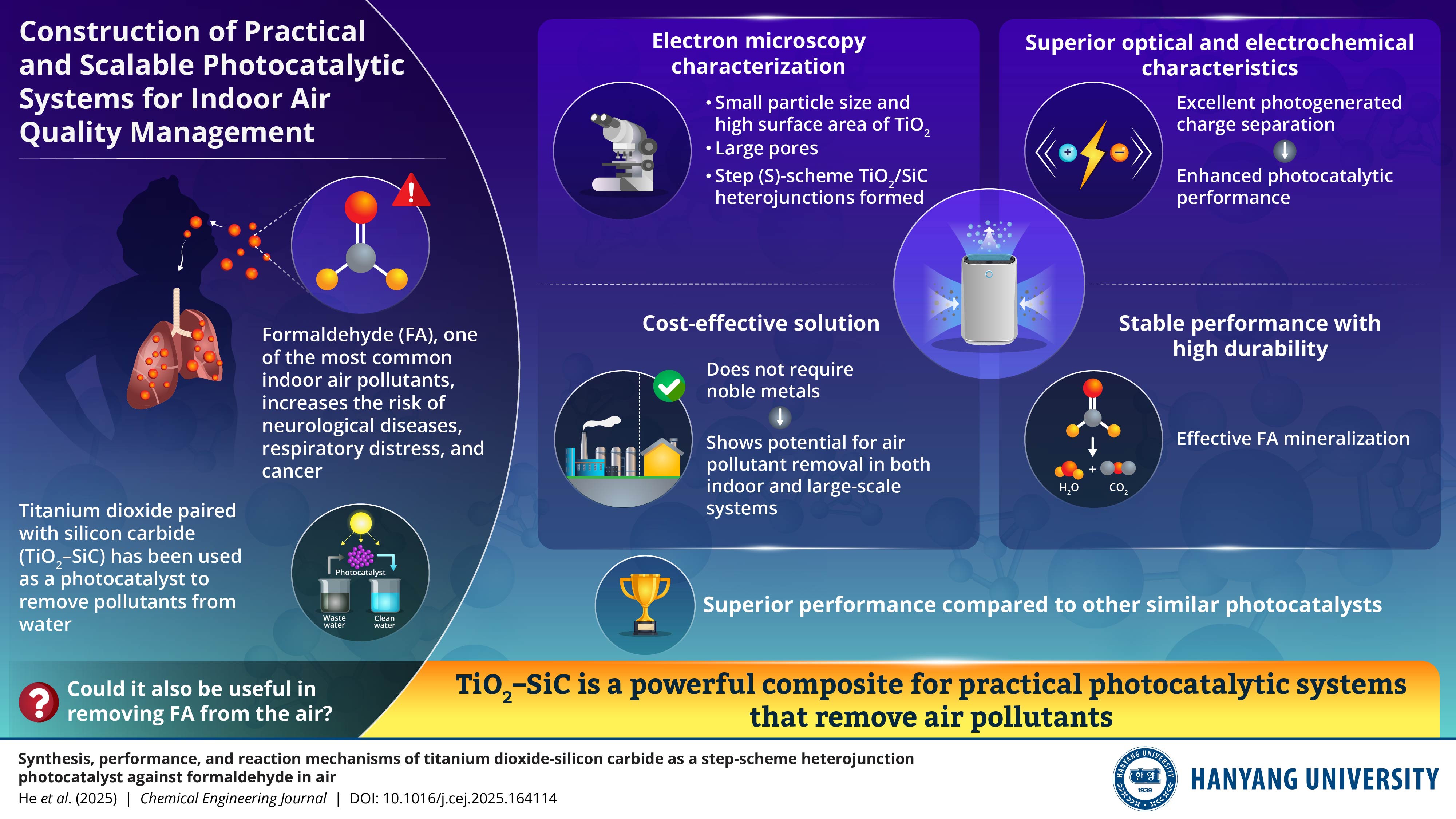
Image title: Toward Cleaner Indoor Air Using Advanced Photocatalysts
Image caption: This infographic summarizes the methodology and key findings of this study, which presents a promising photocatalytic composite that can efficiently remove formaldehyde, a common pollutant, from indoor air.
Image credit: Professor Ki-Hyun Kim of Hanyang University
License type: Original Content
Usage restrictions: Cannot be reused without permission.
While headlines often focus on outdoor air pollution, the air inside our homes, offices, and schools can be just as dangerous due to various invisible contaminants. Among the most concerning of these is formaldehyde, a common airborne chemical released from everyday items, such as furniture, decorative materials, and cleaning products. Exposure to formaldehyde, classified as a Group 1 carcinogen, is linked to a range of health issues, ranging from neurological problems and respiratory distress to cancer. Despite this known danger, current air purification methods like simple filtration systems offer limited protection, as they merely trap particles rather than eliminating harmful gases and become less effective over time.
Photocatalysis—a process that uses light energy to break down pollutants into harmless substances—has emerged as a promising solution for continuous indoor air purification. Unlike traditional filters, photocatalytic systems can operate much longer without requiring replacements, making them ideal for integration into air purifier units. However, conventional photocatalysts like titanium dioxide (TiO 2 ) face a critical limitation - the rapid recombination of charge carriers generated by UV radiations. This process wastes much of the energy absorbed and significantly reduces the system's efficiency, preventing photocatalysts from reaching their full potential for cleaning indoor air.
Against this backdrop, a research team led by Professor Ki-Hyun Kim of the Department of Civil and Environmental Engineering at Hanyang University, Republic of Korea, has developed an innovative photocatalyst that overcomes the fundamental limitations of TiO 2 . Their study, made available online on May 28, 2025 and published on September 1, 2025 in Volume 519 of Chemical Engineering Journal , details the creation of a novel nanomaterial designed to improve the efficiency of photocatalytic air purification by degrading formaldehyde.
The researchers combined TiO 2 with silicon carbide (SiC) to create a new 'step-scheme heterojunction' photocatalyst, named TiO 2 -SiC. This combination was specifically engineered to overcome the charge recombination problem. They prepared different versions of the composite, varying the amount of SiC, and then integrated them directly into the filter unit of a portable air purifier.
Through extensive testing and detailed analysis, the team concluded that the composite with 5% SiC (named TiO 2 -SiC-5) exhibited superior performance compared to the rest. This optimal formulation achieved complete formaldehyde removal within just a few minutes of operation and exhibited 2.3 times better performance than TiO 2 alone, representing a drastic improvement over existing technologies. Notably, the proposed system also maintained its exceptional efficiency even after multiple reuse cycles, demonstrating the durability needed for practical applications.
The researchers confirmed that formaldehyde molecules were completely mineralized—broken down into carbon dioxide and water—rather than simply being trapped or converted into other potentially harmful compounds. Moreover, advanced microscopy and spectroscopy techniques showed that the SiC creates an optimal interface with TiO 2 , allowing for efficient charge separation while maintaining the strong oxidative power needed to degrade formaldehyde. “ Imagine smart air purifiers for homes, offices, and schools that don't just filter particles but actively break down harmful volatile organic compounds and formaldehyde at lower energy costs ,” says Prof. Kim. “ This would mean healthier indoor environments, reducing respiratory issues, allergies, and the long-term health risks associated with chronic pollutant exposure .”
Overall, the proposed TiO 2 -SiC photocatalyst offers key advantages over current alternatives. It does not contain noble metals, making it cost-effective for widespread use and suitable for other promising endeavors. “ Beyond inside spaces, this technology could be scaled for industrial emissions or even city-level air treatment, leading to tangibly cleaner air in urban areas and near industrial zones ,” notes Prof. Kim. “ This would directly translate to improved public health and quality of life. ”
As air quality becomes an increasingly recognized public health priority, this study on photocatalyst technology is an important step toward creating truly clean indoor environments where people can breathe safely.
Reference
Original Title:
Synthesis, performance, and reaction mechanisms of titanium dioxide-silicon carbide as a step-scheme heterojunction photocatalyst against formaldehyde in air
Journal:
Chemical Engineering Journal
DOI:
About the author
Professor Ki-Hyun Kimearned his MS from Florida State University and Ph.D. from the University of South Florida. He then served as a Research Associate at ORNL, USA. In 1995, he moved to Sang Ji University, Korea, before joining Sejong University in 1999. Since 2014, he has been a faculty member in the Department of Civil & Environmental Engineering at Hanyang University. His research integrates air quality and environmental engineering with materials engineering, focusing on advanced novel materials such as metal-organic frameworks. His contributions earned him numerous accolades, including being named one of the top 10 National Star Faculties in Korea in 2006 and becoming an academician of the Korean Academy of Science and Technology in 2018. Clarivate Analytics recognized him as a "Highly Cited Researcher" in 2019 within the "Environment & Ecology" field. He serves as an Associate Editor for “ Environmental Research ,” “ Sensors ,” and “ Critical Reviews in Environmental Science & Technology .” With over 1,050 published articles, his work frequently appears in leading scientific journals.
About Hanyang University
Hanyang University has pioneered higher education in Korea since 1939.
Rooted in the philosophy of 'Love in Deed and Truth,' we aim to cultivate global innovators.
Through cutting-edge R&D, international collaboration, and sustainable innovation,
Hanyang is positioning itself as a global hub for academic excellence and societal impact.