
Nanosheet Immunoswitches: Next-Gen Technology for Cancer and Sepsis Immunotherapy
These switches bi-directionally regulate the phenotypes of pro-inflammatory M1 and anti-inflammatory M2 macrophages

Sponsored by

Sponsored by
Macrophages are promising primary therapeutic targets in cancer and inflammation immunotherapy owing to their flexible nature. Recently, a team of researchers from Hanyang University have come up with a groundbreaking technology based on functional nanosheet immunoswitches such as palmitic acid-WSe2 and linoleic acid-WS2 for innate immune microenvironment regulation. The proposed innovation is expected to find use in both colorectal cancer and sepsis immunotherapy.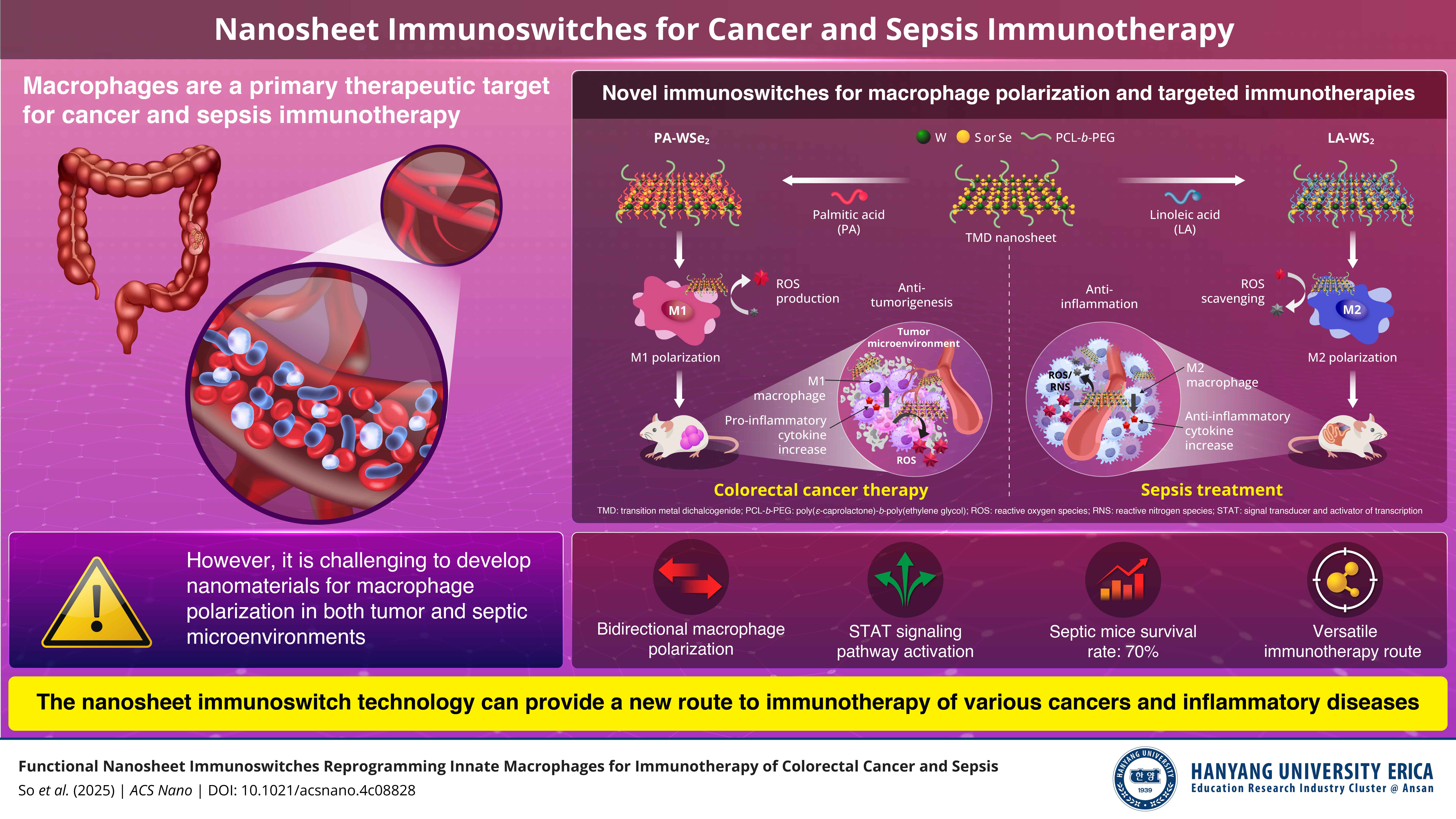
Image title: How Nanosheet Immunoswitches Reprogram Macrophages for Precision Immunotherapy
Image caption: Nanosheet immunoswitches—palmitic acid-WSe₂ (PA-WSe₂) and linoleic acid-WS₂ (LA-WS₂)—precisely reprogram macrophages within disease-specific microenvironments by shifting them from an immunosuppressive M2 state to a pro-inflammatory M1 state in tumors for enhanced cancer immunotherapy, or from a hyper-inflammatory M1 state to a healing M2 state in sepsis to reduce excessive inflammation, thereby enabling targeted, lesion-specific immunotherapy through bidirectional control of the innate immune response.
Image credit: Jong-Ho Kim from Hanyang University ERICA
License type: Original Content
Usage restrictions: Cannot be reused without permission
Macrophages, modulator and effector white blood cells in the innate immune system with antitumoral and anti-inflammatory functions, have emerged as a primary therapeutic target in cancer and inflammation immunotherapy. Classified into M1 and M2 phenotypes with pro-inflammatory and anti-inflammatory activities, these cells can be adapted in response to microenvironmental stimuli. Therefore, they can be made to switch their phenotypes and functions in response to microenvironmental signals.
In this context, “nanosheet immunoswitches” are highly promising as they can transform immunosuppressive microenvironments in lesions into immunoactive ones, thereby maximizing the therapeutic effect of various diseases ranging from cancer to autoimmune disorders. Furthermore, lesion-specific nanosheet immunoswitches can address the limitations of conventional immunotherapeutics offering a paradigm shift in immunotherapy.
Pioneering this novel cutting-edge technology, a group of researchers from the Republic of Korea, led by Professor Jong-Ho Kim and Ph.D. candidate Yoonhee So from Department of Materials Science and Chemical Engineering, Hanyang University ERICA, have presented novel nanosheet immunoswitches capable of bi-directionally reprogramming innate macrophages toward either M1 or M2 phenotypes for the targeted immunotherapy of cancer and sepsis. Their findings were made available online and published in the journal ACS Nano on February 3, 2025.
In this study, the researchers functionalized biocompatible WS₂ nanosheets with linoleic acid (LA-WS₂) for scavenging reactive oxygen species and M2 polarization, leading to potent anti-inflammation in sepsis. Notably, it achieves this result by activating the STAT3 signaling pathway. In contrast, palmitic acid-functionalized WSe₂ nanosheets (PA-WSe₂) activate the STAT1 signaling pathway. Thereby, they enable M1 polarization and upregulate the secretion of pro-inflammatory cytokines and reactive oxygen and nitrogen species. This causes sufficient inflammation in the tumor microenvironment for the immunotherapy of colorectal cancer.
“The LA-WS2 immunoswitch exhibited a potent immunotherapeutic efficacy in sepsis animal models, and the PA-WSe2 immunoswitch displayed an effective immunotherapeutic effect in animal models of colorectal cancer. These nanosheet immunoswitches can thus provide a new route to immunotherapy of various cancer and inflammatory diseases,” remarks Prof. Kim.
The development of an innovative nanosheet immunoswitch technology—capable of reprogramming the immune microenvironment in a lesion-specific manner—is anticipated to create high-value industrial opportunities and enhance national competitiveness.
So highlights the immense potential of their recent breakthrough. “It is expected to drive significant advancements in the nanomedicine sector and contribute to the broader evolution of the biomedical industry. By overcoming the limitations of conventional immunotherapies, nanosheet immunoswitches offer superior safety, biocompatibility, and therapeutic efficacy. Consequently, they hold strong potential to reduce healthcare costs at both the societal and individual levels.”
Reference
Title of original paper:
Functional Nanosheet Immunoswitches Reprogramming Innate Macrophages for Immunotherapy of Colorectal Cancer and Sepsis
Journal:
ACS Nano
DOI:
About Hanyang University ERICA
Hanyang University ERICA (Education Research Industry Cluster at Ansan) is a prominent research-focused campus established in 1979 in Ansan, South Korea. ERICA offers undergraduate and graduate programs. ERICA is renowned for its active industry-university cooperation, offering students hands-on experience through partnerships with various industries. This ensures that graduates are well-prepared to meet societal needs and excel in their respective fields. With state-of-the-art facilities and a supportive learning environment, Hanyang University ERICA empowers students to pursue their passions and contribute meaningfully to society, staying true to the university's founding philosophy of "Love in Deed and Truth."
Website: https://www.hanyang.ac.kr/web/eng/erica-campus1
About the author
Professor Jong-Ho Kim is a distinguished Professor in the Department of Materials Science and Chemical Engineering at Hanyang University, Korea. His impressive publication record includes 105 SCI(E) papers, accumulating 12,813 citations (h-index 47, i10-index 81). For his excellence, the National Research Foundation ranked him among Korea’s top ten chemists from 2009–2014. Additionally, in both 2023 and 2024, Professor Kim was named among the world’s top 2% scientists by Elsevier and Stanford University, a recognition based on his significant research impact and citation metrics. This highlights his substantial contributions to the fields of nanoscience and biomedical engineering.