
Entering New Markets: Novel Similarity Score for Customer Recommendation


Sponsored by
Sponsored by
Firms often aim to expand to new markets. However, it is difficult to find potential customers in such scenarios. Recently, researchers from Hanyang University ERICA have proposed a novel similarity score to capture intermarket similarities between different companies and identify potential customers in new markets. The innovative and efficient framework is expected to facilitate market expansion via an inter-firm transaction network.
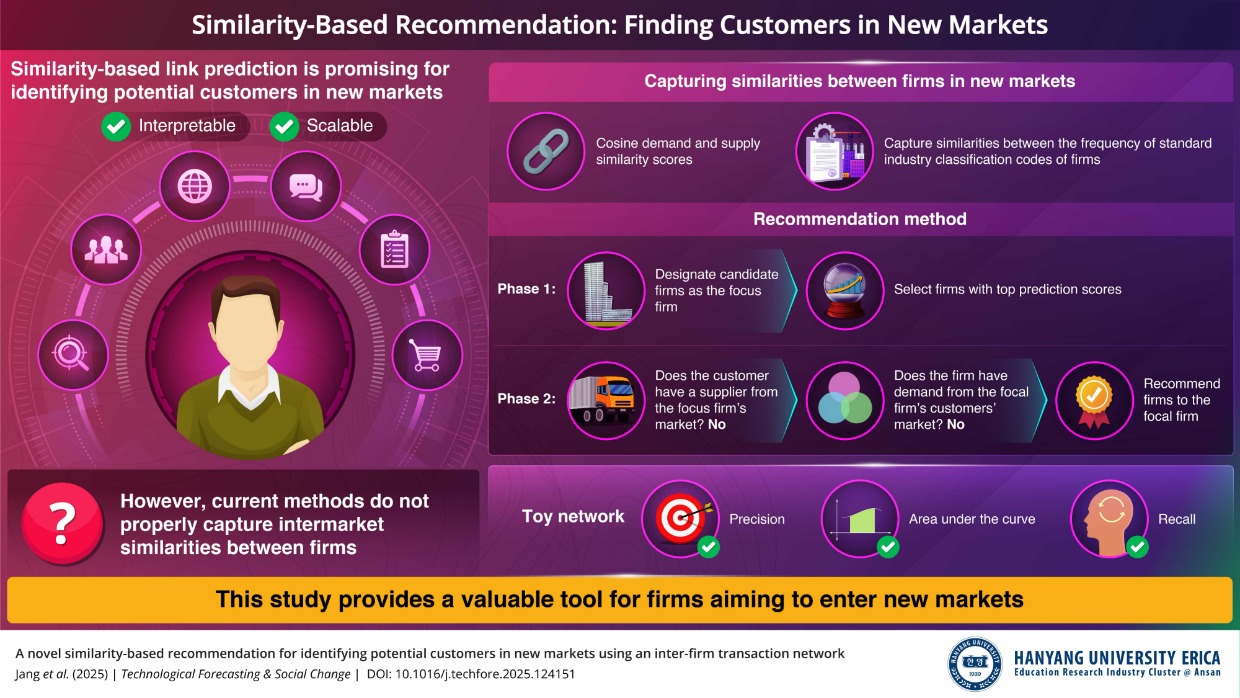
Image title: Similarity score for market expansion
Image caption: The proposed framework outperforms current methods in terms of area under the curve, precision, and recall, potentially aiding small and medium-sized enterprises.
Image credit: Byunghoon Kim from Hanyang University ERICA, South Korea
License type: Original content
Usage restrictions: Cannot be reused without permission.
Markets are changing rapidly in this century. In such a dynamically evolving corporate scene, it is crucial to reliablypinpoint potential new customers to facilitate the sustainable growth and development of firms and organizations. Typically,companies find new customers by predicting the link foreshadowing potential future transactions with other companies, forming an inter-firm transaction network. This approach is referred to as similarity-based link prediction. It iswidely utilizedbecause it is interpretableas well as scalable.
Unfortunately, current similarity measures employed for link prediction are deemed insufficienttoencompass intermarket similarities, limiting their applicability to cases wherein firmstry to expand to new markets.
Addressing this knowledge gap, a team of researchers from the USA and South Korea, led by Dr. Byunghoon Kim, an Associate Professor in the Department of Industrial and Management Engineering at Hanyang University ERICA, have come up with a novel similarity score to capture the similarities between companies in different markets. Their novel findings were made available online on April 17, 2025, and published in Volume 216 of the journal Technological Forecasting & Social Change on July 01, 2025.
“It differs from previous works by presenting a novel, data-driven recommendation method that utilizes quantitative analysis of inter-firm transaction data to enable companies to efficiently discover and prioritize potential customers in entirely new markets—even in industries where they have no prior transaction history. Unlike previous research that focused on predicting potential transactions within existing financial networks, our approach directly addresses the challenge of recommending new customers for market expansion using objective, transaction-based data,” Dr. Kim highlights the main contribution of their study.
The researchers validate their approach through toy network experiments. In this way, they demonstrate the capability of their concept in reliably forecasting customers in various markets. Notably, the proposed recommendation approach achieves outstanding performance, outperforming standard methods in terms of all chosen indicative parameters: the area under the ROC curve, precision@k, and recall@k. This makes the similarity-based method an indispensable new tool for firms seeking to enter new markets.
“Our research offers a recommendation system that analyzes inter-firm transactions and industry data to help companies identify promising new customers, even in industries where they have no prior business experience. In fact, we have already received an inquiry from a company interested in discussing this research further and exploring its potential applications in identifying new business partners,” remarks Dr. Kim.
Over the next 5 to 10 years, the present research could have a significant impact by making it much easier for small and medium-sized enterprises (SMEs) with limited marketing resources to discover new business partners and expand into new markets. In the long term, this could help more SMEs find practical opportunities for growth and compete more effectively.
Overall, the key contribution of this work is its practical and quantitative ability to help firms identify valuable opportunities outside their current markets, rather than simply predicting future links among already known firms.
Here’s hoping that the present breakthrough paves the way for a more diverse corporate landscape as well as flourishing markets!
Reference
Title of original paper:
A novel similarity-based recommendation for identifying potential customers in new markets using an inter-firm transaction network
Journal:
Technological Forecasting & Social Change
DOI:
10.1016/j.techfore.2025.124151
About Hanyang University ERICA
Hanyang University ERICA (Education Research Industry Cluster at Ansan) is a prominent research-focused campus established in 1979 in Ansan, South Korea. ERICA offers undergraduate and graduate programs. ERICA is renowned for its active industry-university cooperation, offering students hands-on experience through partnerships with various industries. This ensures that graduates are well-prepared to meet societal needs and excel in their respective fields. With state-of-the-art facilities and a supportive learning environment, Hanyang University ERICA empowers students to pursue their passions and contribute meaningfully to society, staying true to the university's founding philosophy of "Love in Deed and Truth."
Website: https://www.hanyang.ac.kr/web/eng/erica-campus1
About the author
Dr. Byunghoon Kim is an Associate Professor in the Department of Industrial and Management Engineering at Hanyang University ERICA, South Korea. He received his Ph.D. in Industrial and Systems Engineering from Rutgers University, New Jersey, in 2015. His research interests include data mining in semiconductor manufacturing processes, network data analysis, and high-dimensional data analysis.