
Developing Digital Twin Framework to Enhance Sustainability and Efficiency of Modular Buildings

Sponsored by
Sponsored by
Relocatable modular buildings (RMBs) represent a sustainable construction method where buildings are assembled and transported easily using prefabricated modules. However, challenges in management and logistics hinder their wider adoption. In a new study, researchers developed an innovative digital twin facility management system tailored specifically for RMBs. This advanced framework integrates cutting-edge technologies to enhance management efficiency throughout the building lifecycle, establishing a foundation for wider digital twin integration in construction.

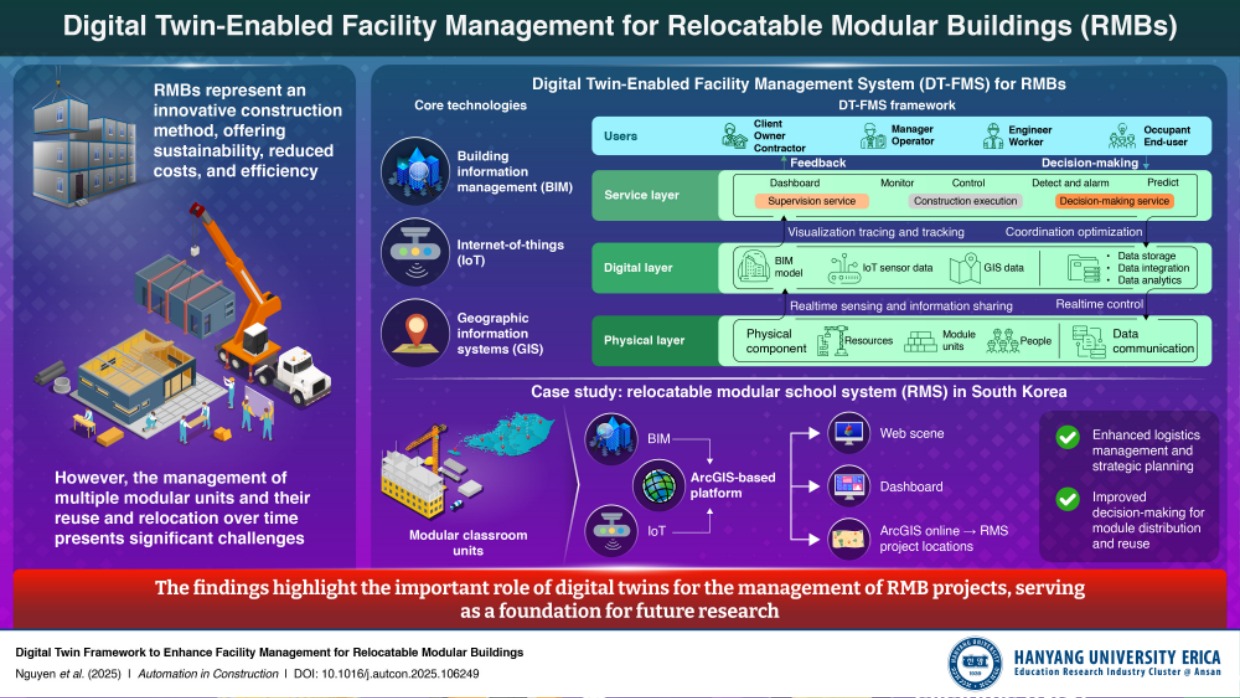
Image title: Proposed digital twin framework for relocatable modular buildings
Image caption: The proposed digital twin facility management system integrates technologies like building information management, internet of things, and geographic information systems, to improve management and logistics of modular units, and enhance decision-making across repeated building lifecycles.
Image credit: Yonghan Ahn from Hanyang University ERICA
License type: Original Content
Usage restrictions: Cannot be reused without permission
To address this, a research team led by Associate Professor Yonghan Ahn from the School of Architecture & Architectural Engineering at Hanyang University ERICA in South Korea, developed a new digital twin (DT)-based framework for facility management of RMB projects. “Digital twin technology is a groundbreaking tool that offers a digital replica of physical assets, integrating real-time data, predictive analysis, and decision-making abilities,” explains Prof. Ahn. “Although digital twins are gaining popularity in other fields, their usein modular construction remains limited. We introduce a novel digital twin-enabled facility management system (DT-FMS) tailored specifically for RMBs.” The team also included contributions from Dr. Dennis Nguyen from Hanyang University. Their study was made available online on May 05, 2025, and published in Volume 176 of the journal Automation in Construction in August 01, 2025.
The new DT-FMS integrates building information modeling (BIM), internet of things (IoT), and geographic information systems (GIS) to create a detailed virtual model of RMBs. This model supports real-time monitoring, performance analysis, and logistics simulations across the building’s lifecycle. BIM offers robust 3D modelling and comprehensive building information. IoT provides real-time sensor data. GIS contributes critical geographic data, supporting effective logistics of modular units and location-based decision making.
This framework is structured across three interconnected layers: physical, digital, and service. The physical layer forms the foundation for real-time tracking and communication among different physical components such as resources, modular units, and people, including stakeholders, engineers, and workers. The digital layer includes modeling tools, data integration, and analytics. Finally, the service layer allows users to monitor, control, and interact with the DT framework, supporting effective decision making throughout the building lifecycle.
To demonstrate the practical application of the framework, the researchers conducted a case study on a relocatable modular school system in South Korea. DT-FMS enhanced the decision making for module distribution and reuse, resulting in improved management efficiency.
“Our research highlights the important role of digital twins in promoting a circular economy by enabling the reuse, reconfiguration, and optimal relocation of modular units, thereby minimizing waste and maximizing value throughout repeating project cycles,” remarks Dr. Nguyen.
Reference
Title of original paper:
Digital twin framework to enhance facility management for relocatable modular buildings
Journal:
Automation in Construction
DOI:
About Hanyang University ERICA
Hanyang University ERICA (Education Research Industry Cluster at Ansan) is a prominent research-focused campus established in 1979 in Ansan, South Korea. ERICA offers undergraduate and graduate programs. ERICA is renowned for its active industry-university cooperation, offering students hands-on experience through partnerships with various industries. This ensures that graduates are well-prepared to meet societal needs and excel in their respective fields. With state-of-the-art facilities and a supportive learning environment, Hanyang University ERICA empowers students to pursue their passions and contribute meaningfully to society, staying true to the university's founding philosophy of "Love in Deed and Truth."
Website: https://www.hanyang.ac.kr/web/eng/erica-campus1
About Professor Yonghan Ahn
Professor Yong-Han Ahn is an Associate Professor in the School of Architecture & Architectural Engineering at Hanyang University ERICA. After earning his Ph.D. in Environmental Design and Planning from Virginia Tech, he went on to lead the Sustainable Building and Construction Management Laboratory at Hanyang University ERICA. His research interests are centered on a wide range of topics, including sustainable construction and infrastructure, green building and design, modular construction, Building Information Modeling (BIM), and the integration of digital technologies and artificial intelligence in construction.
About Dennis Nguyen
Dr. Dennis Nguyen holds an undergraduate degree in Architecture and a Ph.D. in Smart City Engineering from Hanyang University, South Korea. He is a postdoctoral researcher at the Center for AI Technology in Construction at Hanyang University, where his research focuses on modular construction, digital technologies, and sustainably built environments. His recent work centered on enhancing facility management and promoting circular economy practices through relocatable modular building projects in South Korea.