
Cancer Dormancy: Mitigation via Sequencing Technologies and Artificial Intelligence

Sponsored by
Sponsored by
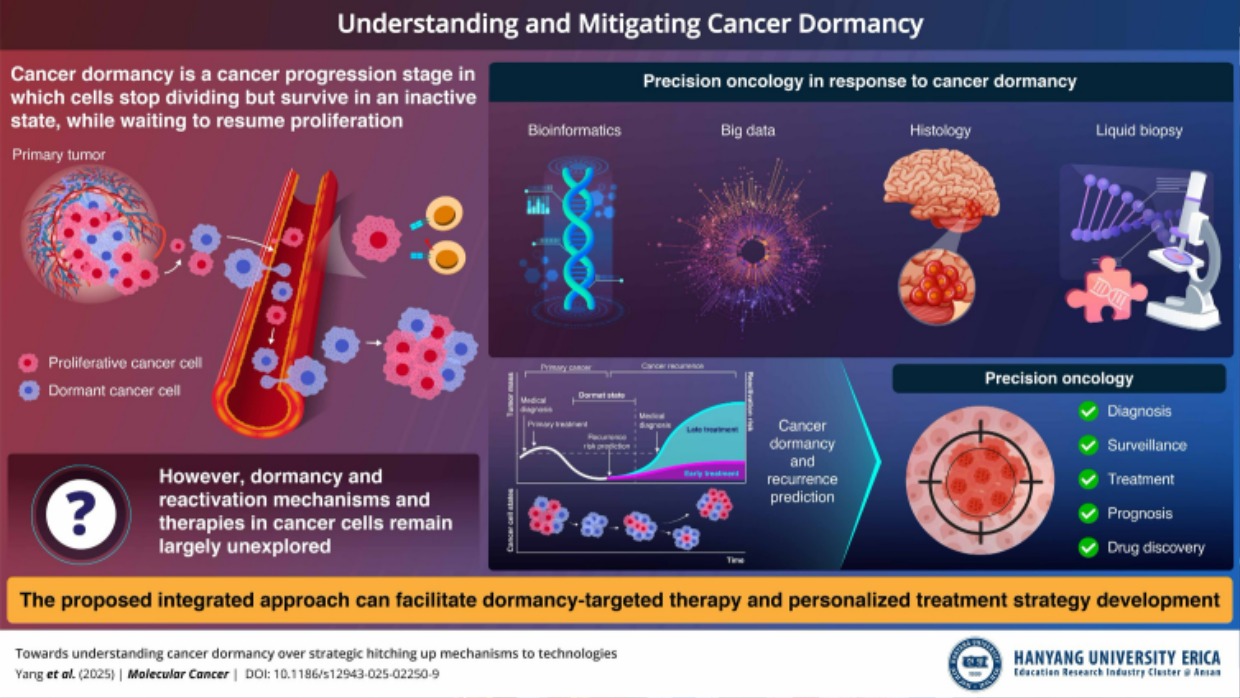
Cancer dormancy is a major concern in cancer treatment. Recently, a team of researchers from Hanyang University has shed light on all aspects of the dormancy, including the life cycle, mechanisms, targeted therapeutics, advanced sequencing technologies, and artificial intelligence approaches, potentially paving the way for precision oncology. This next-gen technology can lead to personalized treatment strategies that prevent relapses after conventional cancer therapy.

Image title: Towards precision oncology to address cancer dormancy
Image caption: Researchers leverage advanced sequencing technologies as well as AI-assisted techniques to tackle cancer dormancy.
Image credit: Jae-Yeol Joo from Hanyang University
License type: Original Content
Usage restrictions: Cannot be reused without permission
Cancer is among the leading causes of death across the globe. While a significant process is currently being made towards curing the various forms of this disease, another main area of concern is related to cancer dormancy. It is a stage in cancer progression wherein the cells stop dividing but survive in an inactive state while waiting for ideal environmental conditions to resume proliferation. During this life cycle , a cellular machinery , which mainly depends on gene regulation, decides the state of cells. However, the mechanisms of dormancy induction in cancer cells have not been fully understood. Moreover, therapeutic strategies targeting dormancy-reactivation also need further elucidation.
Addressing this knowledge gap, a group of researchers from Republic of Korea and USA, led by Associate Professor Jae-Yeol Joo from the Department of Pharmacy, College of Pharmacy, Hanyang University, Korea, has presented a comprehensive perspective of this field: the life cycle of the dormant cell, factors affecting cancer dormancy and reactivation, associated biological mechanisms and therapeutic strategies, as well as precision oncology. Their recent work has been published in the journal of Molecular Cancer on 14 February 2025.
“Our aim is to advance single cell and long read sequencing through analysis methodologies and artificial intelligence—the most recent stage in the research tool progress—to provide a holistic view of the diverse aspects of cancer dormancy,” remarks Dr. Joo.
In this study, the researchers suggest insights to uncover the mechanisms of cancer dormancy by utilizing a variety of input data, including bioinformatics (genome, epigenome, transcriptome, proteome, and metabolome), big data, histology, and liquid biopsy, as well as by leveraging advanced sequencing technologies and artificial intelligence-assisted approaches such as neural networks.
Dr. Joo says: “Specifically, we propose focusing on advanced sequencing applications—such as ctDNA profiling and liquid biopsy approaches—to monitor minimal residual disease and dormancy in a non-invasive, clinically accessible manner. As a consequence, this approach could help establish clinical protocols for monitoring dormancy states, reducing metastatic risk, and ultimately improving long-term survival rates in cancer patients by eliminating or stabilizing dormant cancer cells. Combined with the rapid advancement of artificial intelligence applied to the prediction of cancer dormancy, our technology is anticipated to accelerate the development of precision oncology strategies—from the brain to systemic applications.”
Overall, the proposed integrated approach could potentially lead to the early detection of dormant cancer cells, the development of dormancy-targeted therapies, and personalized treatment strategies that prevent relapse after conventional therapy.
Therefore, the present research is expected to guide the development of diagnostic tools that detect dormant cancer cells before relapse.
Reference
Title of original paper:
Towards understanding cancer dormancy over strategic hitting up mechanisms to technologies
Journal:
Molecular Cancer
DOI:
About Hanyang University ERICA
Hanyang University ERICA (Education Research Industry Cluster at Ansan) is a prominent research-focused campus established in 1979 in Ansan, South Korea. ERICA offers undergraduate and graduate programs. ERICA is renowned for its active industry-university cooperation, offering students hands-on experience through partnerships with various industries. This ensures that graduates are well-prepared to meet societal needs and excel in their respective fields. With state-of-the-art facilities and a supportive learning environment, Hanyang University ERICA empowers students to pursue their passions and contribute meaningfully to society, staying true to the university's founding philosophy of "Love in Deed and Truth."
Website: https://www.hanyang.ac.kr/web/eng/erica-campus1
About the author
Dr. Jae-Yeol Joo, an associate professor in Hanyang University's Department of Pharmacy, is a leader in applying artificial intelligence (AI) to human diseases. His work spans diverse areas, including using AI for GWAS and deep learning-based SpliceAI in clinical approaches, identifying novel therapeutic targets through single-cell long-read sequencing, and developing therapeutic strategies for brain disorder diagnosis from lncRNAs. As a corresponding author, Dr. Joo's significant contributions to neuroscience and genetics are featured in prestigious journals like Nature Neuroscience , Molecular Cell , Molecular Psychiatry , PNAS , Brain , Molecular Neurodegeneration , Advanced Science , and many others.