
Sustainable cooling solutions to combat global warming
An innovative, electricity-free cooling technology company based in Hong Kong makes a compelling case study on how entrepreneurship can transform on-campus innovation into global solutions

Sponsored by City University of Hong Kong

Sponsored by

Sponsored by
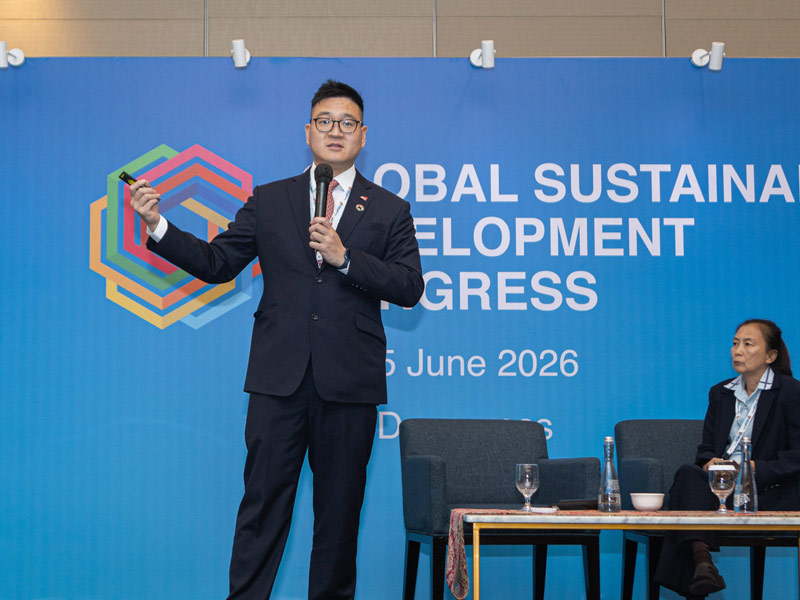
In today’s interconnected world, challenges are rarely confined to a single country or region. City University of Hong Kong (CityUHK)’s Fostering Innovation for Resilience and Sustainable Transformation (FIRST) programme recognises this reality. A session – held in partnership with CityUHK – at the 2026 THE Global Sustainable Development Congress, discussed how the university harnesses new technology to accelerate energy generation and smart management to support economies.
Designed to co-develop affordable and scalable technologies, the FIRST programme focuses on empowering communities and vulnerable urban regions through sustainable innovation. “Our school’s mission is to drive interdisciplinary research and education in sustainability, energy, environment and climate to cultivate visionary leaders and deliver solutions for decarbonisation and future resilience,” said Edwin Chi-Yan Tso, associate dean for internationalisation and outreach at CityUHK’s School of Energy and Environment.
For example, a project inspired by scientific curiosity about how the hair structure of Saharan silver ants helps them remain cool in desert environments has grown into a commercially successful company with a presence in over 30 countries. It now delivers electricity-free cooling through an array of passive radiative cooling paints, films and textiles. Tso co-founded i2Cool with Martin Zhu, adjunct professor in the Department of Management at CityUHK.
Tso’s foundational research into metamaterials and photonic material structures took more than eight years. It led to several published papers, but the founders’ goal was to bring the technology out of the laboratory and turn it into a low-cost and scalable solution. It is now used in manufacturing electric vehicles, textiles and solar panels. It can also be used to store agricultural produce more effectively and coat rooftops to reduce heat stress on a building’s air conditioning system.
The company has partnered with commercial and not-for-profit organisations across the world to bring its solutions to market. Tso argued that science has a duty to serve society. Poh Choo Kang, a teacher at the Chinese High School in Batu Pahat, Malaysia, spoke about how the school works with CityUHK researchers to reduce the surface temperature of its buildings. “In tropical countries like Malaysia, temperatures are rising, creating challenges for schools,” said Kang. At the same time, air conditioning leads to higher energy use and carbon emissions.
“Our school connected with CityUHK researchers, who studied our campus conditions, identified suitable areas and then planned how to improve the learning environment. One of the key solutions was to apply a radiative cooling coating on selected rooftop areas,” Kang said, adding that results have been remarkable. “This project is not only about technology – it’s about putting environmental, social and governance principles into action.”
The company has partnered with Citybus in Hong Kong to apply its radiative cooling coating to bus roofs and cooling films to windows. Similarly, the cooling technology helps gas companies reduce heat-induced evaporation losses of raw materials.
Such initiatives underpin CityUHK’s vision to be at the centre of a burgeoning innovation ecosystem. The university is developing the next generation of sustainability-conscious leaders while promoting an entrepreneurial mindset among its staff and students, enhancing its position as a first-class research institution.
The speakers:
- Poh Choo Kang, teacher, Chinese High School, Malaysia
- Edwin Chi-Yan Tso, associate dean for internationalisation and outreach, School of Energy and Environment, City University of Hong Kong