
Nepal’s deadly floods are a warning of how climate change makes disasters more extreme
Rising temperatures are destabilising Himalayan glaciers, increasing disaster risks and exposing vulnerable communities to lethal events

Sponsored by City University of Hong Kong

Sponsored by

Sponsored by
Extreme weather events, such as the recent catastrophic flash flood in Nepal, are becoming more frequent and intense, and the situation will only get worse if humanity does not urgently act to curb climate change, says Benjamin Horton, dean of the School of Energy and Environment at City University of Hong Kong (CityUHK).
“These events, whether it's a flash flood in Nepal, a typhoon that hits Shanghai, or a heat wave in France, they're all tied to climate change,” Horton says.
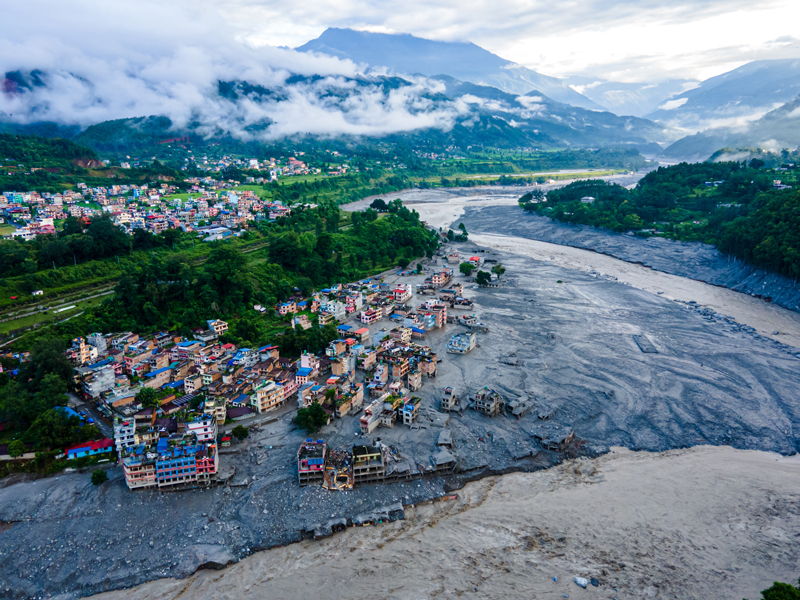
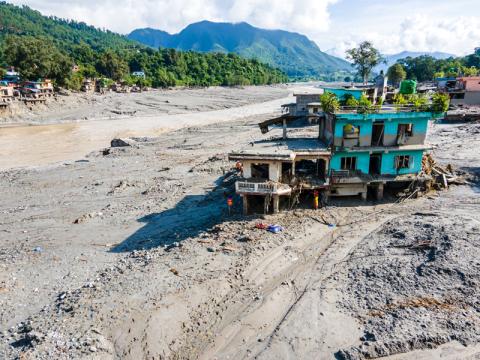
On 26 August 2026, a glacier collapsed high up in the Himalayan mountain range. So much debris plummeted to the ground that it registered as a 4.4 magnitude earthquake. “Ice and rock hit the valley floor at such an explosive impact that the pressure turned the ice into water that flowed down the valley at speeds in excess of 100 miles per hour and destroyed everything in its sight,” Horton says. More than 1,400 people died in the flash flood, and thousands are still missing.
The Himalayas are a hazardous region. It is prone to earthquakes and has steep mountains capped with large stores of ice and snow. However, climate change is making the mountain range even more dangerous, Horton says.
“The Himalayan ice cap has been warming faster than the global average. It’s warmed about 1.3 degrees Celsius in the last 50 years,” Horton says. “When you start to have increases in temperature, it can cause a destabilisation of glacial ice.” Climate change “caused this event to be more likely and more extreme”, he says.
It is difficult to monitor glaciers in the mountain range. “It’s a remote, hazardous region, and it’s difficult to place monitoring systems,” Horton explains. “Of the roughly 40,000 glaciers across the Himalaya-Karakoram region, fewer than 40 have been scientifically observed and only about 20 are monitored systematically. That leaves enormous gaps in our understanding of which glaciers may be becoming unstable.”
The area is also renowned for its cloud cover, and optical remote sensing satellites struggle to see through the cloud to the land below, Horton says. Radar satellites can see through clouds and operate at night, but steep terrain, gaps between observations and the time needed to analyse the data mean that dangerous changes may still go undetected until it is too late.
However, recognising the hazard is only one part of the response to extreme events. “It’s one thing to identify a hazard. The next step is getting people out of harm’s way,” Horton says. “If you’re not able to control the hazard, then you have to work out who is exposed to it in terms of areas, populations, infrastructure and ecosystems, and then determine ways to reduce that vulnerability.”
Reducing vulnerability could involve improving building regulations so that homes and infrastructure can weather extreme events more effectively, he says. Governments and communities could also employ land-use mapping to ensure people don’t build in exposed areas.
“It’s quite complicated,” Horton says. “You have to think of the hazard, who is exposed to it and how you reduce their vulnerability. Monitoring is only one aspect.”
He says that affected communities need support to develop their climate-resilient responses. “There has to be some sort of climate equality here. The people in the Himalayas are not responsible for climate-related hazards,” Horton says. Humanity’s carbon emissions are driving climate collapse, but Nepal’s contributions to global carbon dioxide are about 0.05 per cent, he says. “It is minuscule compared to the contributions of Northwestern Europe, North America or China.”
He suggests that at-risk areas should be given funds to improve climate resilience. “These events are just going to happen again and again, and they will be of a larger and larger magnitude,” he warns. “If you don’t do anything about the exposure or the vulnerability, the whole country is just going to disappear.”
There is a clear link between frequency and intensity of extreme weather events and climate change, Horton says. “We urgently need to start protecting the most vulnerable people from the impacts of climate change, and we need to solve the problem of greenhouse gas emissions,” he says.
CityUHK is working to tackle the problem of climate collapse, he says. The university is recruiting climate scientists and has built up a critical mass of expertise. “CityUHK’s approach to climate change is very interdisciplinary,” Horton says. “It’s not just the physics; they think about the impact and search for solutions.” Researchers at the School of Energy and Environment, for example, are investigating renewable energy, adaptive cooling and policy “to think about how you can create the city of tomorrow”, he says.
At the same time, the university is well-known for its innovation and technology, he says. “It’s famous for its HK Tech 300”, which is a large-scale flagship innovation and entrepreneurship programme. “It’s got an increasing number of innovators who take the very best science and try to find solutions.”
Horton says that universities can help vulnerable communities through research and innovation and by pushing governments, companies and individuals to reduce greenhouse gas emissions. “People don’t need to give up hope,” he says.