
Connecting institutional excellence with sustainability
Higher education can combine excellence, innovation and sustainability to attract global partnerships and create lasting value

Sponsored by City University of Hong Kong

Sponsored by

Sponsored by
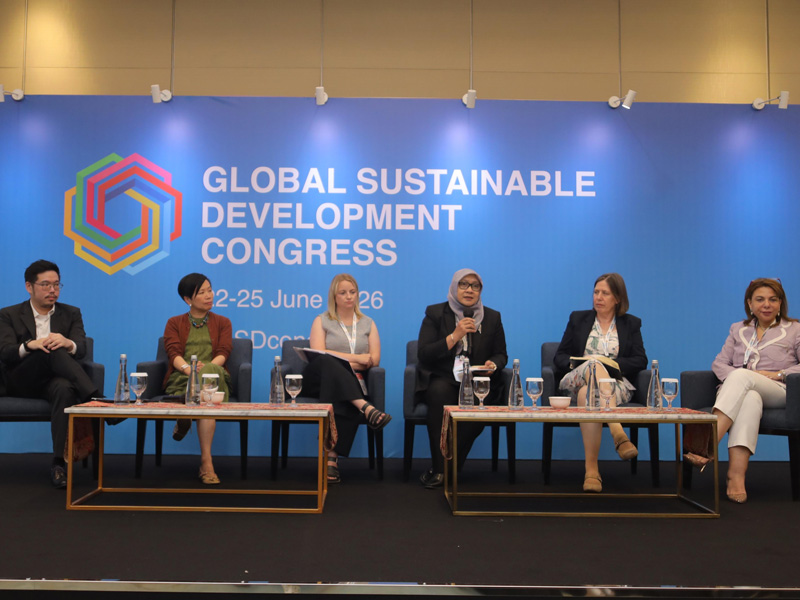
Universities around the world are increasingly participating in sustainability-focused activities to demonstrate commitment to societal impact. A session – held in partnership with City University of Hong Kong (CityUHK) – at the 2026 THE Global Sustainable Development Congress, brought together a panel of experts to share best practice in sustainability, academic partnerships and reputation building.
Universities are looking to partner with institutions that are aligned with their vision. “Sustainability is a long-term goal, and we cannot achieve it without global partners,” said Shirley Chong, chief communications and global affairs officer at CityUHK. “We always say distance can separate countries, but it need not separate the ambitions to promote inclusiveness, sustainability and impact.”
Prioritising sustainability helps universities to grow while helping the planet, said Ashley Mok, director of consultancy at Times Higher Education. “There is a massive increase in the number of universities that are participating in sustainability-focused activities,” Mok said. Such initiatives are also an important branding and reputation-building tool.
Mok shared examples of universities that actively promote their sustainability achievements using eye-catching infographics and digital campaigns. Global rankings and ratings, such as the THE Sustainability Impact Ratings, enable institutions to illustrate their commitment to facilitating progress within their communities and advancing partnerships that drive growth.
The 2026 Sustainability Impact Ratings evaluated 1,646 universities from 116 countries and territories based on the University Nations’ Sustainable Development Goals (SDGs). “What we’re hoping to achieve is that universities record and measure the return on investment of any sustainability-related activity,” said Mok. This information not only drives sustainability within higher education today but also influences the decisions of institutional leaders, which impact future activities.
Engaging with different stakeholders such as local communities and government organisations also creates opportunities for institutions to publicise their activities, Mok said. With the widespread use of large language models (LLMs), it is important for institutions to promote their activities online, Mok said. Most students now ask AI tools to learn about green credentials and initiatives at institutions. As LLMs are trained using open-source information, having strong visual representations and information that is publicly available could directly contribute to how an institution is perceived by prospective students.
In the modern world, “sustainability has to be a key factor in branding and governance”, Mok said. “It has to be part of your university’s core motto and strategy.” This includes branding, research agenda, operations, procurement and infrastructure. “People are able to see what your university stands for,” he said.