
Cats can help researchers understand how some cancers develop – and how to cure them
In comparative oncology, scientists compare cancers in different species to understand how to treat them

Sponsored by City University of Hong Kong

Sponsored by

Sponsored by
Researchers at the City University of Hong Kong (CityUHK) are using comparative oncology to understand the similarities between cancer-causing viruses that infect cats and humans to improve treatment for both species. Comparative oncology is the study of naturally occurring cancers across species both to understand the biology of cancers and how to cure them.
“Our overarching goal is to improve cancer outcomes for pets and their people,” says Julia Beatty, chair professor of veterinary medicine and infectious diseases, and clinical specialist in feline medicine at CityUHK’s Jockey Club College of Veterinary Medicine and Life Sciences.
Viruses cause many human and animal cancers. In fact, researchers estimate that about 15 per cent of all human cancers are caused by viruses. “If a cancer is caused by a virus, then we have the chance to prevent it, which is the Holy Grail of cancer medicine,” says Beatty. Patients can be vaccinated against the virus, and treatments that restrain the virus or clear it from a patient’s system can be developed.
Recent studies have shown that there are similarities between an increasing number of cancer-causing viruses in humans and cats, Beatty says. For example, chronic hepatitis B virus (HBV) is the leading cause of liver cancers in humans, and the number of cases is rising in some regions.
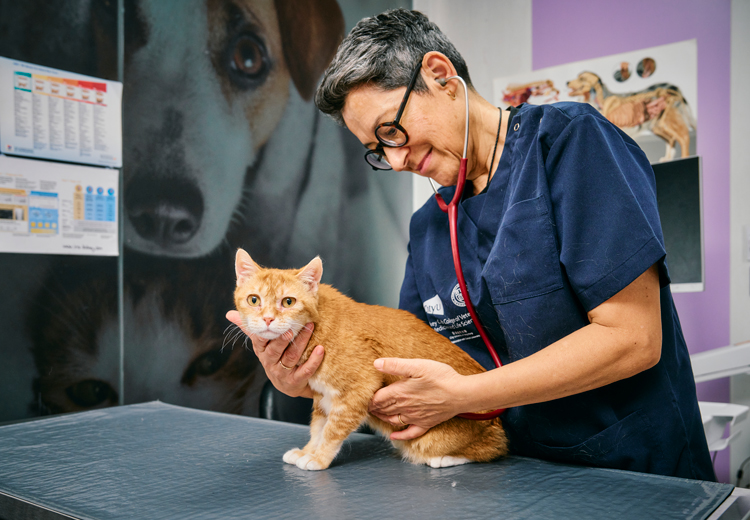
In 2018, a team led by Beatty discovered that cats in Australia were infected by an HBV-like virus, called domestic cat HBV. Cats infected with the virus have since been identified around the world. The researchers have recently found a link between the virus and liver cancer in cats. The biology and behaviour of the cat and human viruses are similar.
In a commentary published in Nature Reviews Cancer, Beatty and colleague Thomas Tu argue that research into HBV-like viruses in cats could benefit both human and feline patients. The research involves field studies. “We’re not interested in doing laboratory studies because we think the field model is much more important,” says Beatty. “We want to see what happens in the cats that are naturally infected and sharing the same environment as their owners. They’re living their normal lifespan.”
An important benefit of these types of studies is that they could help fast-track drug development for humans, Beatty adds. Increasingly, countries are restricting laboratory animal research, “so the more natural models we have, the better”. If researchers show that treatments work in cat field studies, those treatments can progress to human clinical trials or even to market more quickly, she says.
There is another indirect benefit of this comparative approach, Beatty says. “If those drugs are not, for some reason, eventually used in people, then the pharmaceutical companies can potentially recoup some of their costs by repurposing them back into veterinary medicine. The more funds we can conserve, the more research we can do,” she explains.
Collaboration is vital in veterinary medicine and comparative oncology, Beatty notes. “Humans are just one species,” she says. “There are other mammals as well, and the more we can integrate that, the more we’re going to learn from each other and advance the whole field.”