
Building sustainable cities in the face of climate emergency
To protect communities vulnerable to climate-related disasters, researchers must work hand-in-hand with policymakers and industry to translate green technologies into real-world solutions

Sponsored by City University of Hong Kong

Sponsored by

Sponsored by
Climate change is taking the world into uncharted territory. Each year brings extreme weather events that test the resilience of cities. While science and technology make vital contributions to developing climate resilience, it is a responsibility that must be shared across different sectors.
Fadly Amran, mayor of Padang in Indonesia’s West Sumatra Province, was only eight months into his role when the city was ravaged by extreme rainfall and flash flooding, devastating infrastructure, killing 11 people and leaving thousands without homes. The recovery project required thousands of workers to remove mud and debris. Amran’s administration rolled out the R3P framework, focusing on recovery, rehabilitation, reconstruction and preparedness.
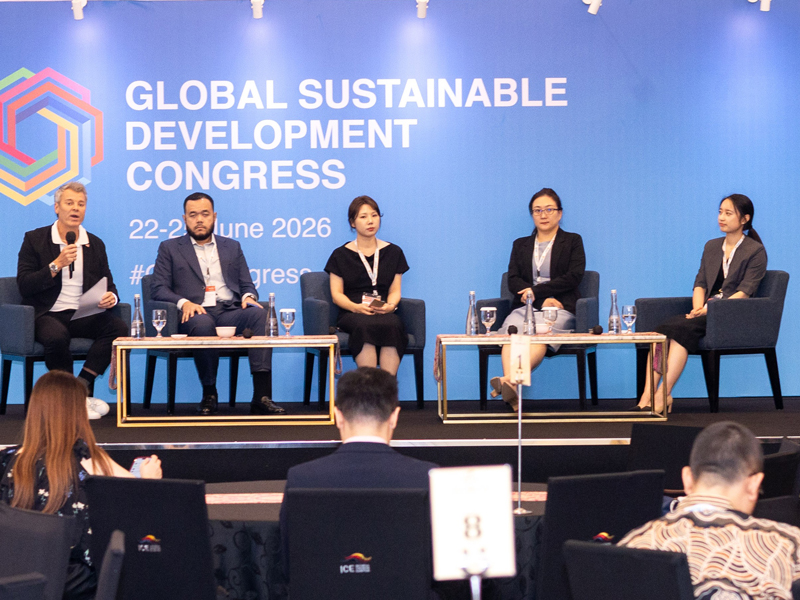
“We gave economic lifelines, providing micro-grants to victims, markets and also local economies,” said Amran, speaking at a panel discussion – held in partnership with City University of Hong Kong (CityUHK) – at the 2026 THE Global Sustainable Development Congress. The administration is now focusing on a medium-term rehabilitation plan. “The first step is to restore public services and utilities. This is still ongoing.”
Such storms are predicted to return, so building resilience is crucial for securing the area’s future. “Preparedness is a collaboration,” said Amran, who argued that local government must work with central government, industry and higher education to develop climate resilience. Universities offer data-driven insights that can support projects such as relocating at-risk coastal communities.
The new climate reality demands an innovative approach to infrastructure. In Indonesia, the government is planting mangroves, which can enhance protection in vulnerable coastline environments. It is partnering with industry to use flood and earthquake-resistant building materials in reconstruction projects.
Jung-Eun Chu, assistant professor at the School of Energy and Environment at CityUHK, warned that we are in a new normal, which makes early warning systems integral to security. “Climate change is increasing the intensity and frequency of extreme weather events,” she said. “The rapid changes in land use, such as deforestation, increase the vulnerability of cities to flooding.”
Chu echoed the need for collaboration between organisations and said she would like to see cities combining technology and data from early warning systems to inform proactive preventative measures. For example, Hong Kong monitors flooding hotspots and uses pumping robots to clear drain blockages in advance of heavy rainfall.
But science is only one piece of the puzzle. Building awareness and social acceptance around green technologies is equally important. Peipei Chen, assistant professor, School of Energy and Environment at CityUHK, shared examples of clean energy projects that failed to secure community support, underscoring the importance of academia, government and industry working together to develop green technologies and establish trust in the communities where they will be deployed.
Benjamin Horton, dean of the School of Energy and Environment at CityUHK, agreed. Tackling climate change requires interdisciplinary coordination, but the social sciences are often overlooked. “You can have the best possible solutions, but if you don’t understand the community and what they want, then it’s going to fail,” he said.
The panel:
- Fadly Amran, mayor, Padang, West Sumatra Province, Indonesia
- Peipei Chen, assistant professor, School of Energy and Environment, City University of Hong Kong
- Jung-Eun Chu, assistant professor, School of Energy and Environment, City University of Hong Kong
- Penny Han, associate professor, School of Energy and Environment, City University of Hong Kong
- Benjamin Horton, dean, School of Energy and Environment, City University of Hong Kong (chair)