
AI and strong academic partnerships can advance digital health
Synergy between academia, government and industry is essential for accelerating progress in digital health

Sponsored by City University of Hong Kong

Sponsored by

Sponsored by
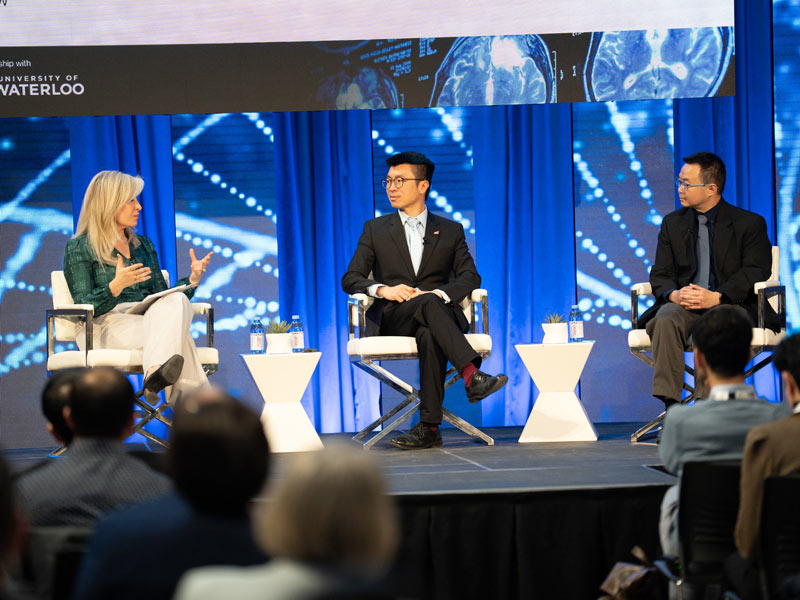
City University of Hong Kong (CityUHK) has joined forces with institutions and industry to achieve global impact on digital health by leveraging advancements in AI and holistic stakeholder engagement. During a session at the 2025 THE Digital Health event, Anderson Shum, vice-president of research at CityUHK, spoke about the vision behind the university’s new facilities, such as the Institute of Digital Medicine and the Hong Kong Institute of AI for Science.
“Our faculty members are highly accomplished and we have a very high density of talent,” Shum said. “Their research capabilities form an important basis on which we can build our collaborations.”
Bringing together different partners to identify problems faced by communities, clinicians and healthcare professionals is an effective way to advance digital health, Shum said. “We focus on interdisciplinary collaborations within the university and driving innovation through collaborations and partnerships between government, industry and academia.” Researchers also benefit when investors and governments provide guidance on important areas of research and support them in commercialising the findings, he added.
For collaborations to be a success, it’s important for universities to fully understand and establish strong working relationships with stakeholders, said Alfred Yu, assistant vice-president of research and international at the University of Waterloo (UW) in Canada.
UW has a long-term partnership with CityUHK and hosts events where prospective industry partners, faculty members and government agencies get together and discuss their needs and interests. Yu said that local knowledge is essential for building successful cross-border partnerships: “What we want to do is need-driven innovation. Unless we work locally with a particular partner, we cannot understand what the local needs are.”
The smart use of AI could provide cost-effective exploration of data and solutions to help universities reduce costs. “There’s hope that artificial intelligence and digital health are the way to get around our perennial challenge of how do we do more with less,” said Bessma Momani, associate vice-president of international at UW.
When it comes to integrating AI, each local problem provides an exciting opportunity to develop new solutions, Yu said. For example, Hong Kong does not currently have a centralised medical records system, which is an area where generative AI solutions could “fill some potholes”.
AI offers the chance to process and analyse huge amounts of data more quickly and cheaply than before. When working internationally, explicit data access clauses built into the agreements from the beginning can help avoid regional issues, Yu said.
CityUHK’s approach to AI is that it is not just a tool but also a science that is capable of accelerating progress, including the discovery of innovative drugs, materials and agricultural products. When working with AI, it’s essential that clinicians, scientists, governments and regulators ask good questions, Shum said. “The quality of the questions determines what you can do in terms of innovation,” he concluded.
The panel:
- Bessma Momani, full professor of political science, University of Waterloo
- Anderson Shum, vice-president of research, City University of Hong Kong
- Alfred Yu, assistant vice-president of research and international and professor of biomedical engineering, University of Waterloo