
Advancing science for global progress
From its origins in 1940 to today’s global research partnerships, Beijing Institute of Technology applies scientific innovation to address real-world challenges and support sustainable development
Sponsored by Beijing Institute of Technology

Sponsored by
Sponsored by
Throughout history, the pursuit of knowledge has been driven by a common desire to better understand the world and improve society. At Beijing Institute of Technology (BIT), this enduring spirit continues to inspire research that addresses some of the world’s most pressing challenges.
Across disciplines – including information science, intelligent technologies, aerospace, marine engineering, advanced materials, and sustainable transportation – BIT’s faculty and students are committed to developing practical solutions with lasting societal impact.
Since its founding, BIT has emphasised the application of science and technology to real-world problems, a tradition that continues to define its mission more than 80 years later. BIT traces its origins to the Yan’an Academy of Natural Sciences, established in 1940 during a period of significant national hardship. The institution’s early scholars focused on solving immediate practical challenges, from improving salt production techniques to surveying local natural resources. This commitment to serving society through scientific innovation laid the foundation for the university’s development and remains central to its identity today.
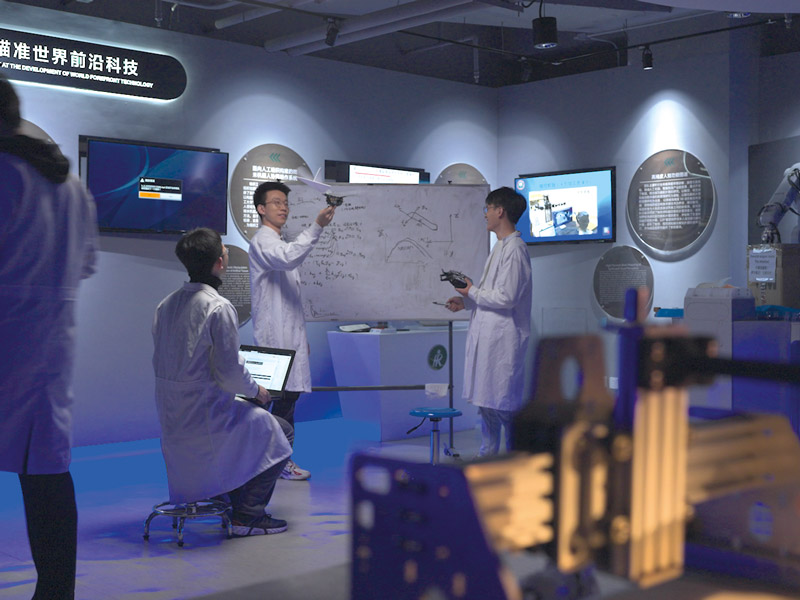
As BIT has evolved into a leading research university with state-of-the-art laboratories and extensive international partnerships, its core philosophy has remained unchanged: research should contribute to long-term social and technological progress. Today, BIT has built a multidisciplinary, collaborative research ecosystem that spans engineering, information technology, space science, advanced materials, intelligent systems and environmental technologies.
BIT’s research strengths include precision manufacturing through advanced laser-based micro and nano-scale processing techniques, as well as emerging AI hardware. Scientists at BIT are exploring innovative materials and device architectures for neuromorphic computing, aiming to improve the efficiency and capability of future intelligent systems. The university has also made significant contributions to sustainable transportation.
As one of China’s early contributors to electric vehicle technology, BIT has participated in pioneering work on electric buses and continues to advance research into energy-efficient mobility systems and next-generation transportation engineering.
Innovation in materials science represents another major area of strength. BIT researchers are developing next-generation lightweight materials with exceptional thermal insulation properties, including advanced aerogels and bio-inspired structural composites. These materials have potential applications across aerospace, energy and advanced manufacturing industries.
Marine science and environmental technology are expanding areas of research, particularly at BIT’s Zhuhai campus. Researchers are developing integrated air-sea monitoring systems that support ocean observation, environmental protection and emergency response capabilities. Meanwhile, in the space sector, BIT continues to contribute to satellite communication technologies and onboard data-processing systems that enhance the performance and reliability of modern space missions.
Recognising that today’s scientific challenges extend beyond national borders, BIT has established partnerships with universities and research institutions around the world. Through international collaboration in areas such as aerospace engineering, intelligent technologies, sustainable energy and advanced manufacturing, the university contributes to a global exchange of knowledge and innovation.
As science and technology continue to reshape society, BIT remains committed to applying research in ways that address real-world challenges, foster sustainable development and create lasting benefits for communities worldwide.