
Emily Corner is tracing the grievances behind violence
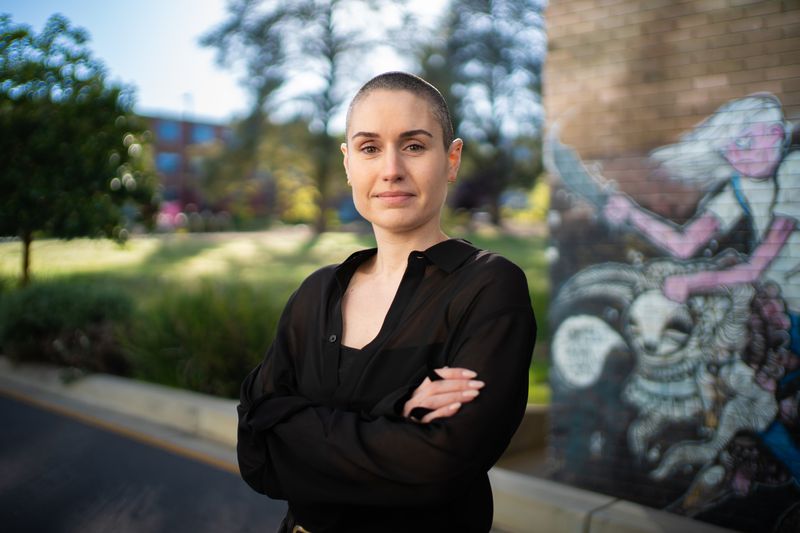
Associate Professor Emily Corner from The Australian National University (ANU) studies why some people turn to violence. Her work looks past the labels we give offenders to understand what drives them, and how to step in before harm is done.

Sponsored by

Sponsored by
Key Details
Give 100 people in a room the same instructions, and most will follow them.
"Ninety-five per cent will do as you've told them. Five per cent will not, and they'll each do different things," says Associate Professor Emily Corner.
Emily, Associate Professor and researcher at POLIS: The Centre for Social Policy Research at The Australian National University (ANU), has built her career on understanding that 5 per cent. More specifically, the people whose behaviour turns to violence.
"I just happen to research behaviours that aren't socially acceptable, I suppose," she says.
She started by asking why people become terrorists. Criminologists know a lot about why most crimes happen. When people's needs for safety, health care or education go unmet, some turn to crime. But terrorists often don't fit that picture.
"When there are all these other options, when basic needs are being met, why do people still turn to these belief systems and structures?" she asks. "For me, it's: why?"
Beyond the boxes
Over time, Emily's research has grown from terrorism to other forms of violence that threaten public safety: mass murder, school shootings, hate crimes, stalking and severe family and domestic violence.
When a crime happens, police and courts classify it, and research usually starts from that label. But within each type of crime, Emily found a group of people who are more like each other than like anyone else who commits the same crime.
"There are cohorts of terrorists who are similar to a specific cohort of mass murderers, a specific cohort of stalkers and a specific cohort of family and domestic violence offenders," she says.
What connects them is grievance. The area is now known as grievance-fuelled violence, and Emily's early work helped define it.
"I didn't intend to, but it started that thinking, and now I'm working in the middle of it," she says.
For Emily, the finding shows the limits of putting people in boxes.
"When you look at their backgrounds and motivations, they're all very similar. Motivation is complex."
No neat stories
After a serious act of violence, public conversation often reaches for a simple explanation. Frequently, it's mental illness.
For a long time, the common view was that people with mental illness couldn't be terrorists. Emily's PhD showed that they can and are. But the relationship is far from simple.
"I spent a long time researching mental illness in terrorism, looking at hundreds of cases. In all my research, I didn't find one case where it was immediately causal," she says.
In some cases, mental illness had nothing to do with a person's behaviour. In others, it made them more vulnerable to being radicalised by other people. In some, it was even protective. People withdrew from the social settings that were radicalising them and only returned once they'd recovered.
"It’s quite hard because it's not a nice, neat story to tell people about what has happened," Emily says.
It’s important because simple explanations impact how we respond to these events. If violence is put down to one cause, the beliefs and grievances driving it can be missed, along with the chance to prevent the next act.
Stepping in before harm
Emily's research is now informing prevention. She is part of a team working with the Australian Government to design interventions for people who commit family and domestic violence driven by grievance.
These offenders can be hard to see.
"They're not reported because they're quite well functioning in society, but they're driven by this grievance," Emily says. "When they do commit acts of domestic violence, they tend to be more severe."
The approach draws on another area of Emily's work, fixated threat. This involves people who become fixated on public figures, such as politicians. Specialist teams have long worked to assess and manage that risk before anyone is harmed.
Under the new model, people already in contact with potential offenders, such as family courts, men's behaviour change programs or schools, will be able to refer them to multidisciplinary teams. Those teams will assess the risk and decide how to prevent future harm.
Pilot sites will be set up across Australia, with Emily and her colleagues building the evidence behind them and evaluating how they work.
Asking why
Emily's work comes as governments in Australia and overseas rethink how they define terrorism and ideology and recognise that motivation is rarely as simple as a single label.
"This research is becoming very relevant because everyone is reassessing what mass violence is and how we define it," she says.
Much of her work is with governments, and part of the challenge is the translation of turning complex evidence into something decision-makers can use, without adding to public fear.
At its heart, though, her research comes back to the question she started with. Why do people do what they do?
"It's because we're humans, and we're not robots."
Find out more about Emily Corner and the POLIS: The Centre for Social Policy Research at The Australian National University.