
Waves to watts: converting wave power to electricity
Climate change and coastal erosion are two big, intractable problems facing our planet. Fortunately, Adelaide University’s wave power research group offers an innovative approach to solve both.

Sponsored by

Sponsored by
Scientists are highlighting the urgent need for action to limit the devastating consequences of climate change, which makes renewable energy innovation increasingly important. In coastal communities around the globe, the threats of the climate crisis are exacerbating the ongoing problem of coastal erosion and its impact on homes and important infrastructure.
Wave power could provide a two-in-one solution to these dual issues. Researchers at Adelaide University are developing ground-breaking technology to create wave farms that will simultaneously harness wave energy efficiently and minimise waves’ destructive potential.
For more than a decade, the university has been at the forefront of devising ways to capture and convert the enormous but often overlooked renewable energy potential held in ocean waves. The availability of this power source makes it a valuable addition to the broader energy system.
“Wave energy is available almost 24/7, as opposed to wind or solar,” says Adelaide University’s Dr Nataliia Sergiienko.
“Adding wave energy to the renewable energy mix is beneficial for the national grid.”
To support this integration, the team has helped refine the technology. Sergiienko and her colleagues, Professor Ben Cazzolato, Associate Professor Boyin Ding, and Professor Maziar Arjomandi, made design changes to a wave power prototype called CETO that doubled the device’s energy efficiency. Now, they’re developing a soon-to-be-deployed control system to maximise CETO’s capacity.
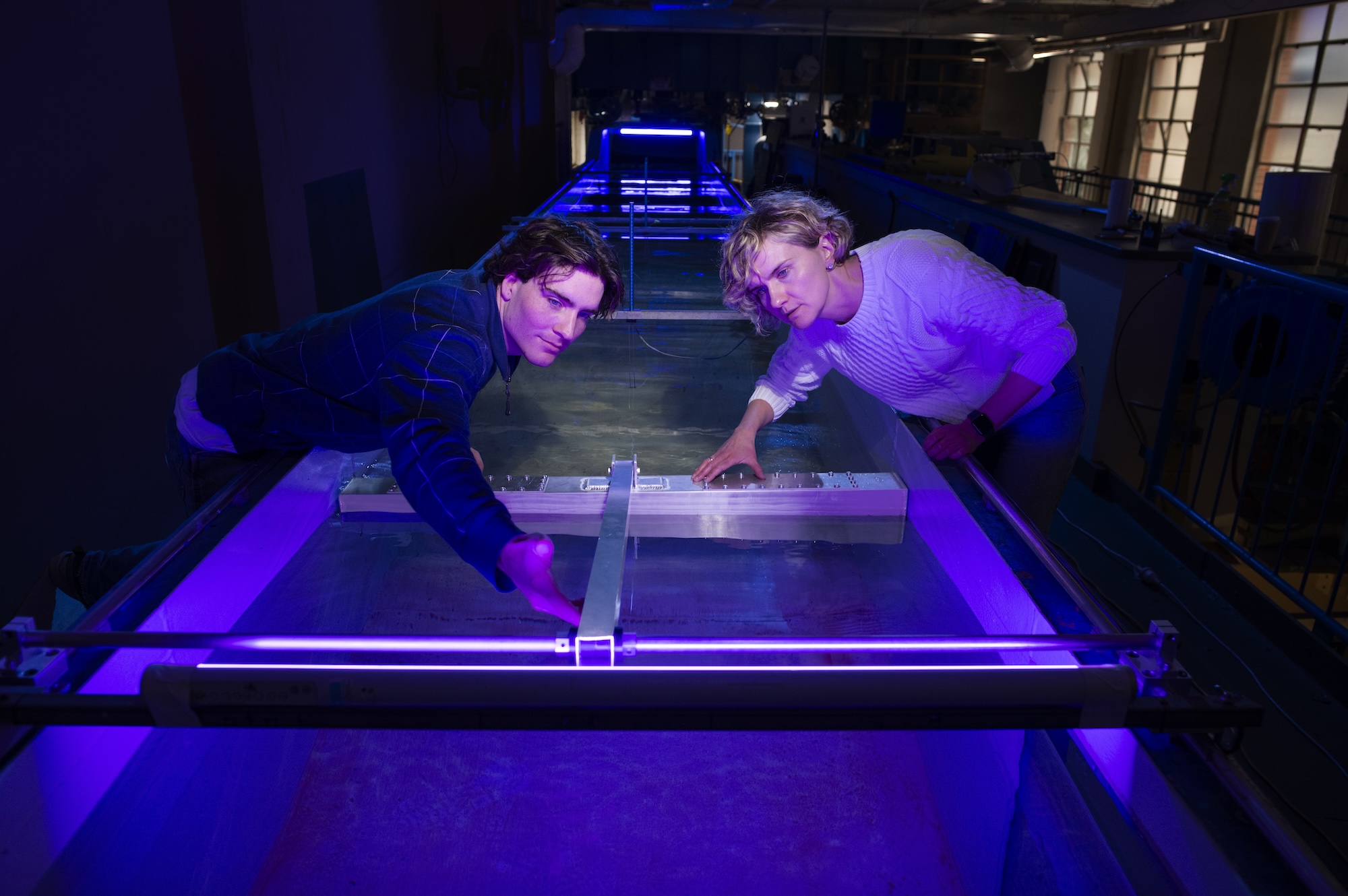
“The advanced controller that our group developed has already been tested in the tank and demonstrated a significant increase in generated power as compared to other state-of-the-art controllers,” said Sergiienko.
The researchers worked in partnership with company Carnegie Clean Energy, and were supported by grant funding from the Australian Department of Industry, Innovation and Science; the Australian Research Council’s Early Career Industry Fellowships scheme; and the Australian Research Council’s Linkage Program to take these bold steps in optimising wave power as a renewable energy technology.
Along the way, they discovered an important secondary benefit of wave farms: combatting coastal erosion. To explore this facet of wave farm development, the researchers partnered with Swinburne University of Technology, University of New South Wales, Mid West Ports in Western Australia, and Moyne Shire Council in Victoria.
“Wave energy converters work by removing energy from waves, which significantly decreases the height of waves that propagate towards the shore,” said Sergiienko.
“This ‘feature’ could potentially be used to protect vulnerable coastlines of any coastal country.”
Not content to research just two difficult problems, Adelaide University’s growing research team is also investigating a host of other wave energy questions, from maximising power output of wave devices to efficient grid integration.
They’re also exploring smaller-scale applications of wave energy which, though small, have big potential. Wave-powered devices generating just 10–100 W of power are enough to keep many ocean technologies such as navigation buoys, sensor platforms, and small underwater vehicles or drones running. Unlike batteries, which need frequent replacement, these devices offer reliable, persistent energy.
To support this expanding research effort, as well as more realistic testing and faster translation to deployment, Adelaide University is upgrading its wave energy research facilities. These enhancements will generate more accurate and controllable wave conditions by allowing for more advanced experiments and higher fidelity validation of devices and controllers.
Together, these developments will enable further optimisation of wave energy technology, moving its impact beyond the lab.
“I would like to see more wave energy devices moving from labs to open ocean,” Sergiienko said.
“We still have many research questions to be answered.”