
IVF outcomes: lifting success rates
From embryology training courses to groundbreaking research, Adelaide University is taking a comprehensive approach to improving IVF.

Sponsored by

Sponsored by
The birth of the first baby conceived through in vitro fertilisation (IVF) in 1978 marked the beginning of a global fertility revolution. Since then, millions of children have been born via IVF. The groundbreaking treatment has helped families grow despite circumstances once seen as barriers: medical conditions that hinder conception, reproductive difficulties related to age or illness, and biological challenges faced by same-sex couples and single parents. However, despite the importance and growing prevalence of IVF, its global success rates have remained stagnant. In Australia and New Zealand, just 18 percent of initiated cycles have resulted in a live birth in the last two decades, according to the National Perinatal Epidemiology and Statistics Unit. Fortunately, researchers at Adelaide University’s Robinson Research Institute (RRI) are investigating strategies to enhance outcomes worldwide, including more accurate assessment of embryo viability, streamlined fertilisation treatment, sperm preparation, investigation into underlying causes, and improved embryology training for students.
“Infertility affects one in six people globally,” says Associate Professor Kylie Dunning from RRI and the Centre of Light for Life.
“Improving IVF success rates is important for addressing the emotional, medical, and financial burden associated with infertility, and declining birth rates around the world.”
Dunning’s research seeks to increase live births from IVF by advancing embryo selection, a critical challenge for clinics. Rapidly identifying a patient’s most viable embryo can expedite pregnancy, reducing the financial and emotional tolls of failed cycles. Currently, the methods used to assess embryo health involve an invasive biopsy of embryonic cells that become the placenta. Dunning and her research team are exploring a novel non-invasive approach that assesses embryonic cells destined to form the actual fetus, giving better insights into its viability. The new approach works by shining gentle doses of light onto the embryo and capturing the scattered light that comes back to reveal the intricacies of its biochemistry.
“This method is expected to provide a clearer determination of which embryos are more likely to result in a live birth. The goal is to decrease the time it takes to successfully take home a baby,” Dunning says.
The team, which also includes researchers from the University of St Andrews in Scotland, the University of Nottingham in England, and the Free University of Brussels in Belgium, has recently transitioned to 3D molecular imaging techniques, a groundbreaking step that provides a comprehensive non-invasive view of the embryo as a whole.
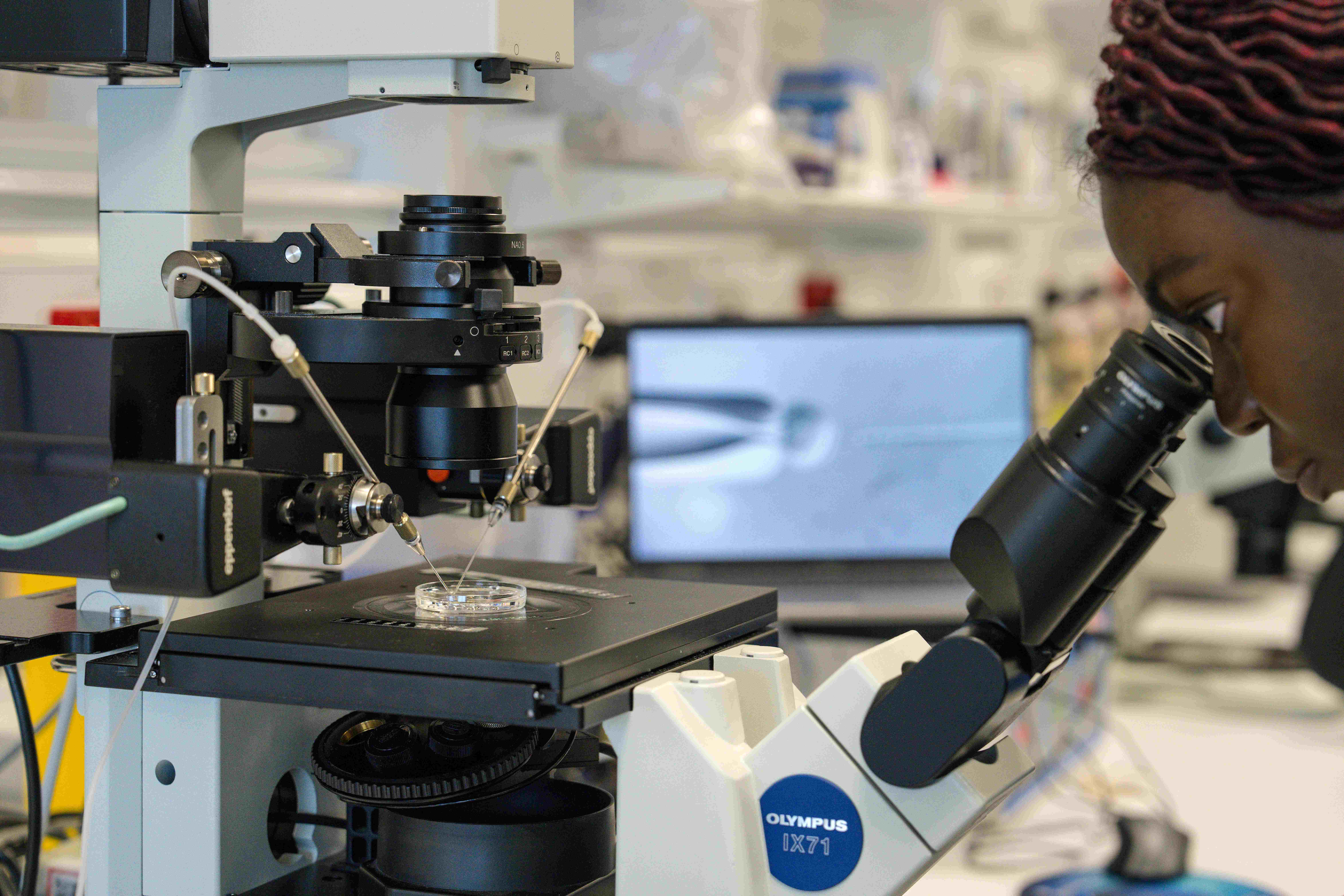
Other research at Adelaide University focuses on improving sperm-related fertility treatments. In a second project, Dunning is advancing Intracytoplasmic Sperm Injection (ICSI), the only treatment available for men with very low sperm counts. The procedure is highly technical, requiring a single sperm to be precisely injected into an egg. The original concept for a miniature 3D-printed “Garage” device was developed by Professor Jeremy Thompson, co-founder of Fertilis, and Dunning led the biological development and experimental validation that established its relevance for IVF practice. The device houses up to 10 unfertilised eggs in individual micro-pods, stabilising them during injection. By simplifying and standardising key steps in ICSI, it has the potential to reduce technical complexity for embryologists, improve efficiency, and increase accessibility to treatment while maintaining embryo quality.
Another project, led by the Reproductive Immunology Group’s Professor Sarah Robertson, has created a device that sequesters DNA-damaged sperm to ensure that only healthy, high-quality material is used for fertilisation. The device, funded by the National Health and Medical Research Council and developed in partnership with IVF technology company Affinyx, works by mimicking natural processes within the female body that select the best-quality sperm.
“Our device deploys innovative technology developed here in Adelaide and is easily integrated into the clinical workflow to facilitate a simpler IVF clinical pipeline with improved success rates,” Robertson says.
“By removing a major barrier impeding development of robust embryos, it is expected to improve pregnancy rates and health outcomes for infertile couples and IVF children.”
Another key challenge is the general health of many people of reproductive age. Professor Louise Hull, working with a team including Dr Lachlan Moldenhauer, is researching how metabolic problems affect the uterine lining’s ability to support embryo implantation. Their work suggests that a form of pre-diabetic state affecting the immune response is common in people experiencing infertility. Their findings open up the potential to improve IVF success by addressing metabolic dysfunction.
In addition to bettering the future of fertilisation procedures, Adelaide University academics are working to bolster the workforce. A new semester-long course is helping meet the increasing need for clinical embryologists as demand for IVF treatment continues to grow. The course, presented in partnership with world-leading fertility clinic Genea, is headed by Dr Nicole McPherson and Professor Rebecca Robker, both senior researchers at RRI. In its first year, six students pursuing a Bachelor of Health and Medical Science took part in the course, receiving 100 hours of practical training in an embryology laboratory.
“We’re excited for our students to be trained with the latest clinical embryology protocols, ensuring that they are job-ready when entering the market,” McPherson says.
“The course will significantly reduce the time taken between training a newly graduated scientist to a fully skilled embryologist.”
As the training course continues to prepare students for the clinical workforce, Adelaide University research continues to advance the field itself. Fertilis is taking the 3D-printed Garage device into global clinical trials, and Robertson’s sperm-purifying device is set for testing in IVF laboratories later this year.
With millions of IVF cycles undertaken each year, the exciting research offers hope for better outcomes.
“Higher success rates would reduce the need for repeated cycles, minimising health risks and improving mental wellbeing,” says Dunning.
“More broadly, higher success rates would better support those wishing to start or grow their family and contribute to population stability in regions with declining birth rates.”